

For owners looking for a shareholder and partnership dispute lawyer Florida, the first question is simple: who owns what, and who decides? Ayala Law PA focuses on business litigation for owners and entrepreneurs, including shareholder and partnership disputes, in Florida courts and arbitration. This page explains what these disputes involve, how Florida law shapes your options, and what to gather before you call. Tampa Bay businesses can contact our team, whose office is located in Tampa, Florida. Eduardo A. Maura is the responsible lawyer for this page.
What a shareholder or partnership dispute is
A shareholder or partnership dispute is a disagreement among owners about their ownership stake, how the business is run, or what each owner is owed. Corporate disputes fall under the Florida Business Corporation Act, Chapter 607. Partnership and LLC member disputes fall under the Revised Uniform Partnership Act, Chapter 620, and the Revised Limited Liability Company Act, Chapter 605.
The people involved are usually co-founders, minority and majority owners, general partners, LLC members and former owners who left on bad terms. Partners also share responsibility for partnership debts.
These disputes differ from an ordinary contract fight. They turn on who owns what, who controls the company, and what duties owners owe each other. Owners often have a long history together, so the dispute can feel personal. Clear records and careful communication matter from the start.
If a co-owner has cut off your access to records or is pushing you toward a buyout you didn't agree to, you don't have to sort it out alone. Call (305) 570-2208 or request a case evaluation with Ayala Law PA. Talk it through with our team — we can walk you through how a situation like yours is usually handled and what your options are.
Disputes we handle for owners and partners
Ayala Law PA handles disputes over control, money and ownership exits. The matters we handle include:
- Deadlock between equal owners on budgets, hiring or a sale of the business.
- Minority owner complaints about being shut out of management or having distributions withheld.
- Buyout and buy-sell disputes over valuation, payment terms and events such as death, disability or departure.
- Breach of fiduciary duty claims, such as self-dealing, diverted opportunities or misuse of company funds.
- Demands to inspect books and records, and disputes over financial statements and capital accounts.
- Judicial dissolution or winding up when owners cannot keep working together.
- Disputes over shareholder, partnership and operating agreements, including how they are read and enforced.
Deadlock has a specific legal path. In a case brought by a shareholder, a court may dissolve a corporation when the directors are deadlocked in managing it, the shareholders cannot break the deadlock, and the business can no longer be run to the advantage of shareholders generally because of it (§ 607.1430). A shareholder may inspect and copy certain corporate records, such as excerpts from board minutes and other books and records, after giving written notice at least 5 business days ahead, if the demand is made in good faith and for a proper purpose, describes the purpose and the records sought with reasonable particularity, and the records are directly connected with that purpose (§ 607.1602).
When the governing documents are silent or unclear
The governing documents control first, and Florida’s default rules fill any gap. The statute governs any matter the agreement does not address (§ 605.0105). That is why we start by reading the articles, bylaws or operating agreement closely.
Some terms cannot override the law. An operating agreement cannot relieve a person of liability for bad faith, willful or intentional misconduct, or a knowing violation of law. A court decides as a matter of law whether a term is manifestly unreasonable (§ 605.0105).
Exact wording matters. Courts read ambiguous terms closely, so a single word can change the result. When the paperwork says little, conduct becomes evidence. Emails, meeting notices, minutes, bank records and how the owners handled money over time can show what they actually agreed.
How a dispute is handled, step by step
A typical matter moves through five steps. Each step can narrow or open your options.
- First conversation. We identify your business structure, the core dispute and any deadlines in your agreements.
- Document review. We review formation records, governing agreements, financial records and key messages.
- Options review. We compare negotiation, mediation, arbitration and litigation in Florida courts. A written agreement to arbitrate is generally enforceable, and a court decides whether one exists (§ 682.02).
- Demand and negotiation. We send demand letters where appropriate and work toward early resolution. Evidence is preserved from the start.
- Litigation, if needed. The case moves through discovery, motions and trial preparation.
Deadlines matter. In a corporate deadlock case, the corporation or a shareholder may elect to buy the petitioning shareholder’s shares at fair value. That election generally must be filed within 90 days after the petition, unless the court allows more time (§ 607.1436). Partnership buyouts follow their own clock. If no agreement is reached within 120 days after a written demand, the partnership must pay the dissociated partner in cash its estimated buyout price and accrued interest, reduced by any offsets and accrued interest under subsection (3) (§ 620.8701).
The timeline for your matter depends on the facts. We explain expected steps once we know what is at stake.
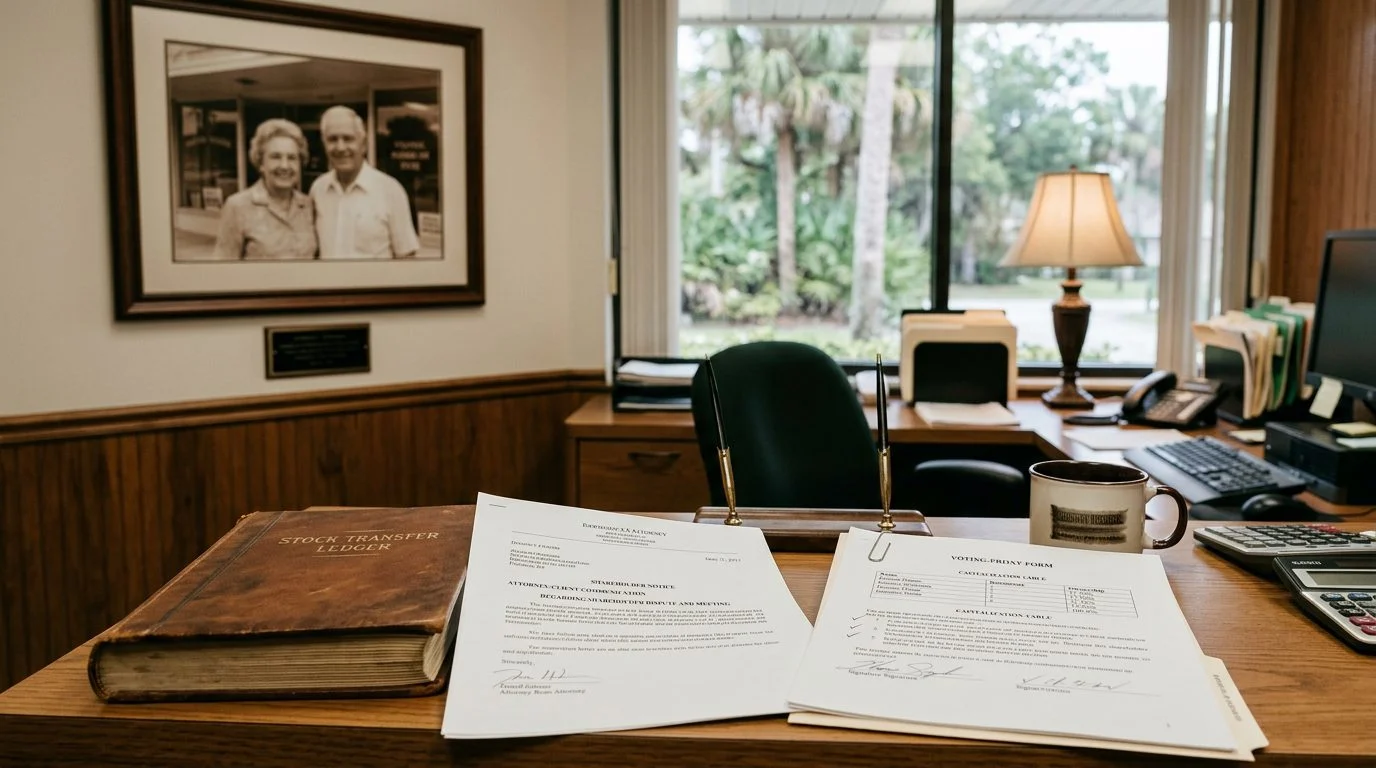
What to gather before your first conversation
Gathering records early lets us move faster. Bring the following if you have them:
- Formation documents: articles, bylaws, partnership agreement, operating or shareholder agreement and any amendments.
- Buy-sell or buyout terms, capital contribution records and ownership certificates or ledgers.
- Financial statements, tax returns, bank statements and ledger entries for the period in question.
- Written communications among owners, including emails, texts, meeting notices and minutes.
- A short written timeline of key events, plus any demands or notices sent or received.
Florida law already requires companies to keep much of this. An LLC must keep, at its principal office or another location, a current list of members and managers, a copy of its operating agreement and its formation documents (§ 605.0410). A partnership must give partners access to its books and records during ordinary business hours (§ 620.8403).
Why Tampa Bay businesses work with Ayala Law PA
Ayala Law PA focuses on business litigation, commercial litigation, contract disputes, shareholder disputes, construction litigation, real estate litigation and international trade litigation. Shareholder and partnership disputes are part of that business litigation work.
Our bona fide office is at 1646 W Snow Ave, Tampa, Florida. We represent businesses in Tampa, Hillsborough County, Brandon, Riverview, Plant City, Temple Terrace and the wider Tampa Bay area in Florida courts and arbitration. Our office is in Tampa, Florida. Attorneys at the firm handle matters in Florida courts and arbitration. Our team provides administrative and office support on each matter.
We review each matter on its own documents and facts. We tie each dispute to the statutes and agreement terms that apply to it. The firm does not promise or predict any result.
Not sure what your next step is?
Talk it through with our team — we can walk you through how a situation like yours is usually handled and what your options are.
Questions owners ask before calling a business dispute lawyer
Do I need a lawsuit?
Not always. Many disputes start with negotiation or mediation, and litigation or arbitration follows when those routes fail.
Can I keep operating during the dispute?
Your governing documents and any court orders control that. We review them first.
Can I be sued personally for company debts?
What if my co-owner has already filed or threatened a claim?
Respond within the deadlines in the papers you received. Keep every record, including messages and notices.
What is the first step?
A conversation about your business structure, the dispute and the documents involved.
Before your co-owner’s next demand or filing arrives, have the documents reviewed. Call (305) 570-2208 to start the conversation, or reach out through our contact page.



