
A business lawsuit in Florida often means the other side will ask for your records, your written answers and your sworn testimony. That stage is called discovery, and it’s where most of the case’s facts come to light.
Discovery is the exchange of information between the parties before trial. Knowing each step and preparing for it makes the process easier to manage.
What discovery is and when it happens in a Florida business lawsuit
Discovery is the stage where each side asks the other for information. The main tools are document requests, written questions called interrogatories, depositions (sworn testimony taken outside the courtroom) and, in some cases, inspections of records or property.
Requests usually focus on the contracts, money and messages at the center of the dispute. They don’t reach every file your company keeps.
If your case is in federal court, the Middle District of Florida’s civil case flowchart explains how a federal civil case starts and where discovery fits.
For the wider path from filing to resolution, read our business litigation overview.
If your company has been sued in Florida and you're unsure what discovery will require of you, our team can talk through your next steps with you. Talk it through with our team — we can walk you through how a situation like yours is usually handled and what your options are.

Document requests: what gets asked for and how to respond
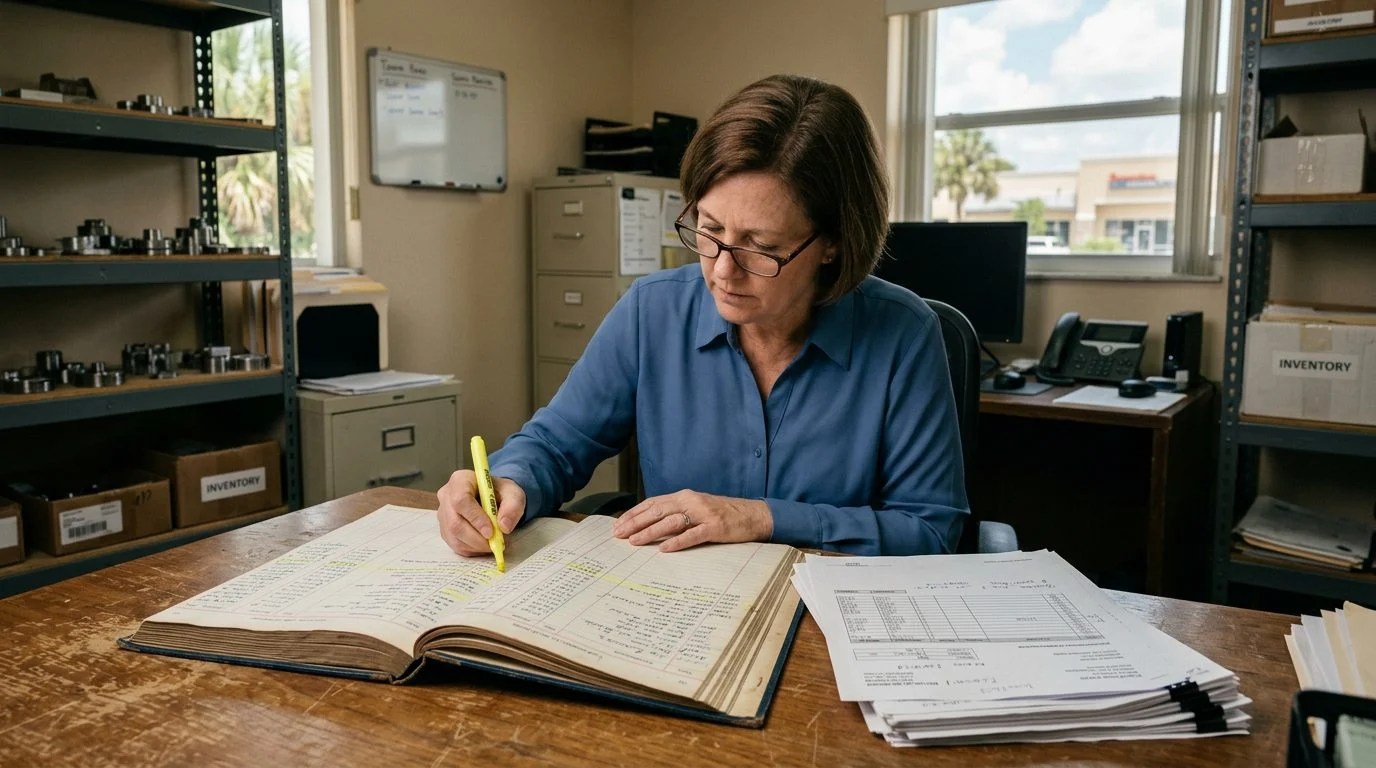
Document requests ask you to produce records that relate to the dispute. In business cases, the usual categories are signed contracts and amendments, emails, text messages, bank and payment records, financial statements, meeting minutes and internal approvals.
Electronic sources deserve early attention. Email, messaging apps and cloud accounts often hold the day-to-day record of what the parties said and agreed.
Responding means reviewing each request. An objection says a request is too broad, too burdensome or seeks protected material. Objecting doesn’t mean you hand over nothing. Many owners produce the documents they don’t dispute and object to the rest.
Preservation is the step owners most often miss. Once a dispute is on the horizon, pause routine deletion of relevant emails, texts and files. Ask your lawyer about a litigation hold, a written instruction to keep relevant material.
Owners can also request records outside a lawsuit. A shareholder must give a corporation written notice at least 5 business days before inspecting records, and for the records described in subsection (2), such as excerpts from board minutes and accounting records, the demand must be made in good faith for a proper purpose, describe the purpose and records with reasonable particularity, and the records must be directly connected with that purpose, under Fla. Stat. § 607.1602. In a member-managed LLC, the company must give a member a written record of what information it will provide, and when, within 10 days of the demand, under Fla. Stat. § 605.0410.
Interrogatories and written questions under oath
Interrogatories are written questions one party sends to the other. You answer them in writing, and the person who signs has to stand behind every word.
Calendar the response date the day the questions arrive. Missing a deadline creates problems you’ll want to avoid.
Check each answer against your records before signing. Your answers become the baseline the other side uses at depositions and in motions. If an answer conflicts with a later email, expect that gap to come up.
Slow or evasive responses carry risk. Under Fla. Stat. § 57.105, a court must award reasonable expenses, which can include attorney fees, when a party proves a discovery response was taken primarily for unreasonable delay.
Depositions: what happens and what the owner’s role is
A deposition is sworn testimony given outside the courtroom. A court reporter records every word, and the transcript can be used at trial.
The witness takes an oath, then answers questions from the other side’s lawyer. Lawyers may object on the record, and objections are noted in the transcript. You may get to review the transcript afterward.
An individual owner can be asked to testify personally. A company can also be asked to send a representative. In a corporate representative deposition, the company picks one person to answer questions on listed topics. That person speaks for the company, so choose someone who knows the facts and can speak accurately about them.
Preparation makes a real difference. Review the documents the witness will likely see. Listen to the whole question. Answer only what’s asked. Say when a question is unclear, and don’t guess.
Preparing your company’s records before discovery begins
Start by gathering the records your company is most likely to need. Build one organized file on the dispute so your documents, answers and testimony match.
- Executed contracts and amendments
- Correspondence with the other party
- Invoices and payment history
- Insurance policies
- Formation and governing documents
A Florida corporation must keep, among other records, its articles, bylaws, minutes of shareholder and board meetings, a list of current directors and officers, and annual financial statements for its last 3 fiscal years, under Fla. Stat. § 607.1601.
Identify the employees and outside vendors who hold relevant information. Then send each of them written preservation instructions.
Florida protects confidential communications made to a lawyer to get legal services, and a business counts as a client under Fla. Stat. § 90.502.
Objections, privilege and protective orders
Objections and privilege claims limit what you must hand over. They work best when they’re specific and used with care.
Overly broad or burdensome requests can be challenged. Privileged material can be withheld, and the privilege may be claimed by the company or by a successor or similar representative of the entity.
The privilege has limits. Under the same statute, it doesn’t apply when a lawyer’s services were sought or obtained to enable or aid anyone to commit or plan to commit what the client knew was a crime or fraud. It also doesn’t cover communications relevant to a breach of duty between the lawyer and client.
Confidential information, such as pricing, customer lists or trade secrets, can call for extra protection. In shareholder inspection cases, Fla. Stat. § 607.1604 allows a court to restrict how records are disclosed, used or distributed. When the parties can’t agree on these issues, the court decides.
Sanctions motions follow a set path. Under Fla. Stat. § 57.105, a motion must be served first and can’t be filed unless the challenged paper isn’t withdrawn or corrected within 21 days after service.
Not sure what your next step is?
Talk it through with our team — we can walk you through how a situation like yours is usually handled and what your options are.

How discovery connects to the rest of a business case
Discovery shapes settlement and trial because it shows what each side can prove. Facts from records and testimony often drive later motions.
Settlement offers follow their own rules. Under Fla. Stat. § 45.061, which does not apply to causes of action that accrue after the section’s effective date, a party may serve a written offer more than 60 days after service of the summons and complaint and at least 60 days (or 45 days for a counteroffer) before trial. Fla. Stat. § 45.061 reads: “The offer shall remain open for 45 days unless withdrawn sooner by a writing served on the offeree prior to acceptance by the offeree.” The offer stays open 45 days unless withdrawn. A defendant that rejects an offer is presumed to have done so unreasonably if the judgment is at least 25 percent greater than the offer. Under Fla. Stat. § 90.408, evidence of an offer to compromise a claim that was disputed as to validity or amount is inadmissible to prove liability or absence of liability for the claim or its value.
Related claims follow the same discovery rules but may focus on different evidence. In a tortious interference claim, a business relationship generally requires an actual and identifiable understanding or agreement, as explained in Ozyesilpinar v. Reach PLC. Read more on our tortious interference page.
Frequently asked questions
Is discovery the same in every business lawsuit?
No. The steps and timing depend on the facts of your case and the court’s schedule.
Are my conversations with my lawyer private?
Confidential communications made to get legal services are generally protected by Florida’s lawyer-client privilege, though exceptions exist.
If your company is facing a business lawsuit in Florida and you’re trying to figure out what discovery will ask of you, contact our team or call (305) 570-2208. Content on this page is the responsibility of Eduardo A. Maura, who practices from our Tampa office at 1646 W Snow Ave, Tampa, Florida. We represent businesses in Hillsborough County and across the Tampa Bay area, and our office is located at 1646 W Snow Ave, Tampa, Florida.



