
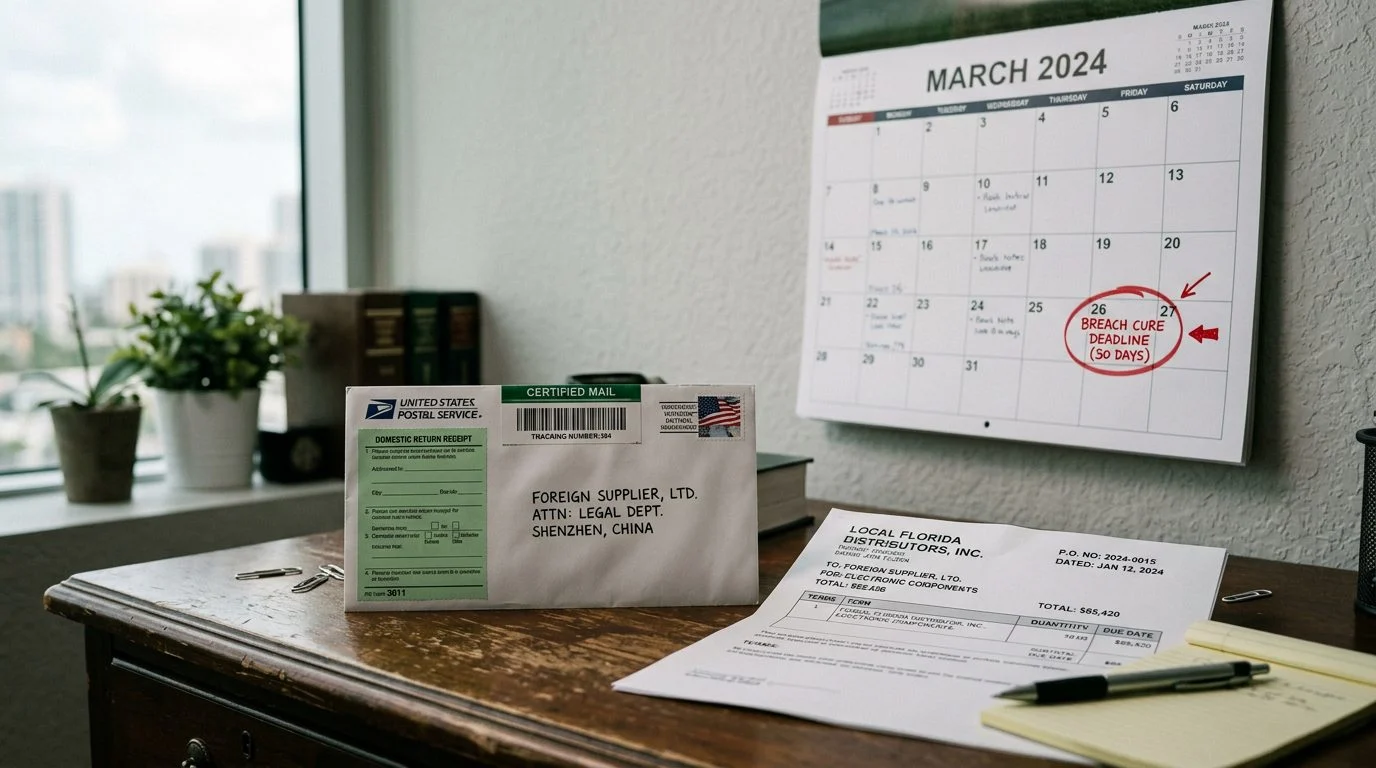
A foreign supplier breach of contract case in Florida starts with the contract and the paper trail. When an overseas company stops shipping or stops paying, a Florida business usually has options under the contract and Florida law. The right path turns on what was bought, which law the contract picks, and how much time has passed. This page explains those points for business owners and managers handling the problem for their company.
What a Cross-Border Supply Contract Dispute Involves
A cross-border supply contract dispute arises when a Florida business and a company abroad agree on goods or services, and one side stops performing. Common patterns include:
- Late or nonconforming goods that don’t match the order.
- Unpaid invoices from overseas buyers after delivery.
- Cancelled orders in the middle of production.
- Suppliers that stop shipping after payment has been made.
Owners, importers, exporters, and purchasing managers often handle these matters while a shipment sits stalled or money is overdue. Ayala Law PA focuses its business litigation practice on contract disputes, including cross-border matters, in Florida courts and arbitration.
If an overseas buyer stopped paying or a supplier went silent, your company may have a claim worth discussing, and we can review the contract with you. Talk it through with our team — we can walk you through how a situation like yours is usually handled and what your options are.
Which Law and Forum Govern Your Contract
The choice-of-law, forum, and arbitration clauses in your contract often decide where and how a claim gets heard.
A written agreement to arbitrate is valid and enforceable in Florida, subject to the grounds that apply to revoking any contract (§ 682.02). A court decides whether an arbitration agreement exists. An arbitrator decides certain conditions that come before arbitration. Federal law gives similar protection to written arbitration clauses in contracts involving commerce (9 U.S.C. § 2).
Florida courts can also reach a foreign company in some situations. That includes a company doing business in Florida, or one that breaches a contract by failing to perform acts the contract required in Florida, for any cause of action arising from those acts (§ 48.193).
Before you act, check the signed terms, delivery terms, governing language, and any steps the contract requires before suit.
Goods Versus Services: How Florida Remedies Differ
Whether your deal is for goods or services decides which rules apply. Chapter 672 covers transactions in goods (§ 672.102). If goods are the main part of a mixed deal, the chapter applies to the whole deal. Other law can still govern parts that are not about goods.
For goods, the remedies are specific:
- Buyers must pay the contract rate for goods they accept (§ 672.607).
- Sellers that a buyer fails to pay can recover the price of accepted goods. They can also recover the price of identified goods they cannot reasonably resell (§ 672.709).
- If the seller had reasonable grounds to believe the delivery would be acceptable and gives timely notice, it may get a further reasonable time to substitute a conforming delivery (§ 672.508).
Sorting the deal correctly changes which rules apply to your remedies.
Using Demand Letters and Notice Early
A written demand that names the breach and sets a deadline is often the first practical step. It should list the contract terms that were missed, what you need the other side to do, and the remedy you may pursue.
Timing matters. If you accepted the goods, you must notify the seller of the breach within a reasonable time after you discover it or should have discovered it. Otherwise you may be barred from any remedy (§ 672.607).
Between merchants, a written confirmation can satisfy the signed-record requirement against you. You have 10 days after receiving it to object in writing (§ 672.201). Fla. Stat. § 672.201 reads: “(2) Between merchants if within a reasonable time a record in confirmation of the contract and sufficient against the sender is received and the party receiving it has reason to know its contents, it satisfies the requirements of subsection (1) against the party unless notice in a record of objection to its contents is given within 10 days after it is received.” Overseas order disputes often turn on this step.
Keep purchase orders, invoices, bills of lading, customs entries, emails, and payment records together from the start.
Deadlines That Can Limit Your Claim
Florida sets time limits for filing contract actions in § 95.11. Filing late can cost you the claim.
A contract clause that sets a shorter filing period than the statute allows is void (§ 95.03). A short deadline in a supply contract may not hold.
The clock may start on a date other than the invoice or shipping date, so the facts decide it. Track the date of each missed delivery or payment from the first breach.
How a Cross-Border Contract Claim Typically Proceeds
A typical claim moves from document review to a written demand, then to negotiation, then to a filing or arbitration.
- Intake and review. The contract, emails, shipping records, and payment records are reviewed together.
- Classification. The team identifies whether the deal is for goods or services, the governing law, the forum clause, and any pre-suit steps.
- Written demand. The demand sets out the breach and a deadline to cure.
- Negotiation or mediation. The American Arbitration Association notes that commercial contracts may require mediation before arbitration.
- Filing. The claim goes to the agreed court or arbitration, followed by discovery and motions.
- Resolution. The matter ends by settlement, award, or judgment, followed by steps to enforce it.
How long this takes depends on the forum, the contract terms, whether the other company responds, and how complex the evidence is. Foreign service of process, translation, interpreter, and arbitration filing fees can be additional amounts the client may owe.
Not sure what your next step is?
Talk it through with our team — we can walk you through how a situation like yours is usually handled and what your options are.
Collection and Enforcement Across Borders
A win on paper does not always produce payment, especially when the other company’s money sits overseas.
- Serving a company abroad can add time and steps before a case moves forward.
- Florida-side leverage can include receivables owed to the other company, payments you control, and letters of credit or payment channels tied to the deal.
- Translation and language differences affect documents, evidence, and settlement terms.
Why Businesses Work With Ayala Law PA on These Disputes
Ayala Law PA focuses its practice on business litigation. That includes commercial litigation, contract disputes, shareholder disputes, construction litigation, real estate litigation, and international trade litigation. These matters are handled in Florida courts and arbitration.
- Responsible lawyer: Eduardo A. Maura is responsible for this page.
- Team: Our team, including support staff, works with business clients from first review through resolution.
- Office: The firm’s office is at 1646 W Snow Ave in Tampa. The firm serves businesses in Tampa, Hillsborough County, Brandon, Riverview, Plant City, Temple Terrace, and the Tampa Bay area.
Each dispute turns on its own contract and facts. No result can be predicted from this page.
Frequently Asked Questions
Is an oral agreement with a foreign supplier enforceable in Florida?
Oral deals can be enforceable, but goods priced at $500 or more generally need a signed record, with exceptions (§ 672.201). Proof of the terms matters a great deal.
How long do I have to sue a foreign supplier in Florida?
Florida sets time limits for contract actions in § 95.11. Track the date of each breach, because late filing can cost you the claim.
Can I sue a foreign company in a Florida court?
Under § 48.193, a person or business that, personally or through an agent, does any of the enumerated acts submits to the jurisdiction of Florida courts for a cause of action arising from those acts. The enumerated acts include operating, conducting, engaging in, or carrying on a business or business venture in Florida, and breaching a contract in Florida by failing to perform acts the contract required to be performed in Florida. The forum clause in your contract also matters.
What if our contract requires arbitration abroad?
The arbitration clause can control where the dispute goes. Florida law generally enforces written arbitration agreements (§ 682.02).
Do I need to send a demand letter first?
Not always, but a written demand is a practical first step. Some contracts also require notice before a claim can be filed.
What should I gather before I call?
Gather the contract, purchase orders, invoices, bills of lading, customs entries, emails, and payment records.
Talk to Ayala Law PA About Your Supply Contract Dispute
If a shipment never arrived or an overseas buyer stopped paying, you may have a claim worth discussing. Call Ayala Law PA at (305) 570-2208 or request a case evaluation to review your contract and records. To discuss a business dispute in Tampa or Hillsborough County, call (305) 570-2208. The firm’s office is at 1646 W Snow Ave, Tampa.



