
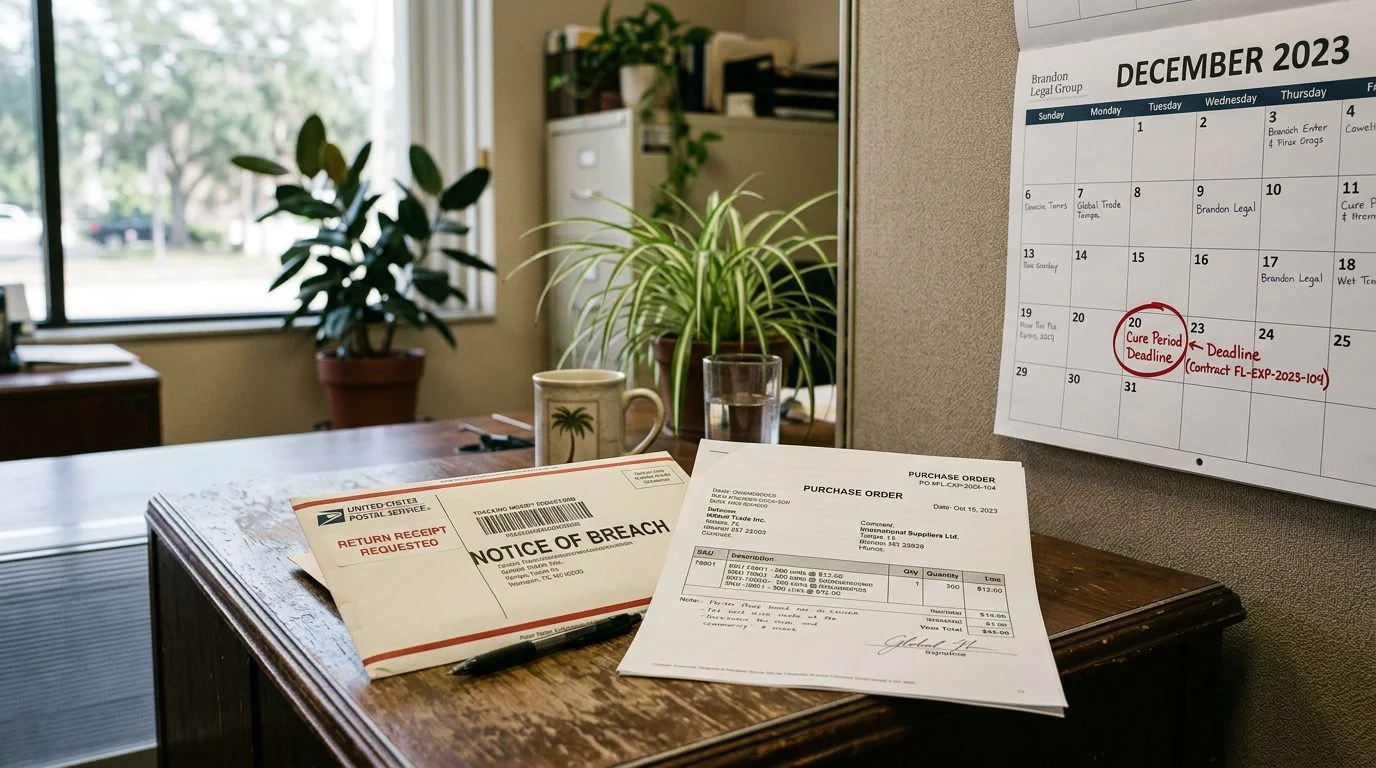
An overseas supplier missed a delivery, or a foreign buyer hasn’t paid your invoice. Where can you sue, and which law decides the fight? The contract answers most of that. Its governing-law clause, its forum or arbitration clause, and the places the goods and money moved shape where a claim can go.
What This Service Covers and Who It Is For
Our practice covers import and export contract disputes that Florida courts or arbitration can hear. The firm focuses on business litigation, commercial litigation, contract disputes, shareholder disputes, construction litigation, real estate litigation and international trade litigation.
Matters include:
- Late, missed or short deliveries
- Goods that don’t match the agreed specification, quantity, quality or paperwork
- Unpaid invoices owed to or by a foreign buyer or seller
- Disputes over who carried the risk of loss under an agreed trade term
- Breach of distribution, supply or sales agency agreements for imported or exported products
This page is for Florida importers, exporters, distributors and manufacturers with a dispute against a foreign counterparty. The firm’s only office is in Tampa, at 1646 W Snow Ave. It serves businesses in Tampa, Hillsborough County, Brandon, Riverview, Plant City, Temple Terrace and the wider Tampa Bay area.
If a foreign buyer or seller has missed a delivery or payment, your claim may be worth a closer look, and our team can review the contract with you. Talk it through with our team — we can walk you through how a situation like yours is usually handled and what your options are.
The First Questions: Governing Law, Forum Clause, and Where the Goods and Money Moved
Three things usually decide where a dispute starts: the law the contract picks, the court or arbitration it names, and where the goods and money moved.
- Under § 671.105, when a transaction bears a reasonable relation to Florida and another state or nation, the parties may agree whose law governs their rights and duties. That freedom applies generally, but for the provisions listed in subsection (2) of the statute, which specify their own applicable law, any contrary agreement is limited to what those specified rules, including their conflict-of-laws rules, allow. Read that clause first.
- Forum. A forum clause names a court. An arbitration clause names arbitration. Either can control where you must file.
- Where the goods and money moved. Origin, destination, delivery point and payment route all serve as evidence.
- Trade terms. Incoterms are standard trade terms. They split responsibility for transport, insurance, risk of loss and customs duties at each handoff point.
- Whether it applies turns on the contract and the countries involved.
Bring these to your first conversation: the signed contract, purchase orders, invoices, bills of lading, emails, payment records and any default notices.
Common Shipment and Import Dispute Types
Most shipment disputes come down to four questions: did the goods arrive on time, did they match the contract, was the invoice paid, and who carried the risk.
Buyers face a notice trap. Under § 672.607, where the buyer has accepted the goods, it must notify the seller of breach within a reasonable time after discovering or should have discovered it, or be barred from any remedy. The buyer also bears the burden of proving any breach in goods it accepted.
Sellers can sometimes fix a rejected delivery. If the buyer has rejected a nonconforming delivery and the time to perform has not run out, a seller may seasonably notify the buyer that it intends to cure and may then deliver conforming goods within the contract time (§ 672.508).
When a buyer fails to pay, a seller may recover the price of goods accepted, plus incidental damages (§ 672.709).
Purchase orders and invoices often carry different terms. Between merchants, extra terms can become part of the deal unless the offer limits acceptance, the terms materially change it, or the other side has already objected or objects within a reasonable time after receiving notice of them (§ 672.207).
Florida Courts or Arbitration: How the Forum Is Chosen
A valid arbitration clause generally sends the dispute to arbitration, so the clause’s exact wording matters most.
An arbitration agreement in a record is valid, enforceable and irrevocable, except on grounds that exist to revoke any contract (§ 682.02). If the other side opposes arbitration, the court decides summarily and orders arbitration unless it finds no enforceable agreement (§ 682.03).
Court cases are generally public, while arbitration is usually private. Pace, discovery and appeal rights also differ between the two.
For court filings, Florida’s venue statute points to the county where the defendant resides, where the cause accrued, or where the property is located. That rule does not apply to actions against nonresidents (§ 47.011). A foreign company needs a closer look at county choice.
Florida’s § 682.13 lists the grounds on which a court, on a party’s motion, shall vacate an arbitration award. One of those grounds is that an arbitrator exceeded the arbitrator’s powers. The motion must be filed within 90 days after the movant receives notice of the award, or of a modified or corrected award. If the movant alleges the award was procured by corruption, fraud, or other undue means, the motion must instead be made within 90 days after that ground is known or, by the exercise of reasonable care, would have been known. A motion to vacate is generally due within 90 days after notice of the award. Awards procured by fraud or other undue means follow a different clock.
How the Process Works, Step by Step
A dispute usually moves through review, evidence preservation, demand, filing or arbitration, discovery and resolution.
- Intake and document review. We review the contract, shipping records and payment history to identify governing law, the forum and key dates.
- Preserve evidence. Keep emails, messages, shipping data and inspection reports. Stop routine deletion where needed.
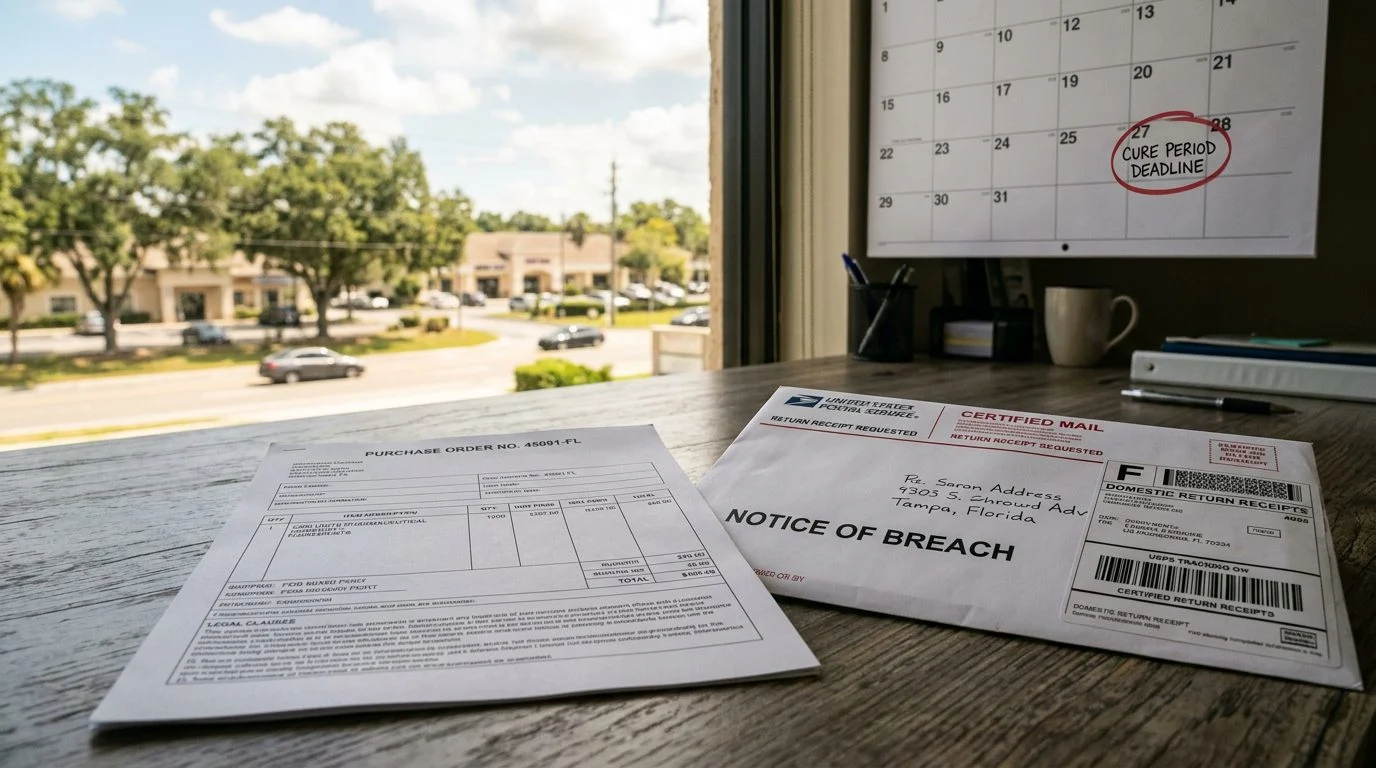
- Demand and negotiation. For accepted goods, send notice of breach to the seller within a reasonable time after you discover or should have discovered it, or be barred from any remedy, and weigh settlement options.
- Filing or arbitration demand. Prepare a complaint for the proper Florida court, or a demand for arbitration under the contract’s clause.
- Discovery and motions. Exchange documents, take depositions where allowed, and address jurisdiction, service and early motions.
- Resolution. The matter may end in settlement, mediation, a hearing, a trial or an arbitral award.
Timelines vary with the forum and with how the other side responds. Our team explains each stage and your options before any filing.
Deadlines and Defenses to Know Early
Florida generally allows five years to sue on a contract founded on a written instrument, but other periods can apply, so act early.
Under § 95.11, a legal or equitable action on a written contract must start within five years. An action for specific performance of a contract must start within one year.
Under section 672.201(2), Florida Statutes, when one merchant receives a written confirmation of a deal from another merchant within a reasonable time and has reason to know what it says, that confirmation can meet the writing requirement against the merchant who received it, unless that merchant gives written notice objecting to its contents within 10 days after receiving it.
Counterparties often raise these defenses:
- No contract, or disputed terms. Conduct by both parties that recognizes a contract can establish one (§ 672.207).
- Unfair terms. Florida courts require both procedural and substantive unconscionability before refusing to enforce a term. Under Basulto v. Hialeah Automotive, both the procedural and substantive aspects of unconscionability must be present, although not necessarily to the same degree, and both should be evaluated interdependently rather than as independent elements.
- Forum objections. Arbitration and venue arguments, covered above.
- Excused performance. Force majeure, waiver and late-notice arguments.
Late notices and slow evidence gathering can narrow your options, so early review helps.
Not sure what your next step is?
Talk it through with our team — we can walk you through how a situation like yours is usually handled and what your options are.
Why Businesses Work With Ayala Law PA on Import and Shipment Disputes
Ayala Law PA handles international trade litigation in Florida courts and arbitration.
The firm’s only office is at 1646 W Snow Ave in Tampa, Florida. The firm represents businesses in Tampa, Hillsborough County and the wider Tampa Bay area, with its office in Tampa. Eduardo A. Maura is the responsible lawyer for this page. Support staff help organize shipping records, invoices and correspondence, so the review starts from a complete file.
A case evaluation looks at your contract, the shipment and payment timeline, the forum clause and realistic next steps. It does not promise any outcome.
Some matters may be referred to another lawyer or firm where appropriate. If that applies to your dispute, we’ll tell you.
Frequently Asked Questions
Can I sue a foreign supplier in Florida if the contract names another country’s courts?
A forum clause often controls where a claim is filed. Review its exact wording before you file anything.
Does a shipment through a Florida port create a Florida connection?
It can help. Where the goods and money moved, and what the contract says, both matter.
Should I send a demand letter before filing?
Some contracts require written notice. For accepted goods, the buyer must notify the seller of breach within a reasonable time after discovering or should have discovered it, or be barred from any remedy (§ 672.607).
Is arbitration always required?
No. A valid arbitration agreement requires it, and a court decides whether one exists (§ 682.02).
What documents should I gather first?
Start with the signed contract, purchase orders, invoices, bills of lading, emails and payment records.
If a foreign buyer or seller has missed a delivery or payment, your claim may be worth a closer look, and our team can review the contract with you. To start that conversation, call (305) 570-2208 or request a case evaluation at https://www.lawayala.com/contact/.



