

If you own part of a Tampa company and think a manager is using company money or deals for personal gain, you probably want to know whether you have a legal claim.
Under Florida’s LLC law, managers and members owe duties of loyalty and care to the company and its members. When an insider breaks those duties, the company or a member may have a breach of fiduciary duty claim. Whether a claim exists depends on the facts and the company’s governing documents.
What is a breach of fiduciary duty claim against an LLC manager?
A breach of fiduciary duty claim says an insider broke a duty of trust owed to the company and its owners.
Florida’s LLC statute sets the core duties. Under Fla. Stat. § 605.04091, each manager of a manager-managed LLC, and each member of a member-managed LLC, owes duties of loyalty and care to the company and its members.
The Florida Division of Corporations explains that LLC members are owners and that some LLCs are run by managers instead of members.
Loyalty includes accounting to the company for any gain from conducting or winding up its affairs, from using company property, or from taking a company opportunity, and refraining from dealing with the company on behalf of someone with an interest adverse to it, unless the transaction meets § 605.04092.
Care is narrower than many people expect. An ordinary business mistake is not the same as grossly negligent conduct.
A fiduciary claim comes from the role a person holds. A contract claim comes from the promises in an agreement. Both can be brought together when the facts support them.
If a manager's choices are hurting your Tampa company, you don't have to sort out the rules alone, and our team can review your documents with you. Talk it through with our team — we can walk you through how a situation like yours is usually handled and what your options are.
What conduct usually leads to these claims?
Most claims involve an insider using company money, deals, or opportunities for personal gain.
- Self-dealing: contracts between the company and the insider’s own business or relatives, on terms unfair to the company.
- Personal use of funds: personal expenses paid by the company, or payments no one properly approved.
- Taking opportunities: pursuing a deal that belonged to the company.
- Competing: starting a rival business or moving customers to a new entity.
- Hiding information: keeping poor books or refusing to share records with members.
- Skipping approvals: ignoring the operating agreement’s voting or notice steps for major decisions.
Self-interest alone is not enough. Under § 605.04091, a manager or member does not violate a duty solely because the conduct furthers the manager’s or member’s own interest.
Deals between the company and an insider follow a separate rule. Under § 605.04092, a conflict transaction is not void or voidable just because of the insider’s interest, if the statute’s requirements are met. A challenger can still show the insider was not disinterested when the deal was approved.
Records change over time. Gather bank statements, emails, and meeting notes early.
What can a claim seek, and who can bring it?
Business disputes often raise questions about what relief a party is asking a court to provide. The right remedy turns on the facts and the documents.
- Parties often disagree about the losses they say a breach caused.
- An accounting of company funds and transactions.
- Some disputes focus on whether a party should be asked to stop a particular action.
- Recovery of diverted company property.
- A negotiated exit, such as a buyout or removal of the insider.
A member may bring a direct action when the member suffered an injury that is not solely the company’s injury. A member may also sue when the member suffers an actual or threatened injury resulting from a violation of a separate statutory or contractual duty owed to the member (§ 605.0801).
A derivative action enforces the company’s own right. The member generally must first demand that the other members or managers act. They have a reasonable time to respond, not to exceed 90 days, unless a demand would be futile or waiting would cause irreparable injury (§ 605.0802). The member must be a member when the action starts and must also have been a member when the conduct giving rise to the action occurred, or have status that devolved from such a person (§ 605.0803).
Records can build the case. A member may inspect company records under § 605.0410. If access is refused, a court may order inspection at the company’s expense (§ 605.0411).
How do the operating agreement and Florida law shape these duties?
The operating agreement is usually the first document to review. It cannot wipe out the core duties.
- Business agreements often address approval thresholds, notice requirements, and conflict procedures.
- It cannot eliminate the duty of loyalty or the duty of care, except as the statute allows (§ 605.0105).
- It cannot relieve anyone of liability for bad faith, willful or intentional misconduct, or a knowing violation of law.
- It can describe how disinterested people may approve a conflict act, after full disclosure of material facts.
Improper distributions have a short clock. A member of a member-managed limited liability company or a manager of a manager-managed limited liability company who consents to an improper distribution, without meeting the duty standards, may be personally liable to the company for the amount that exceeds what could have been distributed without the violation (§ 605.0406). That action is barred unless it starts within 2 years after the distribution.
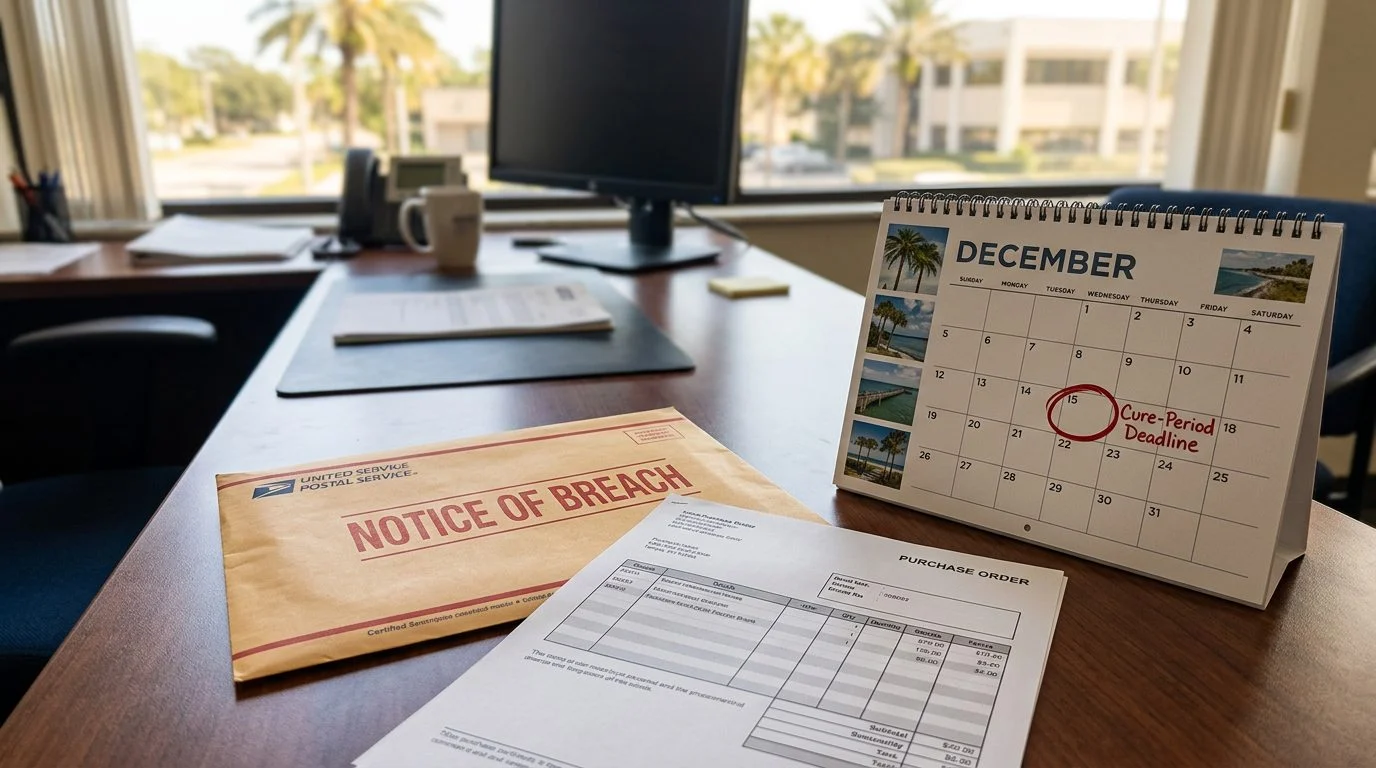
Don’t assume you have years to act. Note the date you first saw warning signs.
How does a fiduciary duty matter usually proceed?
Most matters move from document review and a written demand to negotiation. A lawsuit or arbitration comes only if the matter does not resolve.
- Intake: you describe the company’s structure, the insider’s role, and the conduct you’re concerned about.
- Document review: operating agreement, articles of organization, bank records, ledgers, tax filings, and emails.
- Demand: a written demand to the insider, and sometimes a records request.
- Negotiation or mediation: this can resolve the dispute early.
- Filing: venue lies only in the county where the defendant resides, where the cause of action accrued, or where the property in litigation is located (§ 47.011); this rule does not apply to actions against nonresidents. For many Tampa-area disputes, that points to Hillsborough County.
- Arbitration: if the operating agreement requires it, Florida law generally enforces a written arbitration agreement (§ 682.02).
- Discovery and trial: if needed. Timelines vary with the court’s calendar and how the other side responds.
Why do Tampa businesses bring these disputes to Ayala Law PA?
Ayala Law PA focuses on business litigation in Florida courts and arbitration, including shareholder and partnership disputes.
- Practice areas: business and commercial litigation, contract disputes, shareholder and partnership disputes, construction litigation, real estate litigation, and international trade litigation.
- Responsible lawyer: Eduardo A. Maura. Our attorneys and staff handle business matters for clients in Tampa, Hillsborough County, Brandon, Riverview, Plant City, Temple Terrace, and the wider Tampa Bay area.
- Office: the firm’s only office is at 1646 W Snow Ave in Tampa, Florida. The firm serves businesses in Hillsborough County and the Tampa Bay area.
- Approach: our team starts with the governing documents and financial records, so you understand the facts before choosing a path.
- No promises: no outcome is promised. Each matter turns on its own documents, facts, and the law that applies.
Not sure what your next step is?
Talk it through with our team — we can walk you through how a situation like yours is usually handled and what your options are.
What questions do business owners ask about these claims?
Most answers turn on the operating agreement, the company’s records, and the timeline.
Can a minority member sue a manager?
Possibly. A member may bring a direct action, and in some cases a derivative action, depending on the injury and the governing documents.
Do I need proof the manager meant to take money?
The required proof varies by claim. Records and timelines are central to that review.
Can an insider stay in charge while a dispute is pending?
Interim arrangements turn on the operating agreement and on any court order sought.
Is an investor who is also a manager liable?
Yes, a manager owes duties to the company and its members, and dual roles often raise conflict-of-interest questions.
What should I gather first?
Gather the operating agreement, formation papers, bank and accounting records, tax filings, and written messages about the conduct.
If a manager’s decisions are putting your Tampa company at risk, you don’t have to work through the rules alone. Call Ayala Law PA at (813) 414-5715 or request a case evaluation to talk through your documents and timeline.



