
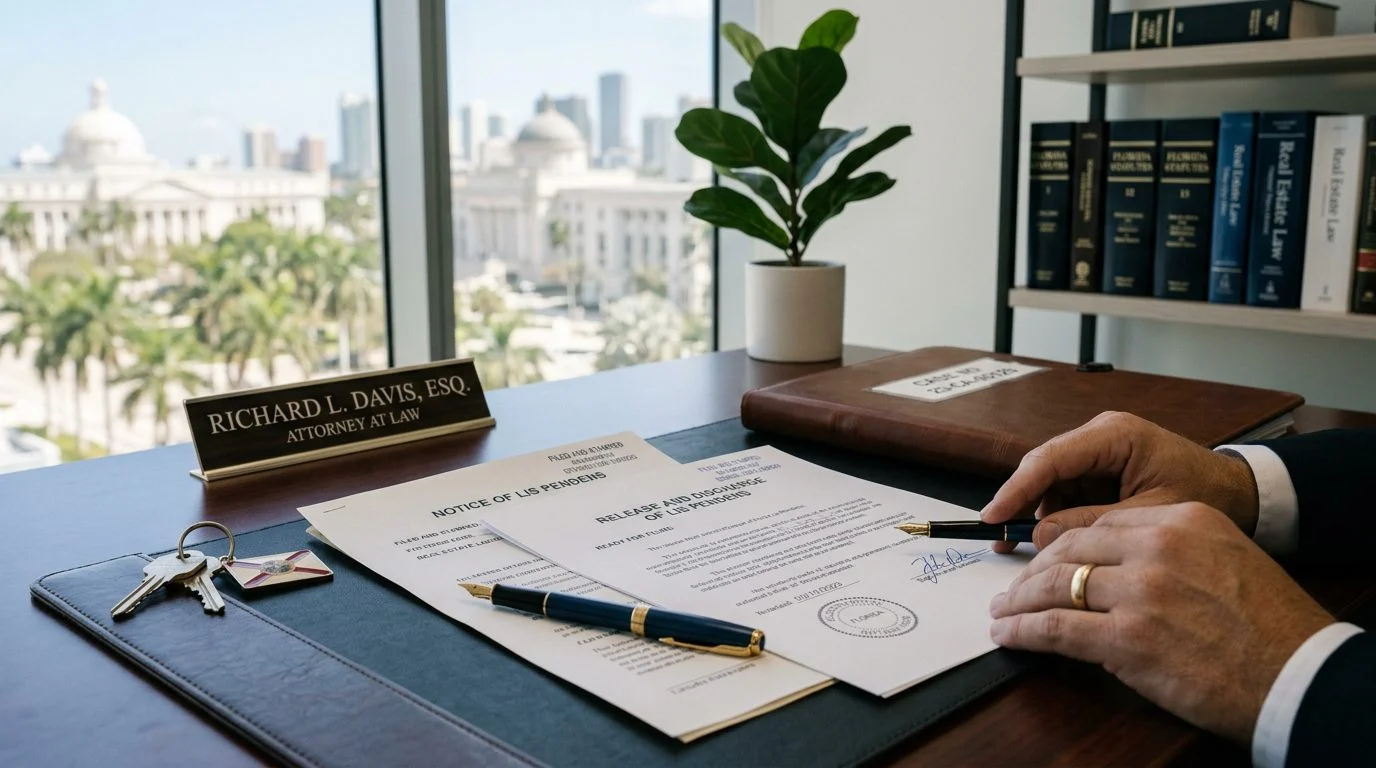
Found a lis pendens recorded against property you own or are buying? That notice often means a lawsuit involving the property is already underway, and it can feel sudden. The case behind the notice decides which route fits.
Short Answer: How a Lis Pendens Comes Off a Florida Property
Which path applies turns on three things: who filed the notice, what the case is about, and whether the case is still pending. For background on the firm’s business litigation work, see our business litigation overview. Start by pinning down the case, because every removal step depends on its status and its facts.
A lis pendens on property you own or are buying can feel urgent, and our team can talk through where your situation stands whenever you're ready to reach out. Talk it through with our team — we can walk you through how a situation like yours is usually handled and what your options are.
What a Lis Pendens Does to Your Property
A lis pendens tells buyers, lenders and title insurers that a lawsuit touching the property is pending. While the notice stays recorded, sales and refinancing often become harder. Title companies usually want it cleared before closing. Construction disputes are one common source of these notices. A lien foreclosure case over unpaid work on a property, for example, may carry a recorded notice while the case runs. Other disputes over title or an interest in property can lead to one as well.
The notice is a claim, not a finding that the owner did anything wrong. Keep that in mind when you talk with a buyer, lender or title company. Pull the recorded copy from the official records of the county where the property sits. Note the case number, the court and the filing date. Those three details drive every step that follows.
Step One: Confirm the Case and the Recorded Filing
Start by confirming the case itself. Identify the court, the case number, the parties named and the claim described in the notice. Then gather the recorded notice, the complaint or the court docket if you can get it, and any deeds, lien papers or contracts tied to the property. Check whether the case is still pending, dismissed or already resolved. That status decides which removal route applies.
Venue matters too. Florida law says actions must be brought in the county where the defendant resides, where the cause of action accrued, or where the property in litigation is located, but this rule does not apply to actions against nonresidents (Fla. Stat. § 47.011). For property in Hillsborough County, the property’s location is one place a case can be brought. A co-owner who was not named in the case may still have grounds to raise the issue with the court. The facts of each matter decide which steps fit.
Option One: Resolve the Underlying Case and Record a Release
When the case ends, the notice is usually cleared by a recorded release or satisfaction. That can follow a dismissal, a settlement or a final judgment. A voluntary release is negotiated with the other side. It should be in writing and recorded in the county’s official records. A verbal deal or a settlement letter isn’t enough.
Buyers and title companies rely on what appears in the public record. The release should identify the recorded notice, the property’s legal description and the case. Some business disputes begin with a deal or term sheet, and the notice may trace back to that paperwork. If that’s your situation, see our letter of intent page for background on how those disputes can develop.
Option Two: Asking the Court to Dissolve or Discharge the Notice
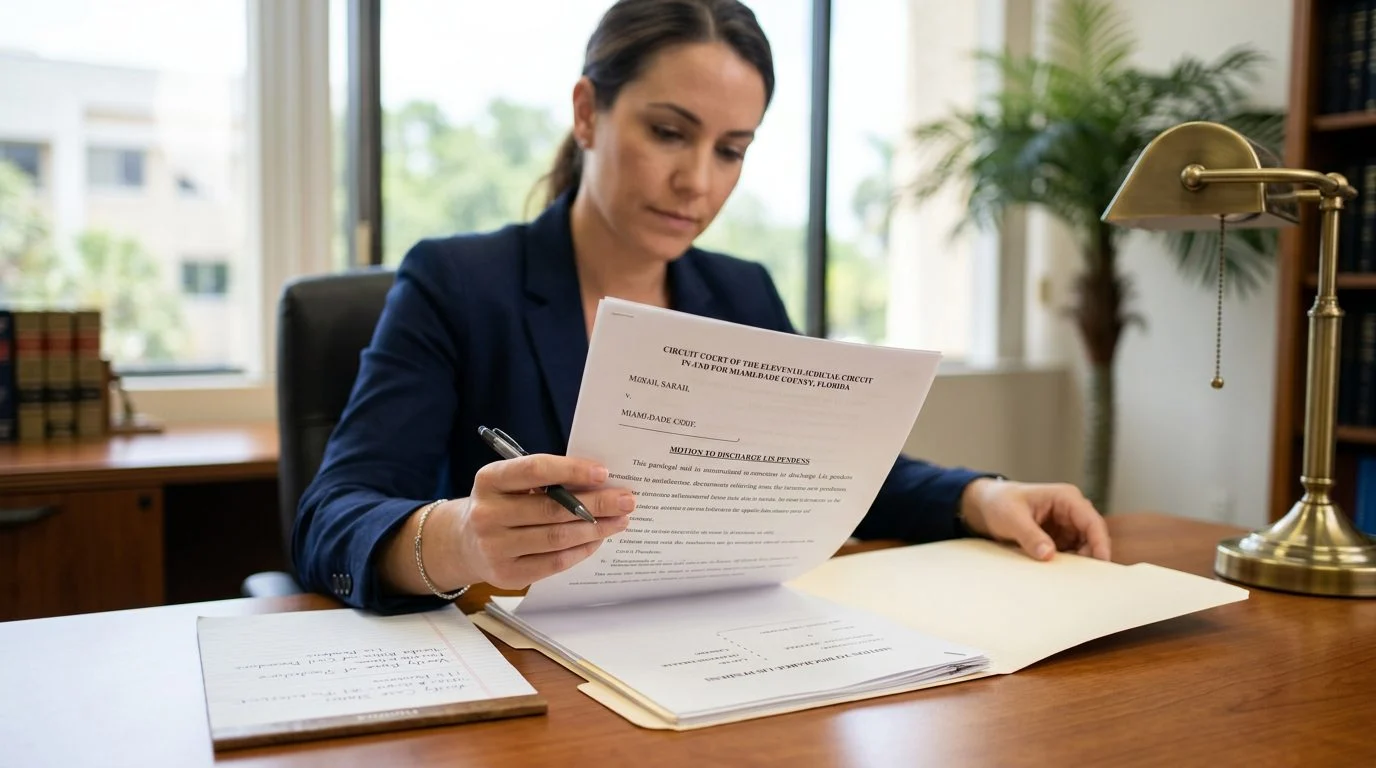
The second route is asking the court in the pending case to dissolve or discharge the lis pendens.
The court decides on the written record and the arguments presented. Court filing rules apply as well, so confirm the procedures for the court where the case is pending. Results turn on the facts, and no outcome is promised.
Time Limits and What Keeps a Notice on Record
A notice can stay recorded for as long as the underlying case stays active. Delays in that case push out the date the notice comes off. Time limits matter too. For actions founded on the design, planning or construction of an improvement to real property, Florida law sets a four-year period. The clock generally starts when the authority having jurisdiction issues a temporary certificate of occupancy, a certificate of occupancy or a certificate of completion, or when construction is abandoned if it is not finished, whichever date is earliest (Fla. Stat. § 95.11). Fla. Stat. § 95.11 reads: “(b) An action founded on the design, planning, or construction of an improvement to real property, with the time running from the date the authority having jurisdiction issues a temporary certificate of occupancy, a certificate of occupancy, or a certificate of completion, or the date of abandonment of construction if not completed, whichever date is earliest; except that, when the action involves a latent defect, the time runs from the time the defect is discovered or should have been discovered with the exercise of due diligence.”
Latent defects follow a different rule. For those, the time runs from when the defect is discovered or should have been discovered with due diligence. Any such action must still be commenced within 7 years after the certificate or abandonment date. Check these dates against your own timeline, and bring the documents that show them.
Not sure what your next step is?
Talk it through with our team — we can walk you through how a situation like yours is usually handled and what your options are.
Recording the Release and Checking Title
The final step is recording the release or a certified court order in the county’s official records where the property sits. Recording makes the change part of the public record that buyers and lenders check. After recording, order a title search or ask the title company to confirm the notice no longer appears before a sale or refinance.
Keep these documents together: the recorded release or court order, the dismissal or satisfaction, the case number, and proof of recording. A buyer, lender or title insurer will likely ask for the recorded release before closing, so have it in hand early. One mistake to avoid is relying on a settlement letter instead of a recorded release. Keep copies with your property file. If a new filing appears, check the record again.
Talk With Ayala Law PA About the Lis Pendens on Your Property
If you found a lis pendens on property you own or are buying, you may be facing a lawsuit you didn’t expect. You may also be reading this for a business partner, a co-owner or a company. Whatever your position, you don’t have to sort out the case alone. Eduardo A. Maura is the lawyer responsible for this page.
The firm’s office is at 1646 W Snow Ave in Tampa, Florida, and the firm represents businesses in Tampa and Hillsborough County from that office. The firm handles matters involving property in Hillsborough County and the Tampa Bay area. You can call (305) 570-2208 or reach out through the contact page. Case evaluations carry fees, and fee terms are explained in writing before any engagement.
Does a lis pendens stop a property sale?
It often makes buyers, lenders and title companies hesitant while it stays recorded.
Where is a lis pendens recorded?
It is recorded in the official records of the county where the property is located.



