

A shareholder derivative lawsuit lets a shareholder sue on behalf of a corporation. It is used when the company has a claim against insiders, such as directors or officers, and the company isn’t acting on it. In Florida, the rules come from the Florida Business Corporation Act (Chapter 607, Florida Statutes). This page explains who can file, what must come first, and what usually happens next.
Ayala Law PA focuses on business litigation, including shareholder disputes. Ayala Law PA’s only office is at 1646 W Snow Ave, Tampa. It serves businesses and shareholders in Tampa, Hillsborough County and the wider Tampa Bay area. Eduardo A. Maura is the responsible lawyer for this page.
What a Shareholder Derivative Suit Is and Who Can Bring One
A derivative suit lets a shareholder act for the company, but only if strict standing rules are met. The shareholder steps in because the company itself has a claim it hasn’t pursued.
The company owns the claim, so the company is the party that benefits. Any recovery generally goes back to the corporation, not to the shareholder who filed.
Common filers include minority owners in closely held companies, co-owners who were pushed out of management, and shareholders in larger companies.
Standing is a threshold question. Under Fla. Stat. § 607.0741, a shareholder can’t start a derivative proceeding unless they are a shareholder when the case begins. They must also have held shares when the challenged conduct happened, or received those shares by transfer or operation of law from someone who did.
If directors' decisions have left you or your company exposed, our team can review your records and timeline with you and talk through your options. Talk it through with our team — we can walk you through how a situation like yours is usually handled and what your options are.
The Demand Requirement and Demand Futility
In most cases, a Florida shareholder must first ask the board to act.
Under Fla. Stat. § 607.0742, the complaint must be verified. It must also state with particularity any demand made on the board. If a demand was made, the complaint must say the board refused, rejected or ignored it before 90 days expired. It can instead explain why waiting would cause irreparable injury, or misapplication or waste of corporate assets causing material injury. If no demand was made, the complaint must give the reasons the shareholder didn’t ask the board.
Demand futility is the argument that asking the board would be pointless. It often centers on board members who have financial ties to the conduct or who benefited from it. Whether a demand is excused turns on the specific facts.
A written demand also creates a record. It shows the board had a chance to act, which matters if the case goes forward.
What a Derivative Claim Can Cover
A derivative claim usually targets harm to the company caused by insiders. Common examples include self-dealing, waste and misuse of company funds.
Typical claim types include:
- Breach of fiduciary duty, such as duty of loyalty or duty of care issues
- Self-dealing and related-party deals that favor an insider
- Corporate waste, meaning company assets spent with no real value to the company
- Taking business opportunities that belonged to the company
- Misuse of company funds or assets
Florida law sets the standard for directors. Under Fla. Stat. § 607.0830, directors must act in good faith and in a way they reasonably believe serves the corporation’s best interests.
Director liability has limits. Under Fla. Stat. § 607.0831, a director is not personally liable for money damages unless the director breached a duty and the breach fits a listed circumstance. Those include an improper personal benefit, or conscious disregard of the corporation’s best interest in a proceeding brought by or for the corporation.
Under Fla. Stat. § 607.0746, a court may order the company to pay a successful plaintiff’s reasonable fees from the recovery. A court may also order a plaintiff to pay the defendant’s expenses if the case was brought without reasonable cause or for an improper purpose.
Derivative Claims Versus Direct Claims
A direct claim is brought in the shareholder’s own name. It addresses harm to the shareholder’s own rights.
Compare two situations. A director moving company money to a personal account harms the company, so it is usually a derivative claim. A majority owner refusing to pay a minority owner’s declared distribution may be a direct claim, depending on how it is framed.
The label matters. A claim framed the wrong way can be dismissed, and a derivative claim brings demand and standing rules with it. One set of facts can sometimes support both kinds of claims.
Keep the veil question separate, too.
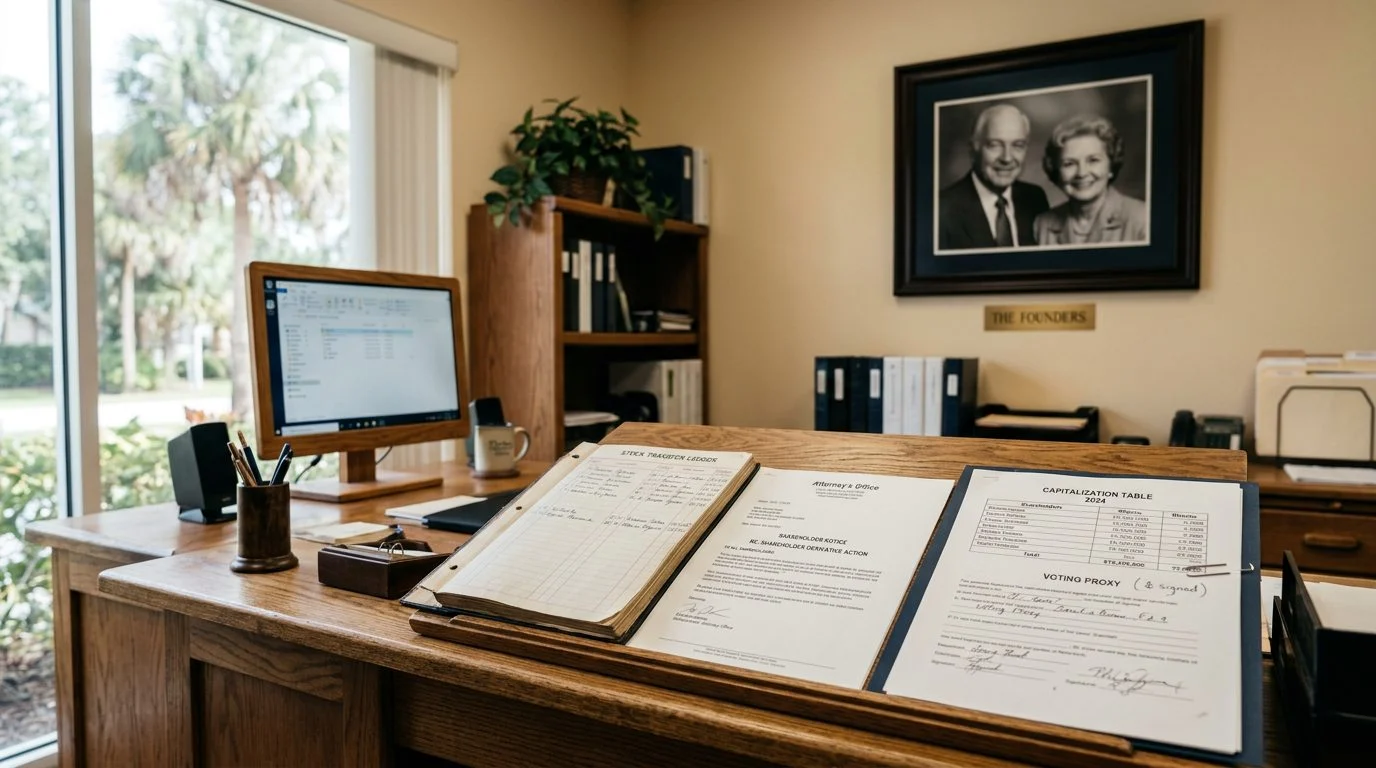
How a Shareholder Derivative Case Typically Proceeds
A case usually moves from records review to a demand, then a verified complaint, then motions and discovery. Each step has its own timing rules.
- Review the records. Florida lets a shareholder inspect certain company records. Under Fla. Stat. § 607.1602, the shareholder must give written notice at least 5 business days before the inspection. A shareholder may inspect and copy the records described in subsection (2) only if the demand is made in good faith, for a proper purpose, and describes the records with reasonable particularity.
- Check standing and timing. Confirm share ownership on the key dates and when the conduct occurred.
- Decide on a demand. Where the facts call for one, send a written demand to the board and track the 90-day period.
- File a verified complaint. The complaint goes to the proper Florida court, or to arbitration if an agreement requires it. It must plead the demand facts with particularity.
- Respond to motions. Defendants often move to dismiss on demand, standing or claim-type grounds.
- Discovery and resolution. Discovery may reach board minutes, emails and financial records. Any settlement or discontinuance needs court approval under Fla. Stat. § 607.0745.
Timelines vary with the facts, the court’s schedule and the arguments raised. No timeline is promised.
Defenses and Board Responses to Expect
The company and its directors often respond with a motion to dismiss, an independent review, or a challenge to the shareholder’s standing. How a court rules on any of these points depends on the facts.
- Dismissal by an independent group. Under Fla. Stat. § 607.0744, the corporation may move to dismiss if a qualified group decided in good faith, after a reasonable inquiry, that the case is not in the corporation’s best interests. The corporation carries the burden of proof on that group’s qualifications and process.
- A pause for inquiry. Under Fla. Stat. § 607.0743, if the corporation starts an inquiry, the court may stay the case for the period it considers appropriate.
- Conflict-of-interest transactions. Under Fla. Stat. § 607.0832, the challenger may carry the burden of proving lack of fairness if the material facts were disclosed and the transaction was authorized, approved, or ratified by a vote of a majority of the qualified directors, even if they are less than a quorum; a single director cannot approve it alone.
- Standing challenges. Defendants may argue the plaintiff was not a shareholder when the conduct occurred.
Not sure what your next step is?
Talk it through with our team — we can walk you through how a situation like yours is usually handled and what your options are.
Why Work With Ayala Law PA on a Shareholder Dispute
Ayala Law PA focuses on business litigation for businesses in Tampa and Hillsborough County, from its Tampa office at 1646 W Snow Ave. The firm’s work covers shareholder disputes, commercial and contract disputes, partnership disputes, construction litigation, real estate litigation and international trade disputes in Florida courts and arbitration.
Eduardo A. Maura is the responsible lawyer for this page. The firm’s support staff assist with case administration.
Our team takes on matters for businesses in Tampa, Hillsborough County, Brandon, Riverview, Plant City, Temple Terrace and the wider Tampa Bay area, with the firm’s only office located in Tampa. We handle these matters from our office in Tampa, at 1646 W Snow Ave.
A case evaluation works in practical steps. You share the company documents, the timeline and the decision you face. We review whether a demand, a direct claim or another route fits those facts.
Ask about fee terms for a case evaluation before you schedule one. You can book a case evaluation online.
If a matter falls outside our practice, we may refer it to another lawyer or firm. We will tell you when that happens.
Frequently Asked Questions About Shareholder Derivative Suits in Florida
Can a minority shareholder file a shareholder derivative lawsuit in Florida?
Yes, if the standing, demand and pleading rules are met. The shareholder sues for the company, not for personal harm.
Do I have to send a demand to the board first?
Generally yes. A demand can be skipped only in limited situations, such as when the facts support demand futility.
Who gets the money if the case succeeds?
The corporation generally receives the recovery. A direct claim works differently and can allow personal damages.
Can an LLC member bring a derivative action?
Can the company pause or end the case?
It may move to dismiss through a qualified group, and a court may stay the case during an inquiry.
How long does a derivative case take?
Timelines vary with the facts, the court and the arguments raised. No timeline is promised.
If directors’ conduct has left your company or your shares exposed, call Ayala Law PA at (305) 570-2208 to talk through your records and timeline.



