
If you’re asking what is considered commercial litigation, the short answer is a civil dispute that grows out of business activity. It usually involves a contract, a partnership, a company’s governance, a construction project or a cross-border sale. It is not a criminal case. It is a fight over whether a business obligation was honored, broken or misrepresented. This page explains the term in plain language, gives a practical example, and covers where Florida cases are filed and how long they tend to take. It comes from Ayala Law PA, which focuses on business litigation in Florida courts and arbitration.
Commercial litigation is a civil lawsuit over business dealings
What is considered commercial litigation? It is a civil lawsuit, or the process of resolving one, over a dispute that comes from business dealings. “Civil” means the case is about money, property or a promise, not a criminal charge. The parties are usually businesses, owners, partners, shareholders or companies that made a deal with each other. An individual can be a party when a business relationship sits at the center of the fight.
The core question is simple. Was a commercial agreement, obligation or relationship honored, broken or misrepresented? A judge or arbitrator answers that by reading the written contract, looking at each side’s conduct, and reviewing the emails, invoices and records that show what happened.
Commercial litigation has two sides. The party who starts the case is the plaintiff, or the claimant in arbitration. The party who answers is the defendant, or the respondent. Many business disputes include counterclaims, where the defendant files its own claim back. A business can be on either side, and sometimes on both at once.
Not sure what your next step is?
Talk it through with our team — we can walk you through how a situation like yours is usually handled and what your options are.
Commercial litigation covers contract, partnership, construction, real estate and trade disputes
Commercial litigation covers five common kinds of dispute, and each one ties back to a business relationship. They are contract, shareholder and partnership, construction, real estate and international trade disputes.
Contract disputes are the most common type. They include breach of contract claims over unpaid invoices, missed deadlines, failed deliveries or terms each side reads differently. A breach means one party did not do what the agreement required.
Shareholder and partnership disputes involve governance, buyouts, profit splits or a partner’s conduct. A shareholder who sues for the company, in what is called a derivative proceeding, generally must have held shares when the conduct happened. Fla. Stat. § 607.0741 sets out that standing rule: a shareholder may not commence a derivative proceeding unless the shareholder is a shareholder at the time the action is commenced and was a shareholder when the conduct occurred, or the shareholder’s status devolved through transfer or by operation of law from one who was.
Construction litigation includes contractor and subcontractor disputes, payment fights and lien foreclosure actions tied to a project. Real estate litigation covers commercial property agreements, leases and disputes over a deal’s terms. International trade disputes arise from cross-border sales, shipments and agreements.
The facts of the agreement and the parties’ conduct decide which category fits.
A supplier’s unpaid invoice is a typical example of commercial litigation
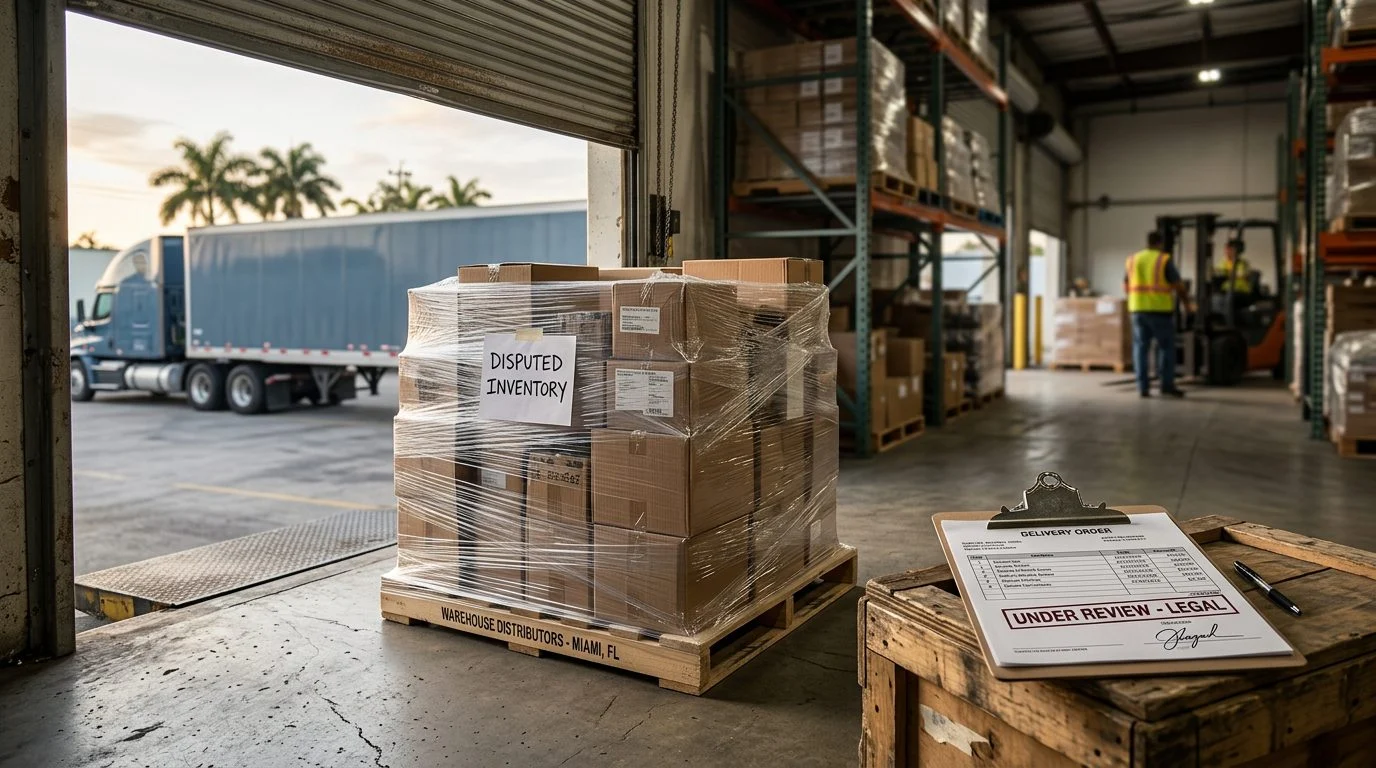
A supplier suing a buyer over unpaid goods shows how these cases work. Imagine a Tampa-area distributor that delivers products under a written supply agreement. The buyer withholds payment, claiming the goods were defective. The supplier files a breach of contract suit.
The case turns on records. Purchase orders, invoices, inspection reports and emails show what was ordered, delivered, accepted and said. Those records make the dispute commercial, because it is about a business transaction.
The buyer may counterclaim, alleging the supplier breached a product warranty. That claim is also commercial litigation.
Florida’s goods rules matter here. A sale of goods priced at $500 or more is generally enforceable only with a record signed by the party being held to it. Fla. Stat. § 672.201 sets that rule. Under Fla. Stat. § 672.607, a buyer who accepts goods must pay at the contract rate and must notify the seller of a breach within a reasonable time after discovering it, or should have discovered it, or be barred from any remedy. This example is illustrative only and does not predict how any real matter would turn out.
Business, commercial and corporate litigation: how the terms differ
Business litigation and commercial litigation usually mean much the same thing. Business litigation is the broadest everyday label, covering almost any dispute involving a company or its owners.
Commercial litigation focuses on disputes over transactions, contracts and dealings between parties. Corporate litigation is a narrower term, sometimes used for disputes about a corporation’s internal affairs, such as governance, shareholder rights and director duties. That overlaps with shareholder disputes.
Firms, courts and publications don’t use these labels the same way. So the label matters less than two practical questions: which claims apply, and where the case will be heard. Those two questions shape a business’s cost, timing and options most.
Have questions about what happened?
Ask our team directly. Tell us what you are dealing with and we will explain how the process works from here.
Commercial cases are heard in Florida courts or in arbitration
Most commercial cases are filed in a Florida court or sent to arbitration, depending on what the contract says. A suit may be brought only in the county where the defendant resides, where the cause of action accrued, or where the property in litigation is located. Fla. Stat. § 47.011 sets that venue rule, which does not apply to suits against nonresidents. A Hillsborough County case fits when the defendant lives there, the dispute arose there, or the property is there.
Many business contracts include an arbitration clause. Under Fla. Stat. § 682.02, a written agreement to arbitrate is enforceable except on grounds that exist to revoke any contract. The court decides whether that agreement exists. For international trade, the American Arbitration Association describes arbitration as a private, legally binding option.
How long does commercial litigation take?
Commercial litigation takes as long as its claims, parties, documents and court schedule require. The timeline is set by the facts of each case. Cases usually move through pleadings, discovery (the exchange of documents and sworn testimony), motions, mediation, and then trial or an arbitration hearing.
Any filed civil action for monetary damages can be sent to mediation on request, provided the requesting party is willing and able to pay the costs of the mediation or the costs can be equitably divided between the parties, unless an exception applies. Fla. Stat. § 44.102 governs court-ordered mediation, with listed exceptions. A settlement can happen at any stage.
Deadlines to file matter.
Early steps help a business protect its position
Early on, a business should preserve records, read the contract and check deadlines. Losing emails or texts can weaken a position that is otherwise sound. Pull the agreement and read its notice requirements, dispute clause and arbitration language.
Avoid casual admissions. A quick message saying “we messed up” can be used later. Don’t change course or stop performing without reading the contract first.
Florida contracts also carry an implied duty of good faith. Under the QBE v. Chalfonte decision, that duty can’t be used to contradict express terms, and a claim on it fails without an accompanying claim for breach of an express term.
Want to know where you stand?
Tell us about your situation and our team will walk you through the options available to you.
Talk with Ayala Law PA about your commercial dispute
If you’re still asking what is considered commercial litigation for your situation, Ayala Law PA handles contract, shareholder and partnership, construction, real estate and international trade disputes in Florida courts and arbitration.
Common questions
Is a breach of contract lawsuit commercial litigation?
Yes, when the contract ties to a business relationship or transaction, a breach claim is commercial litigation.
Does an arbitration clause stop a lawsuit?
It can send the dispute to arbitration, since Florida generally enforces written arbitration agreements.
Can a commercial case be filed in Hillsborough County?
It can, if the defendant lives there, the dispute arose there, or the property is located there.
Case evaluations are fee-based. Eduardo A. Maura is the lawyer responsible for this page. The firm’s only office is at 1646 W Snow Ave, Tampa, Florida, and this page is written for businesses in Tampa, Hillsborough County and the Tampa Bay area.
If a demand letter or a stalled payment has your business in limbo, you don’t have to work out the next step alone. Call (813) 414-5715 or use the contact page to talk through your agreement.



