
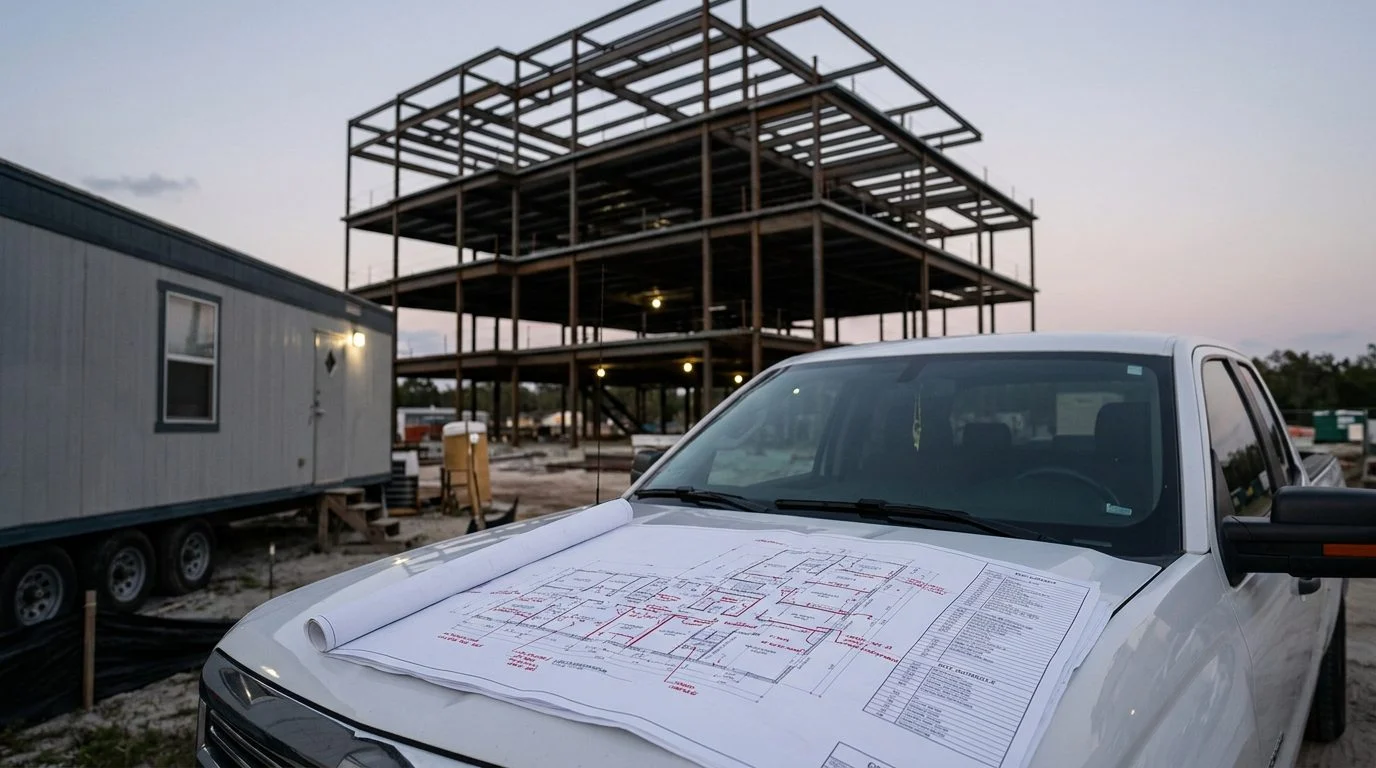
A construction dispute in Hillsborough County can end within months if the parties settle early. A contested case that runs through discovery and trial takes much longer. Timing turns on the facts, so no single construction dispute timeline fits every project. This page walks through the usual phases, the deadlines that start the clock, and the factors that speed up or slow down each step.
How long does a construction dispute take to resolve in Hillsborough County or Tampa-area courts?
Early settlement is usually the fastest path. A contested lawsuit is usually the slowest. Lien foreclosure cases and disputes with many parties often take longer than a single payment claim against one contract. The court’s calendar, the number of claims, and the size of the project file all shape the timeline.
Where a case is filed also matters. Under Fla. Stat. § 47.011, an action must be brought in the county where the defendant resides, where the cause of action accrued, or where the property in litigation is located, but this section does not apply to actions against nonresidents. For many Hillsborough County projects, that points to a Hillsborough court. The specific facts decide it.
If a payment has stopped or a lien notice has arrived, the calendar may already be running, and you don't have to sort out the deadlines alone. Contact Ayala Law PA to talk through where your dispute stands. Talk it through with our team — we can walk you through how a situation like yours is usually handled and what your options are.
What steps happen before a lawsuit is filed, and which ones start the clock?
Before filing, most disputes go through a review stage. You read the contract, pull payment and change-order records, and send a written demand. Check the contract for notice steps and any requirement to mediate or arbitrate first. Those steps add time before a court case starts.
The deadlines matter most. Florida law generally allows four years to bring a claim founded on the design, planning, or construction of an improvement to real property. That period runs from whichever date is earliest under Fla. Stat. § 95.11: the date the authority having jurisdiction issues a temporary certificate of occupancy, a certificate of occupancy, or a certificate of completion, or the date of abandonment of construction if not completed. When a latent defect is involved, the period instead runs from when the defect is discovered or should have been discovered with the exercise of due diligence. The clock runs from the earliest of a temporary certificate of occupancy, a certificate of occupancy, a certificate of completion, or the date construction was abandoned. For a latent defect, the four years run from when the defect was or should have been discovered. Even then, the action generally must start within seven years of that earliest date.
The general accrual rule in Fla. Stat. § 95.031 says a claim starts when its last element occurs. Also, Fla. Stat. § 95.03 voids any contract term that shortens the time to sue below the statute’s period.
How does a Florida circuit court case move from filing to resolution?
A case moves in stages: filing and service, responsive pleadings, discovery, mediation, and then trial or rulings on motions. The court’s case management order sets many of the dates along the way.
Discovery usually takes the most time in construction cases. Parties exchange project files, daily logs, schedules, photographs, and emails. Technical witnesses, such as engineers, can add steps because each side needs time to review their findings.
Mediation often comes early. Under Fla. Stat. § 44.102, a court must, upon request of one party, refer a filed civil action for monetary damages to mediation, provided the requesting party is willing and able to pay the costs of the mediation or the costs can be equitably divided between the parties, unless a statutory exception applies. The requesting party must be able to pay the costs, or the costs must be divided fairly. The statute lists exceptions, including cases where the parties agreed to binding arbitration. Section 44.102(5) ties the tolling of response periods for settlement offers and offers of judgment in a court-referred mediation to two events: the mediator declaring an impasse, or the mediator reporting to the court that no agreement was reached.
What factors make a construction dispute take longer or move faster?
Faster cases usually have clear contracts and complete records. Slower cases usually have many parties, many claims, or disputed facts. Each added party, such as a subcontractor, surety, or lender, adds notices, documents, and depositions.
Defects that need site inspection or testing also add time. Early exchange of records tends to shorten the path. Records that are missing or scattered tend to lengthen it.
An arbitration clause changes both the forum and the calendar. Under Fla. Stat. § 682.02, an agreement in a record to arbitrate a controversy is valid, enforceable, and irrevocable, except on grounds that exist at law or in equity to revoke a contract. If a court orders arbitration, Fla. Stat. § 682.03 requires it to stay the court case on the arbitrable claim. Under Fla. Stat. § 95.051, a pending arbitration also tolls the limitations period. Arbitration then follows the agreement and the arbitrator’s schedule, not the court’s calendar.
How do settlement, mediation, and arbitration compare with court timing?
An early settlement usually ends a construction dispute sooner than a trial. Mediation and arbitration each run on their own track, set by a court order or by the agreement.
A mediated settlement usually covers a payment schedule, a lien release, and a dismissal of the case. Those terms decide how long the project takes to close out. Clear terms help the parties finish the job without a second round of disputes.
Settlement talks also have legal protection. Under Fla. Stat. § 90.408, evidence of an offer to compromise a disputed claim, as well as any relevant conduct or statements made in negotiations concerning a compromise, cannot be used to prove liability or absence of liability for the claim or its value.

How can a business plan around the timeline, and what is the next step?
Start by organizing the contract, change orders, and payment records. Keep daily logs and correspondence in one place. Calendar every notice and filing deadline as soon as a problem appears. Read any release before signing it.
If a payment has stopped, a lien notice has arrived, or a job has stalled while the parties argue over who owes what, the clock may already be moving. Planning early makes the construction dispute timeline easier to manage.
Ayala Law PA concentrates in business, commercial, and construction litigation, including contract and lien disputes in Florida courts and arbitration. Eduardo A. Maura is the responsible lawyer for this page. The firm’s office is in Tampa, at 1646 W Snow Ave, and it serves businesses in Hillsborough County and the Tampa Bay area. To discuss your dispute and its deadlines, call (305) 570-2208 or use the contact page.
Quick answers
What is the construction dispute timeline in Hillsborough County?
A settled dispute can end within months. A contested case that goes through trial usually takes longer.
How long do I have to sue over construction work in Florida?
Construction claims must generally be commenced within the period the statute sets, running from the certificate or abandonment date, and in any event within 7 years after the date the authority having jurisdiction issues a temporary certificate of occupancy, a certificate of occupancy, or a certificate of completion, or the date of abandonment of construction if not completed, whichever date is earliest.



