
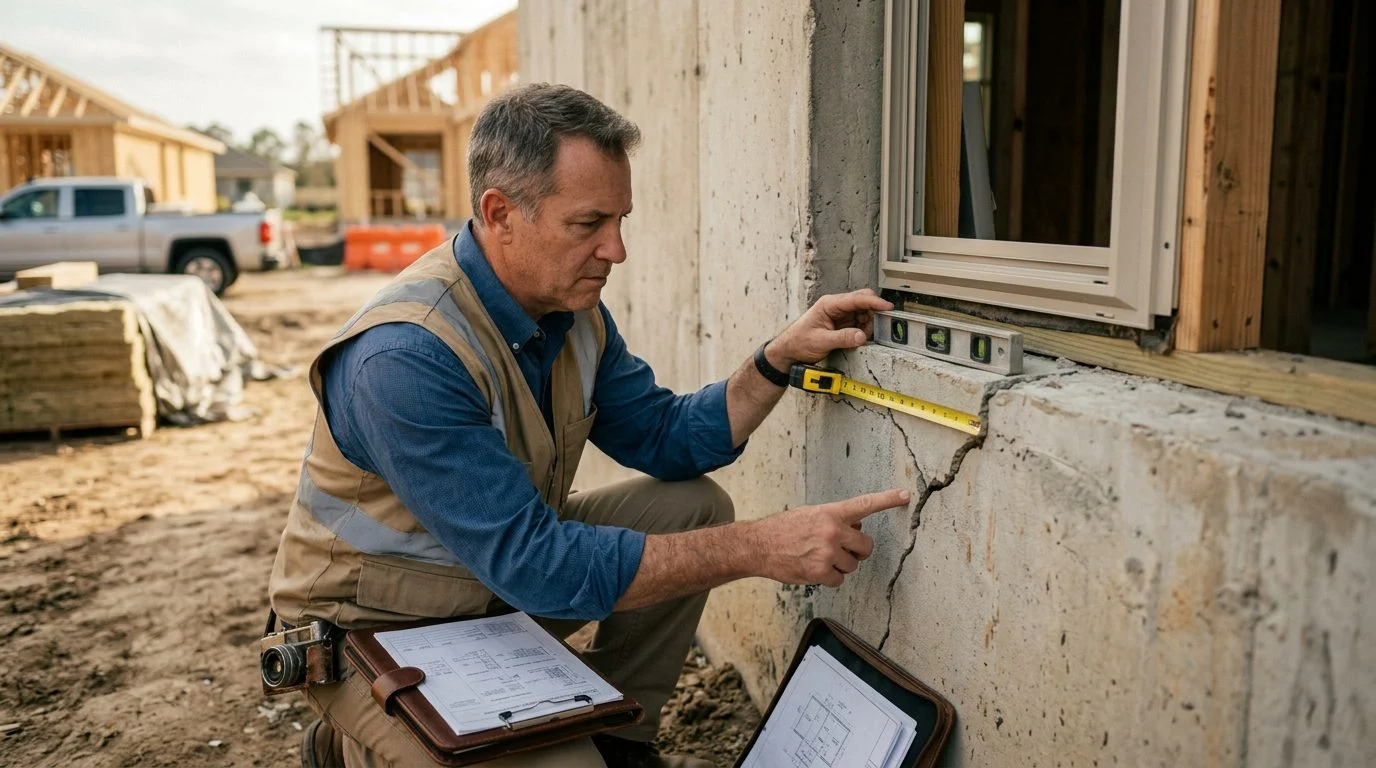
This guide walks through each step, the evidence behind it, and the deadlines that can control whether a claim is still available.
It’s written for property owners, business owners, and family members who are dealing with a construction problem, often on someone else’s behalf.
What Contractor Negligence Means
The real question is whether the work fell below the standard a careful contractor would meet on a similar job.
Negligence is different from a payment fight or a disagreement about what the contract said. If the contractor was paid and simply stopped working, the core issue may be a broken promise, not careless work. Many owners pick one label and miss the other.
The same facts can sometimes support both a negligence claim and a breach of contract claim. A homeowner might allege faulty framing and also say the contractor didn’t build to the agreed plans. A Third District decision in Frutafino, S.A.S. v. Dole Chile says a party generally cannot recover in tort for a contract dispute unless the tort is independent of the breach. So sorting the facts early matters.
If a contractor's work has left your property or business with damage that keeps growing, we can talk through your situation and what it may mean for a claim. Talk it through with our team — we can walk you through how a situation like yours is usually handled and what your options are.

The Four Elements You Must Prove
A court looks for each one.
These are four questions a court asks about one claim. They are not four separate kinds of negligence. Strong evidence of a breach does not fix a missing link on causation. Plan your records around the element that will be hardest to show.
Proving the Contractor Owed You a Duty of Care
Duty is usually the simplest element when you hired the contractor directly. The signed contract, proposal, or purchase order shows who agreed to do the work, what it covered, and when.
Duty can get harder without a direct contract, such as when a subcontractor you never hired did the work. Those questions depend on the facts and on each party’s role in the project.
Licensing matters too. Florida licenses contractors, and the state’s Construction Industry Licensing Board publishes licensing requirements and license verification. Check whether the company held the license needed for the work it actually performed.
Gather these records early:
- Signed contracts and change orders
- Proposals, estimates, and purchase orders
- Permit applications showing who pulled the permit
- Invoices and payment records
Proving Breach: Measuring the Work Against the Standard of Care
You prove it by comparing the work to clear reference points.
Start with the building code that applied, any conditions on the building permit, and the manufacturer’s installation instructions for the products used. A product installed against its written instructions is easier to explain than a general complaint about quality.
An independent engineer or building inspector can document the defect. They can photograph it, measure it, note what the code or instructions required, and explain the gap in plain terms. Their written report often makes the problem easier to follow.
Get that inspection before repairs cover up the evidence. Once walls are closed or old work is torn out, proof of what happened may be gone. How strong this showing is turns on the specific work and the records you have.
Proving Causation: Linking the Defect to the Harm
Causation asks whether the defect actually caused the damage you claim. A defect that exists is not enough on its own.
Say a wall is out of plumb. That is a defect. But if water damage came from a pipe that a plumber you hired separately installed, the claim against the framing contractor gets harder. The question is which problem produced which harm.
Timelines help. Dated photos, inspection results, and a record of when each problem appeared show whether one failure led to the next. A stain that appears the same week as a roof repair tells a different story than one that shows up two years later.
Expect the other side to offer other causes, such as weather, owner maintenance, later changes, or repairs by someone else. Each one needs a written answer in your file. This is where learning how to prove contractor negligence becomes practical: you answer each alternative with records, not memory.
Documenting Damages and Building the Evidence File
Damages are the money or property loss the defect caused. Common categories include the cost to fix the defect, damage to other parts of the property, and loss of use, such as a rental unit that sat empty or a shop that closed during repairs.
Build the file now:
- Dated photos and video of each problem
- The signed contract and any change orders
- Invoices, receipts, and proof of payment
- Permits and inspection reports
- Texts, emails, and letters with the contractor
- Repair estimates from other companies
Keep a running timeline. Note when you first noticed the problem, when you reported it, what the contractor said or did, and what repairs cost. Keep original files and messages, not just screenshots. Gaps in the timeline are easy for the other side to question.
Not sure what your next step is?
Talk it through with our team — we can walk you through how a situation like yours is usually handled and what your options are.
How Florida Construction Negligence Disputes Usually Proceed
A dispute usually moves through a written demand, an investigation, any steps the contract requires before suit, and then a lawsuit or arbitration. The contract’s wording often sets the path.
Deadlines come first. Under Fla. Stat. § 95.11, the four-year period applies to actions founded on the design, planning, or construction of an improvement to real property, with the time running from the date the authority having jurisdiction issues a temporary certificate of occupancy, a certificate of occupancy, or a certificate of completion, or the date of abandonment of construction if not completed, whichever date is earliest; when the action involves a latent defect, the time runs from when the defect is discovered or should have been discovered with the exercise of due diligence, but in any event the action must be commenced within 7 years after that earliest date, and other claims, such as negligence claims, may be subject to different limitation periods. When that period begins depends on specific conditions, including the issuance of a certificate of occupancy or certificate of completion, or the abandonment of unfinished construction, and an action generally must be commenced no later than seven years after that date. That period usually runs from the certificate of occupancy or completion, or from abandonment of construction, whichever date is earliest.
For a latent defect, a hidden problem, the time runs from when the defect was or should have been discovered with the exercise of due diligence. Even so, the action must start within seven years of that certificate or abandonment date.
A contract cannot shorten that window. Under § 95.03, a contract provision that sets a shorter time to sue than the statute allows is void.
Arbitration can pause the clock. Under § 95.051(1)(g), the limitations period is tolled while an arbitration about the dispute is pending.
If your contract has an arbitration clause, Florida law generally enforces it. Under § 682.02, an agreement to arbitrate is valid, enforceable, and irrevocable, except on grounds that exist for revoking any contract.
Mediation is another step. Under § 44.102(2)(a), a court must, on one party’s request, refer filed civil actions for money damages to mediation if the requesting party is willing and able to pay the costs of the mediation or the costs can be equitably divided between the parties, subject to listed exceptions. Fla. Stat. § 44.102 reads: “(2) A court, under rules adopted by the Supreme Court: (a) Must, upon request of one party, refer to mediation any filed civil action for monetary damages, provided the requesting party is willing and able to pay the costs of the mediation or the costs can be equitably divided between the parties, unless: 1.”
Venue matters as well. Under § 47.011, actions must be brought where the defendant resides, where the cause of action accrued, or where the property in litigation is located; this section does not apply to actions against nonresidents. Projects in Brandon, Riverview, and Plant City sit in Hillsborough County, so property location can matter there.
Cost, Difficulty, and Where to Start
Suing a contractor is harder when evidence is thin, the contract has unusual terms, or a deadline is close. It is usually easier when defects are documented early and the contract is in hand.
How difficult is it to sue a contractor?
Difficulty turns on evidence quality, contract terms, and deadlines. A well-documented defect with a clear contract is usually easier to pursue than a vague complaint with missing records.
How much does it cost to sue a contractor?
Under Florida law, each party generally pays its own attorney’s fees unless a contract or statute says otherwise, according to Price v. Tyler. Your total costs vary with the matter. Case evaluations with Ayala Law PA are a paid service, and fees are discussed directly during the evaluation.
What is the deadline to sue over construction defects in Florida?
The general rule under § 95.11(3)(b) is that the time runs from the date the authority having jurisdiction issues a temporary certificate of occupancy, a certificate of occupancy, or a certificate of completion, or the date of abandonment of construction if not completed, whichever date is earliest, with the discovery and seven-year limits described above. Fla. Stat. § 95.11 reads: “(b) An action founded on the design, planning, or construction of an improvement to real property, with the time running from the date the authority having jurisdiction issues a temporary certificate of occupancy, a certificate of occupancy, or a certificate of completion, or the date of abandonment of construction if not completed, whichever date is earliest; except that, when the action involves a latent defect, the time runs from the time the defect is discovered or should have been discovered with the exercise of due diligence.” The rule has exceptions, so the dates in your own file matter.
Talk Through Your Situation With Ayala Law PA
If a contractor left your project half-finished, or a repair keeps growing, you’re probably weighing a hard choice. You may be deciding whether to pursue the contractor, wait, or step in for a family member or business partner who can’t handle it alone.
Ayala Law PA focuses on business litigation in Florida courts and arbitration, including construction and contract disputes for businesses in Tampa, Hillsborough County, and the Tampa Bay area. The firm’s only office is at 1646 W Snow Ave, Tampa. Eduardo A. Maura is the responsible lawyer for this page.
If your situation fits this guide, share the contract, permits, photos, and your timeline with us. Reach out through our contact page or call (305) 570-2208.



