
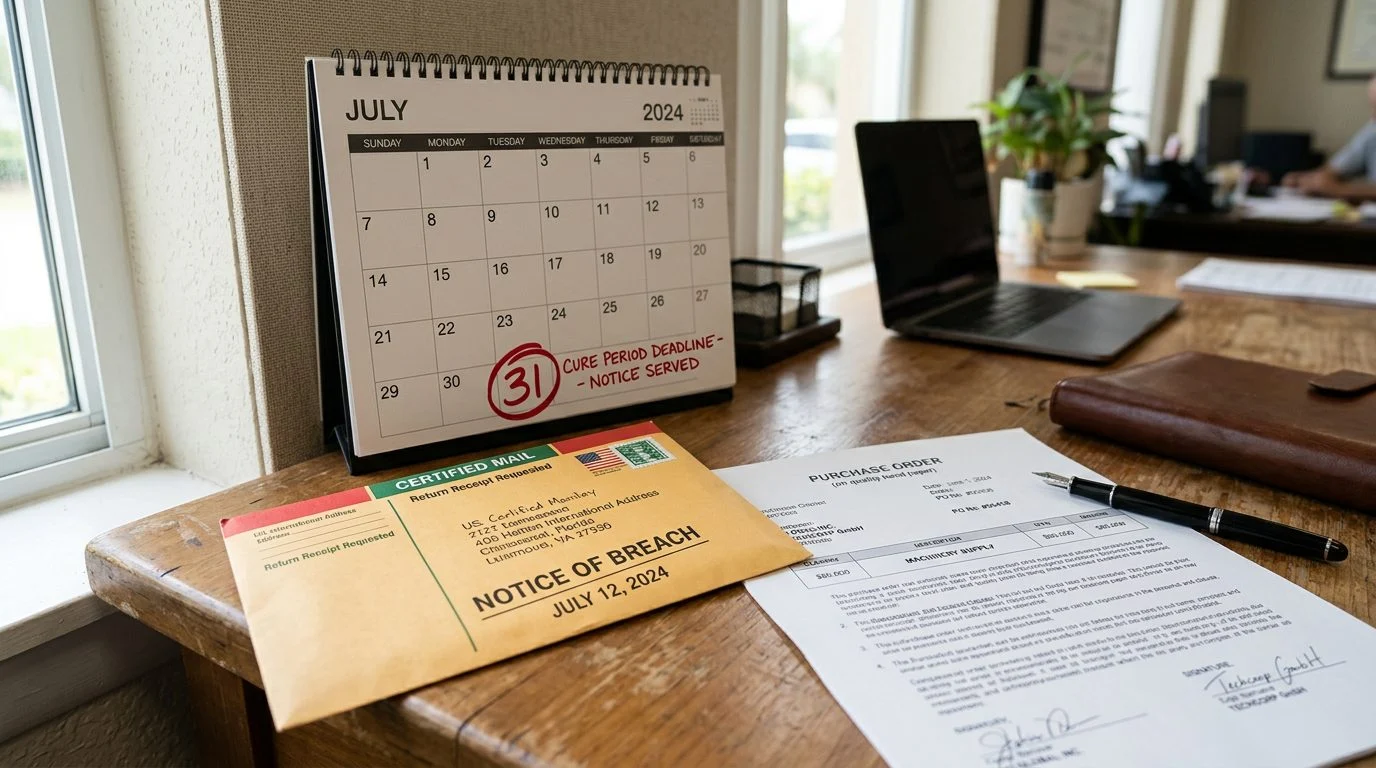
How long does an international contract dispute take to move from filing to resolution in Florida federal or state court?
There is no fixed timeline. The schedule depends on the forum, whether the contract requires arbitration, how quickly a foreign party can be served, and how hard each side contests the claim.
Cross-border cases often take longer than local ones. Service abroad, translation, and collecting records from other countries each add steps. Where a case can be filed also matters. Under Fla. Stat. § 47.011, actions are brought in the county where the defendant resides, where the cause of action accrued, or where the property in litigation is located. That section does not apply to actions against nonresidents, so a foreign defendant raises different questions. Federal cases in Tampa proceed in the Middle District of Florida. For a broader overview, see cross-border business disputes in Florida.
If a foreign buyer or supplier has stopped performing, you may be weighing deadlines while trying to keep your business running, and we can talk through your options. Talk it through with our team — we can walk you through how a situation like yours is usually handled and what your options are.
What happens first: filing the complaint and serving a foreign party?
A case starts when a complaint is filed and the other side is formally served. For a party outside the United States, service is often the first real source of delay.
Formal notice must reach the foreign party in a way the rules allow. That step can take time for transmission, translation, and proof that service was made. A defendant who is hard to locate or does not respond can stretch the early phase further.
Florida courts can reach some foreign companies. Under Fla. Stat. § 48.193, a party that breaches a contract in Florida by failing to perform acts the contract requires in Florida submits to Florida court jurisdiction for claims arising from that act. Whether that applies turns on where performance was due.
How do responsive pleadings and early motions affect the schedule?
A defendant must respond within a deadline set by court rules. A motion can pause the case while the judge decides it.
Early motions often challenge the court’s power over the foreign party, the proper venue, or an arbitration clause. Each ruling adds time before discovery starts.
Arbitration clauses create a separate track. Under Fla. Stat. § 682.02, a written agreement to arbitrate is valid and enforceable, except on grounds that exist for revoking a contract. The court decides whether an agreement to arbitrate exists. If a party to a lawsuit challenges whether an agreement to arbitrate exists, the arbitration proceeding may continue while the court decides that issue, unless the court orders otherwise. If it orders arbitration, it stays the court case on the arbitrable claim. Under Fla. Stat. § 682.03, if a party refuses to arbitrate under an agreement to arbitrate, the other party may move the court to order arbitration, and the court must order the parties to arbitrate unless it finds there is no enforceable agreement to arbitrate. In federal court, 9 U.S.C. § 3 also lets a court stay the trial until arbitration is complete, on application of one of the parties, once the court is satisfied the issue is referable to arbitration under a written agreement, provided the applicant is not in default in proceeding with the arbitration.
Why does discovery across borders usually take the longest?
Discovery usually takes the longest because records, witnesses, and devices may sit in other countries. Each extra step to get that evidence adds waiting time.
Florida state judges manage the case under their own deadlines. Either way, the schedule moves only as fast as the slowest evidence source.
Foreign courts may need formal requests before a witness testifies or a record is produced. Disputes over privileged material and over data rules in other countries can slow production further.
Preserve emails, invoices, shipping records, and messages early. Gaps in those records create delay later. As trial approaches, court deadlines tighten the schedule and push both sides to decide quickly which evidence matters.
Where do mediation, arbitration, and settlement fit into the timeline?
Florida courts must send money-damages cases to mediation when one party asks, provided the requesting party is willing and able to pay the costs of the mediation or the costs can be equitably divided between the parties, unless a statutory exception applies. Settlement talks often happen during discovery, and an arbitration clause can move the whole dispute out of court.
Under Fla. Stat. § 44.102, a court must, upon request of one party, refer to mediation any filed civil action for monetary damages, provided the requesting party is willing and able to pay the costs of the mediation or the costs can be equitably divided between the parties, unless a statutory exception applies. The party must be willing and able to pay the mediation costs, or the costs must be fairly divided. The statute lists exceptions, including actions to collect a debt and cases where the parties agreed to binding arbitration. When a case goes to court-ordered mediation, response periods for settlement offers pause until the mediator declares an impasse or reports no agreement.
Settlement offers carry their own clock. Fla. Stat. § 45.061 keeps an offer open 45 days unless withdrawn sooner, but the section does not apply to causes of action that accrue after the effective date of the act.
Arbitration runs on the rules the parties chose, with its own schedule. Awards involving foreign parties may need a separate court step before they can be enforced.
What happens after trial or an award, and how can your business plan for the timeline?
After a judgment or award, the losing side may challenge it. The winning side may then need to enforce it. Each step adds its own time, so full resolution can come well after the decision date.
Arbitration awards have a short challenge window. Under Fla. Stat. § 682.13, a motion to vacate an award must be filed within 90 days after the movant receives notice of the award. If the claim is that the award was procured by corruption, fraud, or other undue means, the 90 days run from when that ground is known or would have been known with reasonable care. Calendar that deadline when the award arrives.
Enforcement against a foreign party may require a proceeding in that party’s home country. Appeals also take their own time.
Practical steps help. Keep contracts, invoices, shipping records, and payment records in one place. List every notice deadline in the contract. Identify early whether an arbitration clause or forum clause controls where the dispute goes. Under Fla. Stat. § 671.105, when a transaction bears a reasonable relation to Florida and also to another state or nation, the parties may agree that the law of either Florida or that other state or nation will govern their rights and duties, except as that section provides for certain chapters.
Can a Florida court hear a contract dispute against a foreign company?
Florida courts can reach some foreign parties, including one that breaches a contract requiring performance in Florida. The contract’s terms and performance location control the answer.
What happens if my international contract has an arbitration clause?
A court may stay the lawsuit while it decides whether the dispute belongs in arbitration. A valid arbitration agreement is generally enforceable under Florida law.
How long do I have to challenge an arbitration award in Florida?
A motion to vacate generally must be filed within 90 days after you receive notice of the award. Fraud or undue means can change when that period starts.
Ayala Law PA focuses on business litigation, including commercial, contract, shareholder, construction, real estate, and international trade disputes. Eduardo A. Maura is the lawyer responsible for this page. The firm’s only office is at 1646 W Snow Ave in Tampa, and this page serves businesses in Tampa and Hillsborough County. Fees for a case evaluation are explained when you call.
To talk through your contract and its deadlines, call (305) 570-2208 or reach us through the contact page.



