
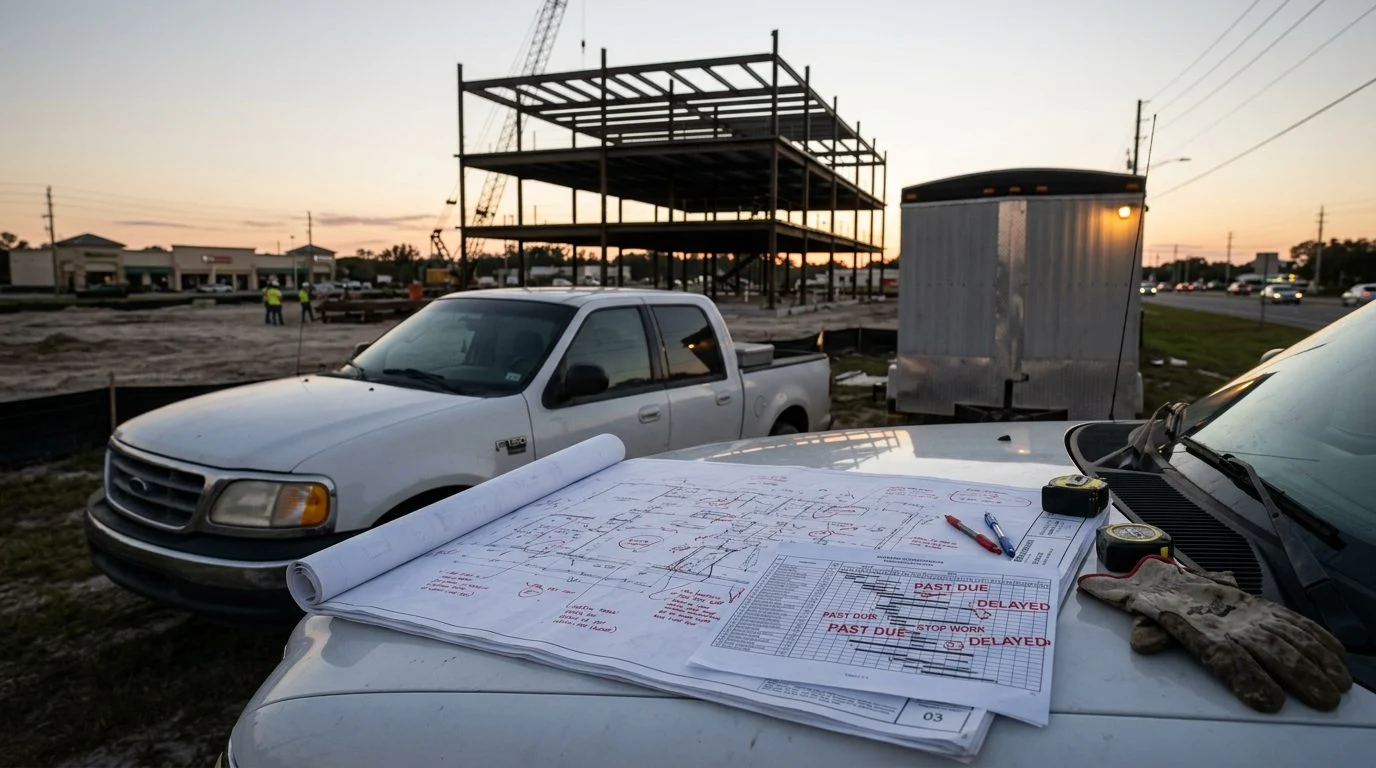
A contractor stopped showing up, and you’ve already paid for work that isn’t finished. That’s a stressful spot, especially when your business, rental property, or home depends on the job.
When a contractor leaves work unfinished or done poorly, an owner may want to review the contract terms, payment records and project correspondence with counsel before deciding on a next step. Start by keeping records of every payment, notice, and change order. This page covers those remedies for business owners, property owners, and family members in Tampa and Hillsborough County.
What Counts as a Contractor Abandoning a Tampa Project?
A contractor abandons a project when work stops for a long time without a valid reason, the contractor stops responding, or the contractor clearly refuses to finish under the contract. Not every stall is abandonment. Each situation below can lead to different remedies, so label the problem early:
- Delay: weather, permit waits, or supply shortages that the contract may allow.
- Change order disputes: a disagreement over added work or price.
- Abandonment: the contractor has walked away and won’t come back to finish.
This page is for Tampa and Hillsborough County business owners, commercial property owners, developers, and family members managing a project for someone else.
If a contractor left your Tampa project half-finished, you may have options worth reviewing, and our team can talk through your contract and records with you. Talk it through with our team — we can walk you through how a situation like yours is usually handled and what your options are.
What Should You Do First After a Contractor Walks Off?
Stop paying and start a written record today. These steps protect your position while you decide what comes next.
- Stop further payments until someone has reviewed the contract terms.
- List every payment with the date, amount, and method used.
- Gather the file: the signed contract, change orders, permits, schedules, invoices, texts, and emails.
- Photograph the site with dates, and write a punch list of incomplete and defective work.
- Check the notice clause. Many contracts say how written notice must be sent and how long the contractor has to fix a problem. That cure period matters before you end the contract.
What Remedies Can You Pursue Under Florida Law?
Negotiated arrangements, such as a takeover agreement, are another possibility to discuss with counsel.
- Termination for breach. Follow the contract’s notice and cure steps first. Skipping them can weaken your claim.
- Cost to finish. A claim may seek the extra cost to complete the work. Keep the original price and any new bids.
- Deposits and overpayments. Money paid for work never performed is often part of the claim.
- Other losses. Some claims reach losses like delayed occupancy or lost rent, depending on the contract and the facts.
- Settlement. A written takeover and completion agreement can set credits and a payment schedule.
Choosing the right legal theory matters. A 2025 Florida appeals court decision explained that a tort claim generally must be independent of the contract breach, as in Frutafino v. Dole Chile. Where an express contract covers the same subject, Williams v. Johnson explains that unjust enrichment claims generally can’t proceed. That’s why many deposit claims are framed under the contract itself. If your contract has a provision allowing attorney’s fees to a party when that party must take action to enforce the contract, Fla. Stat. § 57.105 lets the court also allow reasonable fees to the other party when that party prevails, but only for contracts entered into on or after October 1, 1988.
How Do Liens and Bonds Protect the Property?
Owners who receive notices from people who worked on or supplied a project should keep careful records of them.
- Track every notice. Keep a file of any notice to owner or claim of lien you receive.
- Review deadlines early. Lien timing is often the reason to act fast, even while the dispute is still open.
- Check for a payment bond. Some projects have one. Pull the bond paperwork and read its notice requirements.
- Plan for foreclosure. Lien foreclosure can be one step in a broader contractor dispute.
If a judgment is entered, it can become a lien on real property. That happens when a certified copy is recorded in the county and the address requirement is met, under Fla. Stat. § 55.10.
How Does a Construction Dispute Usually Move Forward?
Most disputes start with a records review and a written demand. They then move toward negotiation, mediation, or a filed case.
- Review the file. Look at the contract, payment history, and project records to identify claims and defenses.
- Send written notice. A demand letter puts the contractor on record and opens talks.
- Negotiate or inspect. Settlement talks or a site inspection often come next.
- Mediate if required. On one party’s request, a court must refer a filed damages case to mediation if the requesting party is willing and able to pay the costs or the costs can be equitably divided between the parties, unless an exception applies. One exception is that the parties agreed to binding arbitration, under Fla. Stat. § 44.102.
- Pick the forum. Actions shall be brought only in the county where the defendant resides, where the cause of action accrued, or where the property in litigation is located, under Fla. Stat. § 47.011 (this rule does not apply to actions against nonresidents).
- Section 45.061’s offer-of-settlement rule does not apply to causes of action that accrue after the effective date of the act. Under Fla. Stat. § 45.061, a written offer of settlement may be served more than 60 days after the summons and complaint are served and at least 60 days before trial (45 days for a counteroffer). Subsection (6), however, provides that the section does not apply to causes of action that accrue after the effective date of this act (ch. 87-249). Fla. Stat. § 45.061 reads: “The offer shall remain open for 45 days unless withdrawn sooner by a writing served on the offeree prior to acceptance by the offeree.” Under Fla. Stat. § 45.061, an offer remains open for 45 days unless withdrawn sooner, but the section states that it does not apply to causes of action that accrue after the effective date of ch. 87-249, so it is not available for any claim that accrued after that date, including a claim arising today.
If your contract requires arbitration, Fla. Stat. § 682.02 makes that agreement valid and enforceable, with limited exceptions. Timelines vary with the facts and the court calendar.
What Time Limits Apply to a Florida Construction Claim?
Florida law sets filing deadlines for construction claims, and the deadline that applies depends on the facts of each matter. When the time period begins to run depends on the facts of each project, so the timing should be reviewed early. Other rules also apply:
- Latent defects: when a defect is hidden, time runs from when it was or should have been discovered.
- Outer limit: the action must be started within seven years after the earliest certificate date or abandonment.
- Counterclaims: these may be filed up to one year after the pleading they relate to is served.
Don’t assume a shorter deadline in your contract controls. A contract clause that sets a shorter period than the statute is void, under Fla. Stat. § 95.03.
Common mistakes hurt claims:
- Paying the final draw without reviewing the work.
- Signing a release without reading it closely.
- Hiring a replacement before documenting the defects.
- Waiting to send written notice.
Not sure what your next step is?
Talk it through with our team — we can walk you through how a situation like yours is usually handled and what your options are.
Why Work With Ayala Law PA on a Contractor Dispute?
Ayala Law PA focuses on business litigation, construction litigation, contractor and subcontractor disputes, and lien foreclosure in Florida courts and arbitration. Eduardo A. Maura is the responsible lawyer for this page. Our team supports the work on each matter, from the records review through settlement or filing.
The firm’s office is at 1646 W Snow Ave, Tampa. The firm represents businesses in Tampa and Hillsborough County in Florida courts and arbitration. Fees depend on the facts of each matter.
Frequently Asked Questions
What can I do if a contractor doesn’t finish a job?
Stop payments, document the work, and send written notice under the contract. Then review termination steps, completion costs, and lien rights.
What kind of lawyer do I need to sue a contractor in Florida?
You need a lawyer who handles construction and contract disputes. Ayala Law PA focuses on those matters, including contractor and subcontractor disputes.
What are common ways a construction contract ends?
Common routes include termination for breach after any cure period, termination the contract allows, and a written mutual agreement to end the deal.
How do I avoid being ripped off by contractors?
Use a written scope and schedule, tie payments to finished work, and keep copies of permits and inspections. Ask for lien waivers with each payment.
Talk With Our Team About Your Project
If a contractor left your project half-finished, you don’t have to sort out the contract, the payments, and the deadlines alone. Call (813) 414-5715 or request a case evaluation so our team can review your contract and project records.



