
Knowing how to legally rescind a contract starts with one question: is there a legal reason to undo the deal? A party seeking rescission must allege that it has rescinded the contract and notified the other party of the rescission, that it offered to restore any benefits it received where restoration is possible, and that it has no adequate remedy at law (Waterside at Boynton Homeowners’ Ass’n v. Southern Homes of Palm Beach, LLC). It is general information, so use it as a map, not as advice on your own deal.
What rescission means and when it applies
To rescind, the moving party must show it has rescinded the contract and notified the other side, and if it received benefits, it should allege an offer to restore them where restoration is possible (Waterside at Boynton Homeowners’ Ass’n v. Southern Homes of Palm Beach, LLC). It is usually considered when the deal was formed with a defect or when the other side’s serious failure justifies ending it. Rescission is an exception to the usual rule that a signed contract stays in force.
Termination is different. Many contracts include a termination clause that lets a party end future performance, often after written notice. Termination looks forward. It does not always undo what already happened, such as money paid or work completed.
Rescission looks back. Among the allegations a rescission claim should include are that the party seeking rescission has rescinded the contract and notified the other party of the rescission, that it offers to restore any benefits it received if restoration is possible, and that it has no adequate remedy at law (Waterside at Boynton Homeowners’ Ass’n v. Southern Homes of Palm Beach, LLC).
For a business, the choice matters. A wrong move can leave you owing money or weaken a claim you could have brought instead.
If a contract you signed now feels like a mistake or a bad deal, you don't have to work out your options alone, and our team can talk it through with you. Talk it through with our team — we can walk you through how a situation like yours is usually handled and what your options are.
Legal grounds that can support rescission
Rescission usually needs a recognized legal ground. The most common grounds involve how the deal was made or whether one side could fairly agree to it.
- Mutual mistake: both sides were wrong about a basic fact the deal rested on.
- Unilateral mistake: only you were wrong, but the other side knew or should have known about the error.
- Ratification occurs when a party entitled to rescind a voidable contract fails to do so after the discovery of facts that warrant a rescission (Flaherty v. Flaherty).
- Material breach or failed purpose: the other side failed in a serious way, or the deal’s main purpose can no longer happen.
These grounds don’t fit every deal. Look at the facts with care before you claim any ground.
Review the contract and act promptly
Start by reading the signed contract closely, then act quickly once you know the facts. Delay can hurt your position.
Look for the termination clause, the notice clause, any cure period (a window to fix the problem), the dispute resolution clause, the governing law clause, and the integration or entire agreement clause. An integration clause says the written contract is the whole deal.
Timing rules are strict in places. Under Fla. Stat. § 95.031(2)(a), a fraud claim generally runs from when the facts were discovered or should have been discovered with due diligence, but no later than 12 years after the fraud. Under Fla. Stat. § 95.03, a contract clause that sets a shorter time to begin an action than the statute allows is void, so don’t rely on one.
For goods, the buyer’s duty is sharper. Under Fla. Stat. § 672.607(3)(a), once a buyer has accepted the goods, it must notify the seller of a breach within a reasonable time after it discovers or should have discovered the breach, or be barred from any remedy.
Waiting also gives the other side time to argue you accepted the deal. Quick, documented action keeps your options open. Note when you found the problem and what each side said about it.
Restore what you received
Rescission generally means giving back what you received, or offering to. If you received goods, materials or services, you may need to return them or account for their value.
Construction work is harder. A contractor who finished part of a job cannot hand back the building. The value of completed work and materials often becomes part of the dispute, and that value must be addressed.
Liens add risk for owners.
Put any offer to restore in writing. A written offer shows you acted in good faith and gives a clear record. Keep copies of payment records, delivery receipts and invoices so you can show what changed hands.
Send a written notice of rescission
A notice of rescission is a written statement that you are cancelling the contract and why. It is often called a letter of rescission, and it puts the other side on clear notice.
A solid notice usually includes:
- the contract and its date
- the legal ground you rely on and the facts behind it
- what you are returning or offering to return
- a clear statement that you are rescinding the contract
- delivery by the method the contract’s notice clause requires
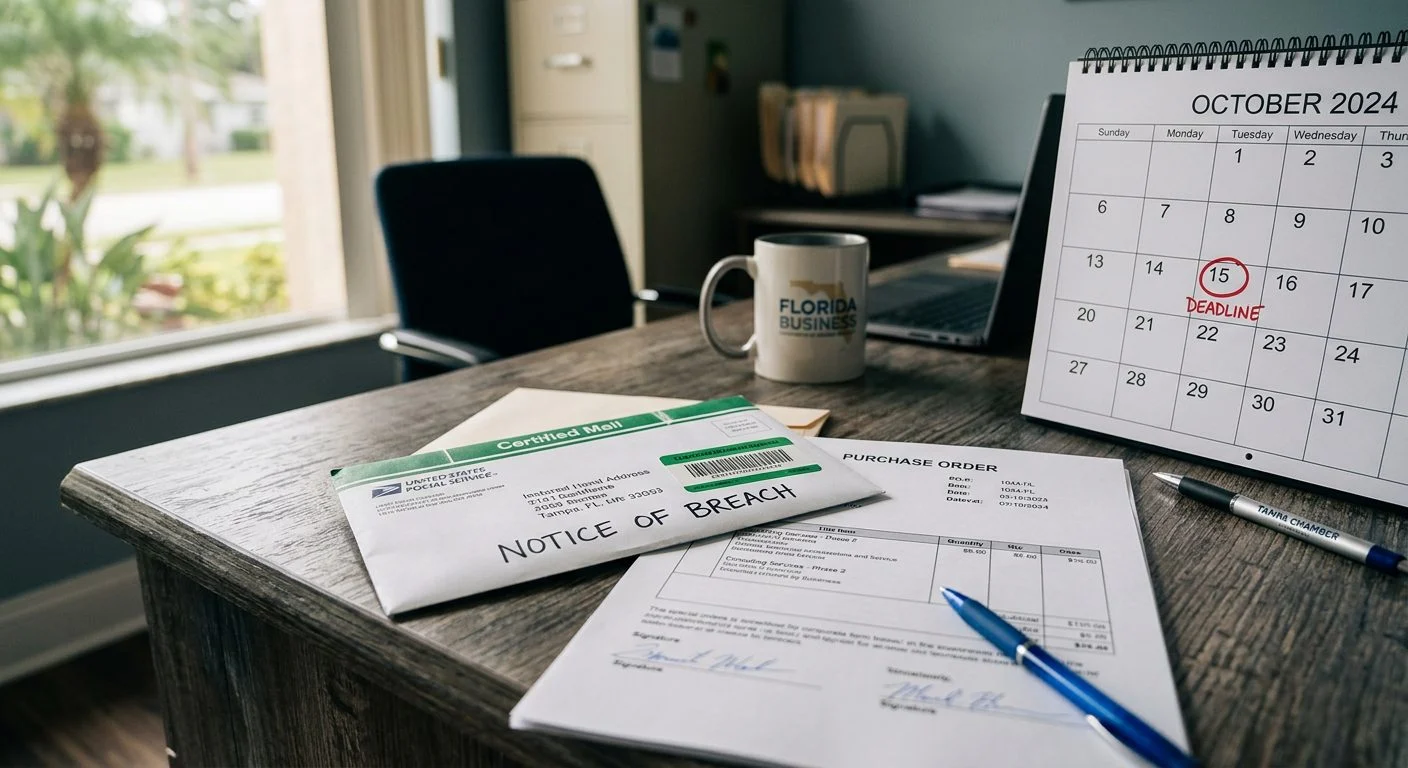
Wording matters. A notice that overstates facts or admits too much can be used against you later. Draft it carefully instead of rushing it out. If the contract allows, send it in a way you can prove, such as certified mail or another tracked method.
Online signing creates a question too. Under Fla. Stat. § 668.004, an electronic signature may be used to sign a writing and has the same force and effect as a written signature, unless other law provides otherwise. Assume an e-signed contract is as binding as a paper one.
Rescission versus suing for breach
Rescission asks a court or the other side to undo the contract.
You often have to choose between them. Insisting the contract was never valid can conflict with claiming damages under the same deal. Pick the route that fits your facts and goals before you send a notice.
Dispute clauses matter too. Under Fla. Stat. § 682.02(1), an agreement in a record to arbitrate existing or future disputes is valid, enforceable and irrevocable, except on grounds that exist to revoke any contract.
Timing can pause during arbitration. Under Fla. Stat. § 95.051(1)(g), the running of limitations is tolled by the pendency of an arbitral proceeding about the dispute.
Our guide on contract disputes in Florida covers the wider picture. Readers weighing money damages can also look at our page on suing for breach of contract in Florida.
Not sure what your next step is?
Talk it through with our team — we can walk you through how a situation like yours is usually handled and what your options are.
Common defenses to rescission in Florida
The other side can fight rescission with defenses that focus on your conduct and the contract’s wording.
- Ratification: you kept the benefits or acted as if the contract still applied after learning the facts.
- Unreasonable delay: waiting too long can prejudice the other side and weaken your position.
- Inability to restore: you cannot give back what you received, or the deal has already been largely performed.
- Waiver: you gave up a right by word or conduct.
Each of these defenses turns on what you did after the problem surfaced, so a clear timeline helps.
Fee exposure is real too. Under Fla. Stat. § 57.105(1), a court shall award a reasonable attorney’s fee, to be paid to the prevailing party in equal amounts by the losing party and the losing party’s attorney, on a claim or defense the losing party knew or should have known was not supported by the material facts or current law. If a contract entered into on or after October 1, 1988 allows fees to the party enforcing it, Fla. Stat. § 57.105(7) lets the court allow fees to the other party when it prevails.
The strength of any defense depends on the facts of your deal.
Frequently asked questions about rescinding a contract
Here are short answers to common questions about how to legally rescind a contract.
What are the rights to rescind a contract?
A business seeking rescission should be prepared to allege that it has already rescinded the contract and notified the other party to the contract of that rescission (Waterside at Boynton Homeowners’ Ass’n v. Southern Homes of Palm Beach, LLC). You also need to act promptly and offer to return what you received.
What are the legal grounds for canceling a contract?
If your business received benefits under the contract, it should also allege an offer to restore those benefits to the party that furnished them, if restoration is possible (Waterside at Boynton Homeowners’ Ass’n v. Southern Homes of Palm Beach, LLC). A termination clause in the contract is a separate route.
How to legally cancel a contract?
As the Fourth District Court of Appeal explained in Waterside at Boynton Homeowners’ Ass’n v. Southern Homes of Palm Beach, LLC, quoting earlier Florida decisions, a moving party that has received benefits from the contract should further allege an offer to restore those benefits to the party that furnished them, if restoration is possible. The right route follows from the contract’s own terms.
Can I rescind a contract after work has started?
Possibly, but partly finished work makes restoration harder. Work done and materials used often need to be valued and addressed in the dispute.
Talk with Ayala Law PA about your contract
If a signed contract now looks like a mistake, was built on false statements, or traps you during a payment or performance fight, you’re carrying a lot right now. You don’t have to sort out your options alone.
Ayala Law PA handles business litigation, commercial and contract disputes, shareholder and partnership disputes, construction litigation, real estate litigation and international trade litigation in Florida courts and arbitration. Clients in Tampa, Hillsborough County, Brandon, Riverview, Plant City, Temple Terrace and the wider Tampa Bay area are served from the firm’s only office, in Tampa.
Eduardo A. Maura is the responsible lawyer for this page. Our support staff handle scheduling and intake. Bring the contract, the notices and your payment records to a first conversation so the discussion stays focused.
Case evaluations involve a fee, which we explain before any engagement begins. We do not promise any particular outcome.
To talk about your contract, call (813) 414-5715 or send a request through our contact page.



