
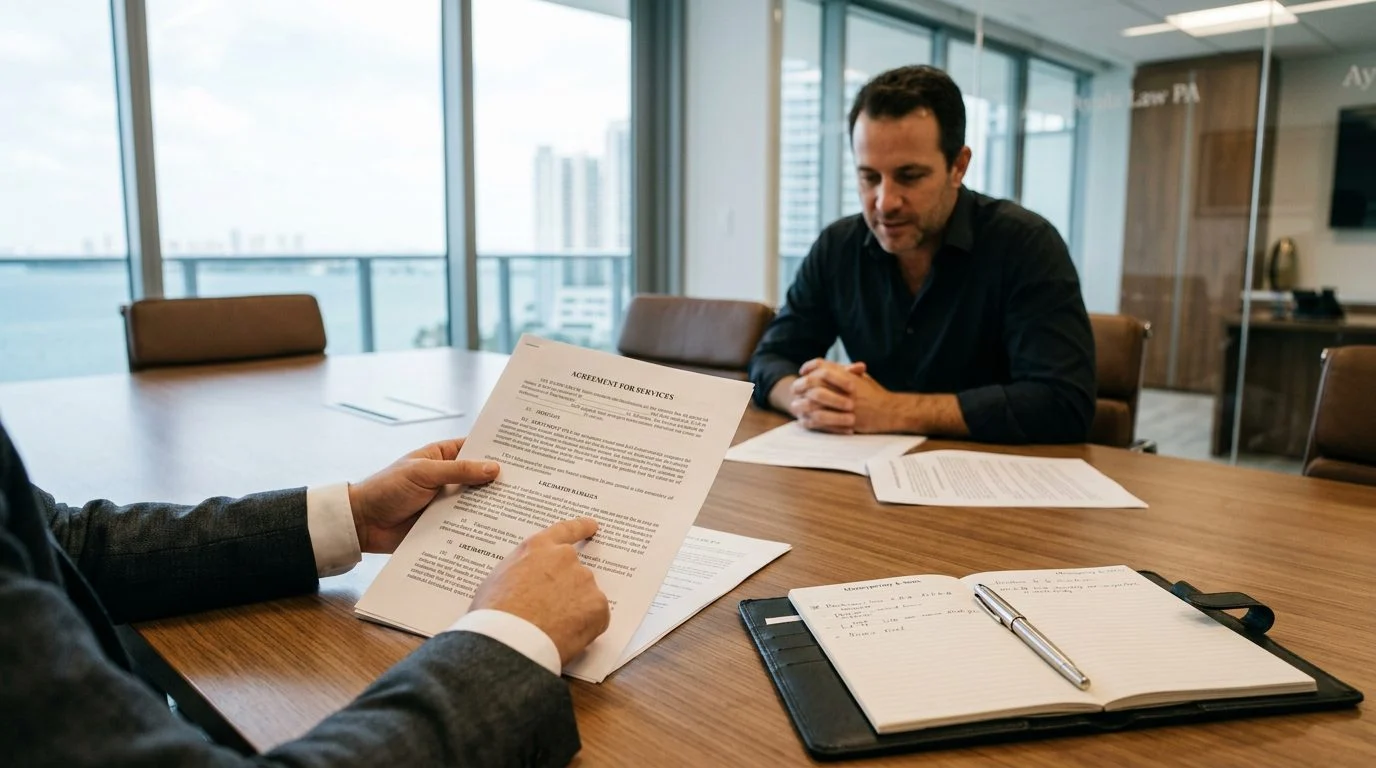
A liquidated damages clause is a contract term that sets the amount one party pays if it breaks the deal. If a liquidated damages clause dispute has reached your desk, this page explains the test, the first steps to take, and how these cases usually move. Ayala Law PA focuses on business and contract litigation for businesses in Tampa, Hillsborough County, and the wider Tampa Bay area.
What Is a Liquidated Damages Clause, and Who Does It Affect?
A liquidated damages clause sets, in advance, the money owed if a party breaks the contract. The amount is fixed when the deal is signed.
Parties use these clauses when harm from a breach is hard to measure later. Construction delay is a common example. Lost rent, extra overhead, and missed sales are hard to prove after a project runs late. So the contract may say the contractor pays a set sum for each day past the completion date.
Here is a hypothetical. A subcontract says the sub pays $1,000 for each day it misses a milestone. If the sub misses by ten days, the clause points to $10,000.
Two groups feel the impact:
- The party that may pay. It needs to know the sum exists and how it would apply.
- The party that would collect. It needs to know whether the sum will hold up if challenged.
Compare this with actual damages. The clause swaps that proof for a fixed number, but only if a court accepts it.
If a demand letter over a per-day sum has landed on your desk, you don't have to work out the clause alone. Our team can talk through your contract with you. Talk it through with our team — we can walk you through how a situation like yours is usually handled and what your options are.
How Do Florida Courts Decide Between an Estimate and a Penalty?
Courts commonly weigh these points:
- Were the damages hard to measure when the contract was made?
- Does the sum bear a reasonable relation to the harm the parties expected?
- Does one flat amount apply to very different breaches, such as a missed date and a total walkaway?
- What was the bargaining context? Were both sides negotiating, or was it a take-it-or-leave-it form?
A clause called “liquidated damages” can still fail.
Florida’s high court applies a related fairness test to contract terms. In Basulto v. Hialeah Automotive, a case about an arbitration agreement, the court held that a term is refused only when procedural and substantive unfairness are both present.
How a court rules depends on the facts of each contract and the record.
Where Do These Clauses Show Up in Tampa Bay Business Contracts?
These clauses appear most often in construction contracts, supply and service agreements, real estate purchase contracts, and shareholder or partnership agreements.
- Construction: daily delay sums in prime contracts and subcontracts, plus change orders that push back a schedule.
- Supply and service: per-day or per-incident sums for late delivery, missed installation dates, or missed service levels.
- Real estate: deposit forfeiture or closing default terms in purchase and sale agreements.
- Shareholder and partnership: buyout or breach amounts triggered when an owner leaves or breaks a noncompetition promise.
Before you sign, ask a few plain questions. Is the amount tied to a real estimate of harm? Does it fit different breaches? What notice and cure steps come first? Which dispute process applies?
Dispute terms matter. Florida enforces a written agreement to arbitrate, and Fla. Stat. § 682.02 makes such agreements valid, enforceable, and irrevocable except upon a ground that exists at law or in equity for the revocation of a contract. Under § 682.03, a court can’t refuse to order arbitration just because the claim lacks merit.
Contractors and subcontractors should also confirm licensing. The Construction Industry Licensing Board publishes licensing requirements and license verification.
What Should You Do First When a Clause Is Invoked?
Your first steps are to preserve records, read the notice and dispute terms, and hold off on withholding money on your own.
- Keep originals. Save the contract, change orders, schedules, notices, and emails in their original form.
- Find the steps. Check for any written notice, cure period, or dispute procedure before you pay or withhold.
- Avoid self-help. Deducting the stated sum from payments on your own can create a second dispute.
- Write down your losses. Record actual losses now, with dates, invoices, and rental or payroll records. You may need them if a court treats the sum as a penalty.
- Calendar the deadlines. Florida’s limitations period for an action on a written contract is generally five years under § 95.11. A contract provision that sets a shorter period is void under § 95.03.
Contract notice steps can run on their own clock. Read them early, especially in a liquidated damages clause dispute.

How Does a Liquidated Damages Dispute Typically Proceed?
Most business disputes move from review to a demand or negotiation, then to a court filing or arbitration. Each case moves at its own pace.
- Review. The contract, notices, and performance record are checked against the clause.
- Demand or negotiation. Many business disputes settle here. Once a damages case is filed, § 44.102 requires a court, on one party’s request, to refer it to mediation if the requesting party is willing and able to pay the mediation costs or the costs can be equitably divided between the parties, subject to exceptions. Under Fla. Stat. § 44.102(2)(a), a court, under rules adopted by the Supreme Court, must upon request of one party refer to mediation any filed civil action for monetary damages, provided the requesting party is willing and able to pay the costs of the mediation or the costs can be equitably divided between the parties, unless one of the statute’s listed exceptions applies.
- Filing. Under § 47.011, actions must be brought in the county where the defendant resides, where the cause of action accrued, or where the property in litigation is located. This section does not apply to actions against nonresidents. If the contract requires arbitration, the process follows that agreement.
- Discovery. The fight often centers on pre-signing estimates, bargaining history, and actual losses.
- Motions, then trial or award. Timing varies with complexity.
The offer procedure in § 45.061 does not apply to causes of action that accrue after the statute’s effective date, so for a claim of that kind in a civil action for damages filed in Florida courts, the offer rules in § 768.79 are the provision to review. Section 45.061 itself does not apply to any class action or shareholder derivative suit, or to matters relating to dissolution of marriage, alimony, nonsupport, eminent domain, or child custody.
Why Readers Work With Ayala Law PA on These Disputes
Ayala Law PA focuses on business litigation, commercial litigation, contract disputes, shareholder disputes, construction litigation, real estate litigation, and international trade litigation.
Eduardo A. Maura is the responsible attorney for this page. The firm’s lawyers handle these matters with support staff.
The work is concrete. The firm reviews the clause against the contract, analyzes the penalty question, evaluates whether notice steps were followed, and litigates or arbitrates the dispute.
The firm’s office is at 1646 W Snow Ave, Tampa, Florida. It serves businesses in Tampa, Hillsborough County, Brandon, Riverview, Plant City, Temple Terrace, and the wider Tampa Bay area.
Every contract and record is different. Some matters may be referred to another lawyer or firm.
Not sure what your next step is?
Talk it through with our team — we can walk you through how a situation like yours is usually handled and what your options are.
Frequently Asked Questions
Short answers to common questions about liquidated damages clauses in Florida business contracts.
What is a liquidated damages clause?
It is a pre-agreed sum owed on breach.
Can a court refuse to enforce the stated amount?
Yes.
Do I have to pay before the dispute is resolved?
Check the notice, cure, and dispute terms before you pay or withhold anything.
How are damages calculated for breach of contract?
Actual damages come from proof of real losses. A liquidated sum is set by the clause, if a court enforces it.
Does an offer of judgment matter?
Yes. It can shift attorney’s fees under Florida law, so review it promptly.
How do attorney’s fees work in these disputes?
Each side generally pays its own fees unless a contract or statute says otherwise, as stated in Price v. Tyler. The firm explains fee terms directly when you call.
Talk With Ayala Law PA About Your Contract
A demand letter citing a per-day or fixed sum can leave a business owner feeling rushed. That reaction makes sense.
You may be the person who signed the contract, or the one who now has to answer for it. Either way, the clause, the notice, and the deadlines are the place to start.
Bring the contract, the notice you received, and a short timeline of the project or deal. Describe the clause in your own words so the firm can map your situation against the test above.
To book a case evaluation, call Ayala Law PA at (305) 570-2208 or use the contact page. The office is at 1646 W Snow Ave, Tampa, Florida.



