
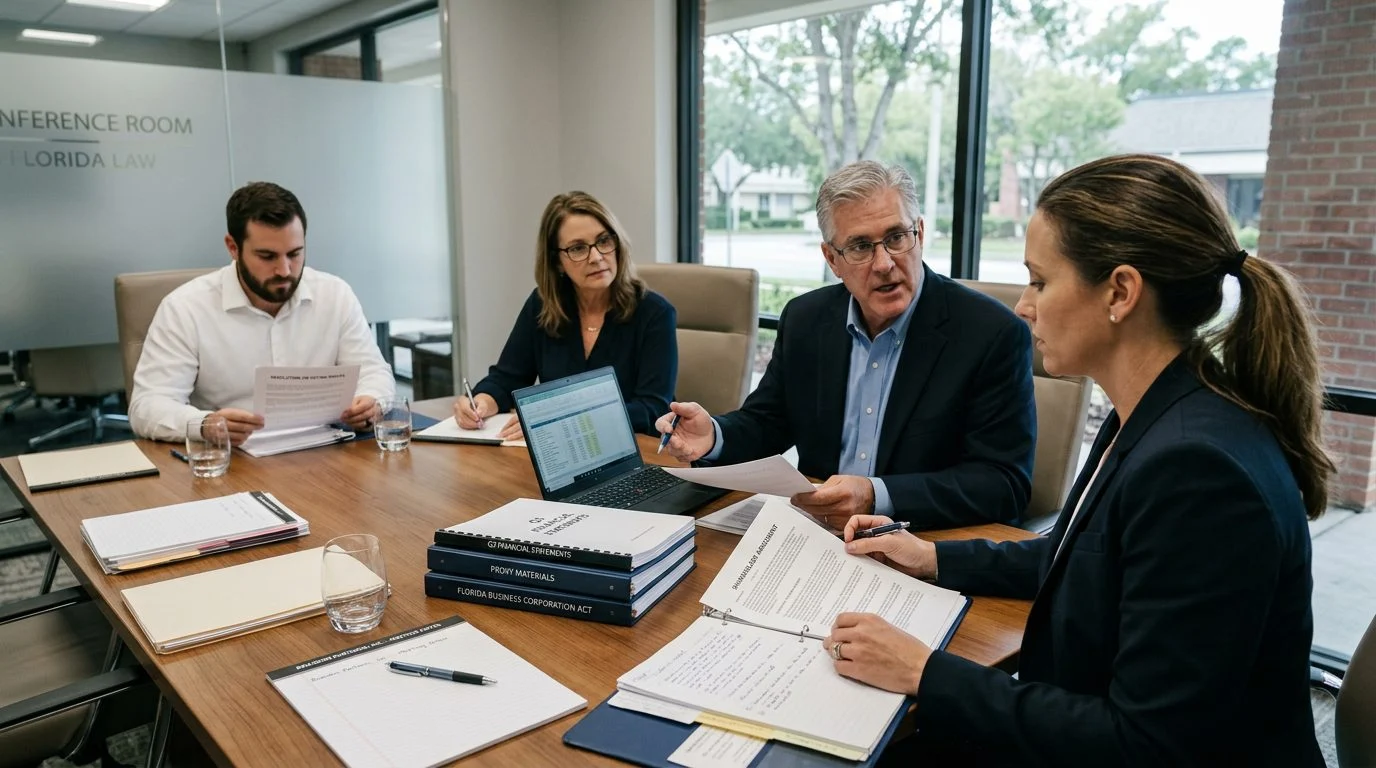
Shareholder Disputes in Brandon: What This Page Covers
Shareholder disputes in Brandon usually come down to four things: records, money, control and ownership. A shareholder dispute is a disagreement between a company’s owners over how it is run, what it pays out, or who owns what.
Brandon is in Hillsborough County. Business owners in Brandon, like those across Tampa Bay, often ask how their company’s formation documents affect a dispute. Disputes about them are decided in Florida courts or, when the agreements call for it, in arbitration. This page explains the common issues and the Florida rules that frame them.
This is general information, not advice on your situation. For a specific dispute, the answer turns on your company’s documents and the facts. Co-owners often know each other well, so a conflict can feel personal. Each dispute turns on its own facts, so the specific documents and available options matter. Our parent guide on minority shareholder rights covers the wider Florida framework.
Not sure what your next step is?
Talk it through with our team — we can walk you through how a situation like yours is usually handled and what your options are.
Disputes That Commonly Arise in Brandon-Area Companies
Most shareholder disputes fall into a few familiar patterns. Each one calls for a different first step and a different set of documents.
- Records. A shareholder asks for books, minutes or financial statements and gets delayed answers, or none at all.
- Money. Owners disagree about distributions, salaries paid to insiders, or company expenses that look personal.
- Control. An owner is pushed out of management, loses a board seat, or is left out of decisions that affect the company.
- Ownership. New shares dilute an owner’s stake, or owners argue about what the company is worth.
- Buy-outs. Owners dispute whether a buy-sell agreement has been triggered, and which price and terms apply.
Many of these problems overlap with contract disputes. The articles, bylaws and shareholder agreement are the written rules owners agreed to. A broken promise in those documents can be a contract problem too. Sorting out which problem you have is the first real task.
Florida Statutes That Frame Shareholder Rights
Florida’s corporate statute gives shareholders certain rights that a company’s own rules cannot erase. The Florida Division of Corporations explains how Florida business entities are structured, including partnerships and corporations.
Inspection of records. A shareholder of a corporation is entitled to inspect and copy, during regular business hours at the corporation’s principal office, any of the records of the corporation described in s. 607.1601(1), excluding minutes of meetings of, and records of actions taken without a meeting by, the corporation’s board of directors and board committees, if the shareholder gives the corporation written notice of the demand at least 5 business days before the date the shareholder wishes to inspect and copy (Fla. Stat. § 607.1602). The inspection happens during regular business hours at the principal office (Fla. Stat. § 607.1602). Board minutes are excluded from that first rule. The articles and bylaws cannot abolish or limit this right. The company may still deny a demand made for an improper purpose. If a company refuses certain records, a circuit court can order inspection. For records under § 607.1602(1), the court must also order the company to pay the shareholder’s reasonable attorney fees; for records under § 607.1602(2), the court must do so unless the company establishes that it refused inspection in good faith because it had a reasonable basis for doubt about the shareholder’s right to inspect or copy the records demanded, or because it required reasonable confidentiality restrictions that the shareholder refused to accept (Fla. Stat. § 607.1604).
Judicial dissolution. A circuit court may dissolve a corporation or order another remedy, as the statute provides. A deadlock is one such situation. A shareholder agreement can set its own deadlock sale. That sale can apply in place of a court order, if its steps are carried out within the time limits it sets.
Derivative claims. A shareholder who sues on the company’s behalf must have held shares when the action began. That shareholder must also have held them when the conduct occurred, or received them by transfer or by operation of law (Fla. Stat. § 607.0741).
Shareholder agreements. These can govern matters such as voting, who serves as directors and how deadlocks are broken. The statute does not invalidate other valid agreements among owners. Your articles, bylaws and any shareholder agreement often control alongside the statute. Read them first.
Negotiation and Mediation as a First Step
Most shareholder disputes start with a written demand and a direct conversation between owners. A written demand creates a clear record of what you asked for and when you asked.
Mediation is a structured process. A neutral mediator helps the owners talk through the issues and try to reach a written agreement. Florida law requires courts to refer many civil money cases to mediation when one party asks. The requesting party must be willing and able to pay, or the costs must be divided fairly. Exceptions apply, including an agreement to binding arbitration (Fla. Stat. § 44.102). Written communications in mediation, other than a signed settlement, are exempt from the public records requirements of chapter 119.
Preparation matters. Gather your documents, write down your numbers, and decide what you need from the other owners. A negotiated buy-out, a governance agreement or a records-access agreement can settle a dispute without a trial. Whether that works turns on each owner’s position and the documents they signed.
Where Brandon Shareholder Disputes Are Resolved
Where a case is filed affects the rules that apply, so the location question matters early. Venue for a judicial dissolution case lies in the circuit court in the applicable county (Fla. Stat. § 607.1431).
For a general lawsuit, an action must be brought in the county where the defendant resides, where the cause of action accrued, or where the property in litigation is located (Fla. Stat. § 47.011). That section does not apply to actions against nonresidents. For a Brandon owner, the practical questions are where the other owner lives, where the problem arose, and where the company’s property sits.
Some owners agree to arbitration instead of court. Florida law says a written agreement to arbitrate existing or future disputes is valid, enforceable and irrevocable. The exception is a ground that exists in law or equity for revoking a contract (Fla. Stat. § 682.02). If your governing agreement requires arbitration, its terms control the process. The right forum and remedies turn on the facts of each dispute.
Documents Brandon Owners Should Gather Before Speaking With a Lawyer
Gathering your papers early makes the first conversation more useful. Bring these items:
- Articles of incorporation or organization, bylaws or operating agreement, and any shareholder or buy-sell agreement.
- Minutes, written consents, stock ledger entries, and notices about meetings or decisions.
- Financial statements, tax returns, bank records, and records of distributions or insider payments.
- Written messages with co-owners, including emails and text messages about the dispute.
- A short timeline of key dates: requests made, meetings held, and payments you question.
Keep every message. Do not delete texts or emails about the dispute.
Timing matters. Florida sets filing deadlines by type of claim (Fla. Stat. § 95.11). Some steps carry their own short clocks. For example, in a dissolution case brought by a shareholder under s. 607.1430(1)(b), the corporation may elect to buy all of the petitioner’s shares at fair value, or, if the corporation does not elect, one or more other shareholders may do so, by filing the election within 90 days after the petition is filed, or later if the court allows (Fla. Stat. § 607.1436).
Not sure what your next step is?
Talk it through with our team — we can walk you through how a situation like yours is usually handled and what your options are.
Frequently Asked Questions About Shareholder Disputes in Brandon
Can a minority shareholder in Brandon see the company’s financial statements?
Florida law gives shareholders a right to inspect and copy certain records, including financial statements, if they meet the requirements of subsection (3) and give the corporation written notice at least 5 business days in advance. The exact scope depends on the demand and the company’s records.
Does a shareholder agreement override the statute?
Not entirely. The articles and bylaws cannot abolish or limit the statutory inspection right, but shareholder agreements can govern many other matters.
Is mediation required before a lawsuit in Florida?
Any filed civil action for monetary damages must be referred to mediation when one party asks, provided the requesting party is willing and able to pay the costs of the mediation or the costs can be equitably divided between the parties, unless an exception applies (Fla. Stat. § 44.102).
Where should a Brandon shareholder file a lawsuit?
Venue generally depends on where the defendant resides, where the claim arose, or where the disputed property sits (Fla. Stat. § 47.011).
Ayala Law PA and Your Next Step in a Brandon Shareholder Dispute
Ayala Law PA focuses on business litigation, including shareholder disputes, commercial litigation, contract disputes, construction litigation, real estate litigation and international trade litigation. Eduardo A. Maura is the lawyer responsible for this page. The firm’s only office is at 1646 W Snow Ave in Tampa, Florida. The firm serves businesses in Brandon and Hillsborough County, and its only office is in Tampa. The firm serves businesses in Brandon, Riverview, Plant City, Temple Terrace and the wider Tampa Bay area.
Fee terms, including any charge for a case evaluation, are explained before any engagement.
If you’ve been shut out of your company’s records, or you face a buy-out or removal from management, call (305) 570-2208. You can also request a case evaluation through our contact page. Describe your situation and the documents you have.



