
Shareholder disputes in Florida usually start when an owner loses access to money, information, or a voice in how the company runs. Florida law gives shareholders specific tools, and each one has its own deadlines. This guide walks through the choices an owner faces next, from a records demand to a buyout or a court petition. It is written for owners of closely held companies in Tampa, Hillsborough County, and across the Tampa Bay area.
What Shareholder Disputes in Florida Usually Look Like
Most of these disputes happen in closely held companies. These are businesses owned by a small group, often family members or longtime partners. Written terms are often thin, so a disagreement can grow before anyone puts it on paper.
Common patterns include a shareholder pushed out of management, information held back, and distributions stopped while the owners still draw salaries. Board deadlock and dilution of an owner’s stake show up often, too.
Warning signs usually come first. Meetings get skipped or moved. Locks change. Bank access gets cut off. New shares get issued without the notice you expected. When you see these signs, write down what happened and when.
If a co-owner has cut off your access or a buyout offer needs an answer soon, call (305) 570-2208 or book a case evaluation with our team. Talk it through with our team — we can walk you through how a situation like yours is usually handled and what your options are.
How Florida Law Frames a Shareholder’s Rights
It gives shareholders a right to inspect records, a path to court when owners cannot agree, and tools to challenge conduct that harms the company.
Your company’s articles, bylaws, and any shareholder agreement matter too. An agreement can change many default terms. But the inspection right cannot be abolished or limited by the articles or bylaws. Under Florida law, a shareholder may inspect and copy certain corporate records during regular business hours if the shareholder gives the corporation written notice of the demand at least 5 business days in advance, and for the broader records the demand must also be made in good faith, for a proper purpose, describe with reasonable particularity the shareholder’s purpose and the records the shareholder desires to inspect, and the records must be directly connected with that purpose.
The result of any claim turns on the facts. Those facts include the company’s documents, its records, and what the people involved actually did. Two disputes that look alike can turn on very different paperwork.
Options a Shareholder Can Pursue
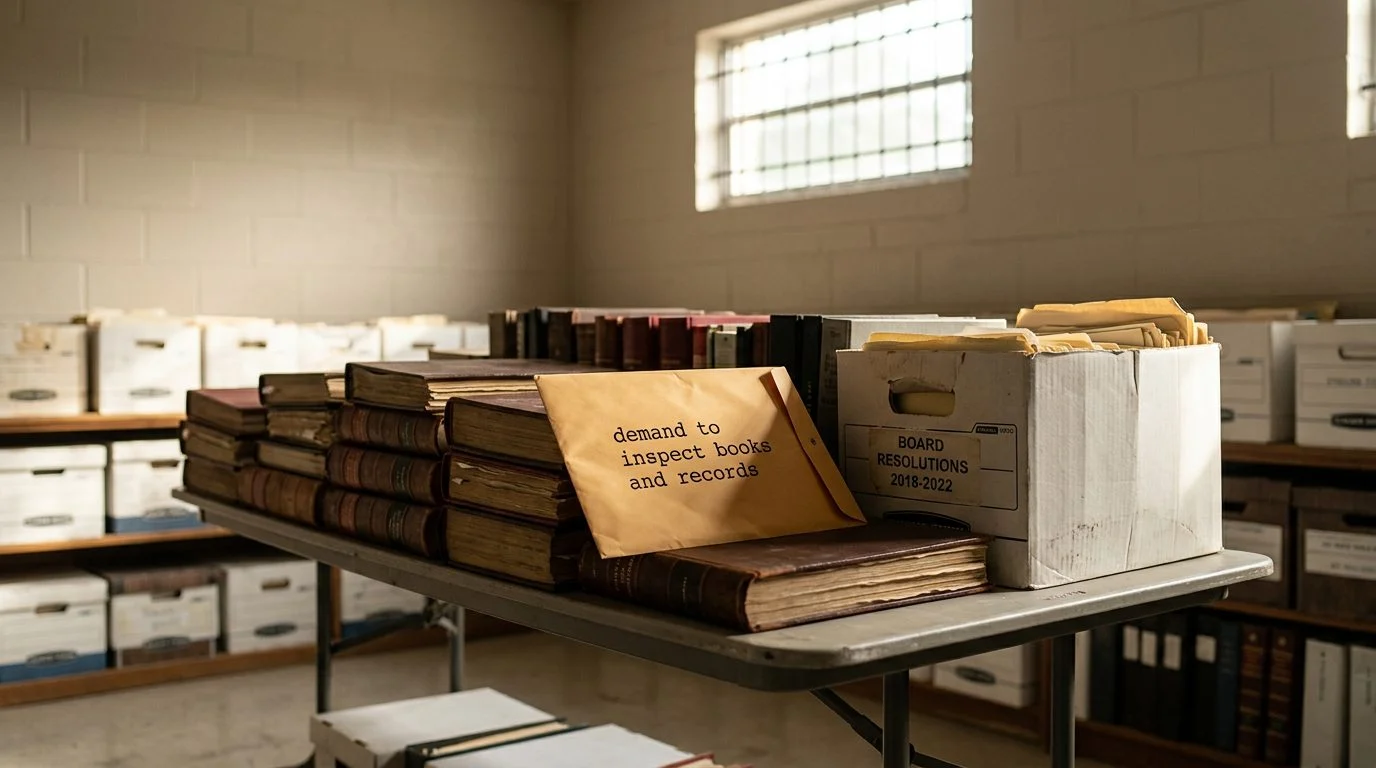
Most shareholders start with a written records demand. That step is often the fastest way to learn what the company has actually done. From there, the path may lead to a buyout talk, a court petition, or a claim.
Records demand
You can inspect and copy the basic records at the corporation’s principal office during regular business hours, excluding minutes of meetings of, and records of actions taken without a meeting by, the corporation’s board of directors and any board committees, and other records at a reasonable location specified by the corporation. You must give written notice at least 5 business days before the inspection date. Broader records, such as accounting records, require a demand made in good faith and for a proper purpose that describes with reasonable particularity your purpose and the records you want, and the records must be directly connected with that purpose. If the company refuses, the circuit court’s power to compel production of corporate records for examination exists independently of this chapter, as provided in s. 607.1602(7)(b), provided that, in the case of production of records described in subsection (2) at the request of the shareholder, the shareholder has met the requirements of subsection (3). If a court orders inspection of the basic records under s. 607.1602(1), s. 607.1604(1) requires the court to also order the corporation to pay the shareholder’s expenses, including reasonable attorney fees. The corporation may impose reasonable restrictions on the disclosure, use, or distribution of, and reasonable obligations to maintain the confidentiality of, the records described in s. 607.1602(2), as provided in s. 607.1602(4). If a corporation does not allow a shareholder to inspect and copy required records, the shareholder may ask the circuit court in the applicable county to order inspection and copying, and the court may order the corporation to pay the shareholder’s reasonable attorney fees.
Negotiated buyout
Many disputes end with one owner’s shares sold. The hard part is usually the price. In a dissolution proceeding brought by a shareholder, the corporation or other shareholders may elect to buy the petitioning shareholder’s shares at fair value. If the parties can’t agree, the court sets fair value as of the day before the petition was filed, unless another date fits better. In a dissolution proceeding brought by a shareholder, the corporation or one or more shareholders may elect to buy the petitioning shareholder’s shares at fair value.
Judicial dissolution
A circuit court may dissolve a corporation under s. 607.1430(1), or order another remedy under s. 607.1434. Fla. Stat. § 607.1434 In a proceeding under s. 607.1430, the court may, as an alternative to dissolution and upon a showing of sufficient merit, appoint a receiver or custodian during the proceeding, appoint a provisional director, order a purchase of the petitioning shareholder’s shares, or make any other order or grant any equitable relief other than dissolution that it deems appropriate.
Direct and derivative claims
A direct claim concerns harm to you personally. A derivative claim is brought for harm to the company. Derivative claims have strict rules. Under s. 607.0742, the complaint must be verified and must include particularized allegations about demand. Fla. Stat. § 607.0742 A complaint in a proceeding brought in the right of a corporation must be verified.
Evidence and Timing Steps Owners Take Early
Start saving evidence before anyone changes it. Keep bank statements, tax returns, board minutes, emails, text messages, and the stock ledger. Build a dated timeline of meetings, distributions, salary changes, and messages with co-owners.
Avoid moving company money, signing new agreements, or sending angry messages without advice. Those moves can affect later claims. Watch the clock, too. The 5-business-day notice rule and the 90-day windows are short. A missed date can cost you options.

How Shareholder Agreements and Buy-Sell Terms Change the Picture
A signed shareholder agreement can shape much of a dispute. A compliant agreement can transfer management authority, including how deadlocks are resolved. It can also set a deadlock-breaking mechanism instead of judicial dissolution. Fla. Stat. § 607.0732 The agreement’s existence or performance is not, by itself, a ground for personal liability for company debts.
Look for buy-sell terms, rights of first refusal, drag-along and tag-along rights, and deadlock clauses. Each one can control what happens next. Arbitration clauses matter too. Under Florida’s arbitration statute, an agreement in a record to arbitrate a dispute is valid and enforceable, except on grounds that allow any contract to be revoked. Read the signed document itself, not a summary or your memory of it.
Where Tampa Bay Shareholder Disputes Are Heard
A suit must be brought in the county where the defendant resides, where the cause of action accrued, or where the property in litigation is located. Under Fla. Stat. § 47.011, actions must be brought only in the county where the defendant resides, where the cause of action accrued, or where the property in litigation is located, although this section does not apply to actions against nonresidents. The facts decide where a claim fits. If an agreement requires arbitration, the dispute may go there instead.
Ayala Law PA’s office is at 1646 W Snow Ave, Tampa, FL. The firm serves businesses in Tampa, Brandon, Riverview, Plant City, Temple Terrace, and across Hillsborough County. Eduardo A. Maura is the lawyer responsible for this page. Our team supports the work with scheduling and records.
Not sure what your next step is?
Talk it through with our team — we can walk you through how a situation like yours is usually handled and what your options are.
Talk With Ayala Law PA About Your Shareholder Dispute
Shareholder disputes move on set dates, so early questions matter. Here are the answers most owners ask first.
Common questions
How much notice does a Florida shareholder need before inspecting records?
At least 5 business days of written notice for the basic records.
Can a shareholder sue on the company’s behalf?
Section 607.1602 gives a shareholder of a corporation the right to inspect and copy certain records; it does not set the standing rules for a derivative proceeding.
Can a court order a company to open its books?
Yes, the circuit court can order inspection of the basic records at the company’s expense.
If a co-owner has cut off your access, distributions have stopped, or a buyout offer needs an answer, call (305) 570-2208 or book a case evaluation with our team. Case evaluations carry a fee, and our team explains the fee terms when you reach out.



