

Examples of Minority Shareholder Oppression in Florida Businesses
Common examples of minority shareholder oppression include diluting a minority owner’s stake, restricting share sales, setting an unfair buyout price, blocking access to company records, pushing out an owner who works in the business, and withholding distributions while insiders get paid.
Each one can hurt an owner with a smaller share of a closely held company. Some are not outright fraud, which is why owners often struggle to name them. This page walks through each pattern in plain language and points to the Florida rules that apply. It does not decide whether any particular set of facts is oppression.
Ayala Law PA concentrates in commercial and shareholder disputes for businesses and owners in Tampa, Hillsborough County and the wider Tampa Bay area.
Not sure what your next step is?
Talk it through with our team — we can walk you through how a situation like yours is usually handled and what your options are.
What is minority shareholder oppression?
Minority shareholder oppression is conduct by the people who control a company that unfairly harms an owner with a smaller stake. It often happens without theft, and it usually strikes at the owner’s expectations and money.
In a closely held company, owners often expect to share in profits, have a voice in decisions, and keep a role they were promised. When controlling owners break those expectations in a way that hurts the minority owner, that is the core of an oppression dispute.
Florida’s corporate statute does not list “oppression” as a separate lawsuit. Instead, the Florida Business Corporation Act, Chapter 607, gives shareholders specific grounds and remedies. One example is the list of grounds for judicial dissolution in Fla. Stat. § 607.1430.
“Oppression” is a useful word for describing the pattern.
What are some examples of shareholder oppression?
These are patterns that often show up in disputes about closely held companies. Each one is a question to ask, not a conclusion about any owner.
- Diluting the minority owner’s ownership or voting power
- Restricting or blocking the owner’s right to sell shares
- Setting a low or unfair value for the owner’s stake
- Refusing access to company financial records
- Firing or sidelining an owner who works in the business
- Withholding distributions while insiders receive payments
A single item on this list may be an ordinary business choice in one company and unfair in another. Each example depends on how the company is built, what the owners agreed to, and what the conduct actually did to the minority owner.
Dilution of voting rights or ownership
Dilution happens when new shares or a change in the company’s capital shrinks a minority owner’s percentage and voting power. The owner may keep the same number of shares but own a smaller slice of the company.
A common example: the majority owner or an insider receives newly issued shares at a low price. Control shifts toward the majority, and the minority owner’s share shrinks without meaningful input from that owner. According to the Florida Office of Financial Regulation guide, newly issued shares can dilute a minority shareholder’s ownership percentage.
The timing, the price and the stated business reason all matter. Those facts help show whether the move had a real business purpose or mainly moved control.
Owners in a 50/50 company often face dilution-type moves too. Our Minority shareholder rights in Florida guide covers the wider framework, and a related page covers equal-ownership deadlocks.
Unreasonable transfer restrictions
A transfer restriction limits who can buy a share and under what conditions. Florida allows many restrictions, so the real question is whether a restriction is reasonable and was properly noted.
Under Fla. Stat. § 607.0627, a restriction may require the shareholder to offer shares first to the company or others. It may also require approval of a transfer or bar transfers to designated people, if the requirement is not manifestly unreasonable.
Abusive examples look like this. A rule lets only the majority buy. An approval threshold no one can realistically reach. A ban on any outside buyer with no other exit. These patterns can leave a minority owner stuck with shares they cannot sell.
The same statute says a restriction is enforceable against a holder or buyer only if it is authorized and noted conspicuously on the certificate or information statement. Without that note, the restriction may not bind someone who did not know about it. Read the bylaws and shareholder agreement closely.
Restrictive determination of share value
A buyout price is often set by a formula, an appraisal or a board decision. That method can undervalue a minority stake. Value disputes depend on the documents, the valuation method and the company’s financial records.
Florida’s corporate statute gives courts a process for valuing shares. Fla. Stat. § 607.1436 reads: “If the parties are unable to reach an agreement as provided for in subsection (3).” It may also use another date it finds appropriate.
The same statute lets the corporation elect to buy the petitioner’s shares at fair value or, if it fails to elect, lets one or more other shareholders elect to buy them. That election may be filed within 90 days after the petition, unless the court allows a later time.
Examples of unfair valuation include methods that ignore assets or earnings. Another is an appraiser chosen only by the majority. A third is a discount applied without any basis in the agreement. An owner forced to sell at a low number does not share in the growth that follows.
Not sure what your next step is?
Talk it through with our team — we can walk you through how a situation like yours is usually handled and what your options are.
Denial of access to records and information
Refusing a shareholder’s request for company records is a common example. It often appears alongside other conduct. Owners may ask for financial statements, excerpts of board minutes, or the record of shareholders.
Florida gives shareholders an inspection right with rules. Under Fla. Stat. § 607.1602, a shareholder must give written notice at least 5 business days before the inspection date. For some records, the demand must also be made in good faith and for a proper purpose.
If a company refuses a qualifying request, a court can act. Under Fla. Stat. § 607.1604, a circuit court may order inspection at the corporation’s expense. Under Fla. Stat. § 607.1604, if a corporation does not allow a shareholder who complies with s. 607.1602(1) to inspect and copy records required by that subsection to be available for inspection, the circuit court in the applicable county may summarily order inspection and copying of the records demanded at the corporation’s expense, and if it does so, it shall also order the corporation to pay the shareholder’s expenses, including reasonable attorney fees, incurred to obtain the order and enforce the shareholder’s rights under this section. Fla. Stat. § 607.1604 reads: “(3) If the court orders inspection or copying of the records demanded under s. 607.1602(2), it may impose reasonable restrictions on the disclosure, use, or distribution of, and reasonable obligations to maintain the confidentiality of, such records, and it shall also order the corporation to pay the shareholder’s expenses incurred, including reasonable attorney fees, incurred to obtain the order and enforce its rights under this section unless the corporation establishes that the corporation refused inspection in good faith because the corporation had: (a) A reasonable basis for doubt about the right of the shareholder to inspect or copy the records demanded; or.”
Keep a written record of each request, its date and each response. A pattern of refusals can matter.
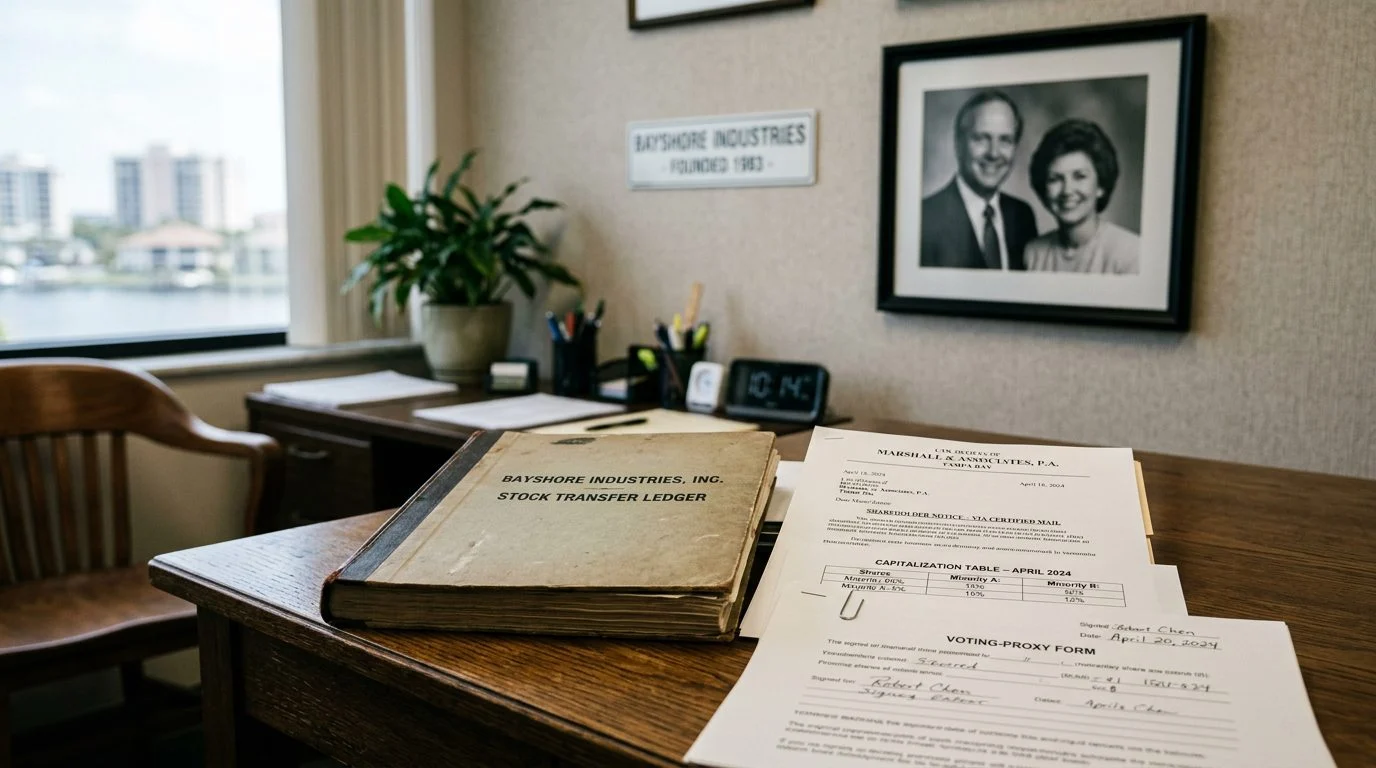
Termination of employment and exclusion from management
Firing, demoting or sidelining an owner who works in the company can be oppression. It becomes that when it targets the owner’s stake and breaks expectations the owner reasonably held.
Common examples include firing without a stated cause when the owner expected to keep the job. Others include removal of signing authority or bank access, being left out of meetings and key decisions, or a sudden change in duties that pushes the owner out.
Context drives the analysis. A company has a legitimate right to manage and to end employment for real reasons. The reason given, the timing and whether the owner’s expectations appear in a written agreement all matter.
Offer letters, employment agreements and meeting minutes can show what the owner was promised. Gather those documents early.
Withholding distributions and diverting company funds
Withholding distributions while insiders take money out is a common pattern. The majority may receive large salaries, bonuses, rent or management fees. The minority owner may receive nothing.
Florida law lets a board authorize distributions, but it limits them. Under Fla. Stat. § 607.06401, no distribution may be made if the company cannot pay its debts as they come due. A distribution is also barred if total assets would be less than the sum of total liabilities plus, unless the articles of incorporation permit otherwise, amounts needed for superior preferential rights.
Deals between the company and one of its directors get a closer look. Under Fla. Stat. § 607.0832, such a deal is tested in part by whether it is fair to the corporation and comparable to an arm’s-length deal.
Diversion can look like customers or contracts moving to a new company the majority owns. Retaining earnings for a real business purpose is different from holding them back to force a sale. Note payments to insiders, unexplained expenses and sudden shifts of business to a related company.
Can majority shareholders be oppressed?
Yes, in some situations a controlling owner can face conduct from other owners. The answer depends on the ownership split and the governing documents. The examples on this page focus on minority owners because that is where the term is most often used.
Deadlock is one setting where this comes up. In a 50/50 company, each side can feel blocked by the other. Florida lets owners plan for that in advance.
Under Fla. Stat. § 607.0732, a shareholder agreement may set up a mechanism for breaking a deadlock, including in lieu of judicial dissolution. Who can bring a claim, and on what grounds, turns on the statute and the documents.
When a disagreement is not oppression, and what to document
Ordinary business disagreements are not automatically oppression. Owners argue about spending, strategy, hiring and growth all the time. A dispute changes character when conduct targets one owner and takes away what that owner reasonably expected.
Three questions help separate the two. Is the conduct aimed at the minority owner? Does it take away benefits the owner reasonably expected? Is there a legitimate business reason that the company’s records support?
Keep these documents in a place you control:
- Operating, shareholder and buy-sell agreements, plus bylaws
- Emails and texts about the disputed conduct
- Financial statements, tax returns and payment histories
- Meeting minutes and written requests for records
Whether a given set of facts amounts to oppression depends on the facts. The records and the governing documents usually tell the story better than memory does.
Not sure what your next step is?
Talk it through with our team — we can walk you through how a situation like yours is usually handled and what your options are.
Remedies and related questions
Florida courts have several tools in shareholder disputes.
Under Fla. Stat. § 607.1431, in a judicial dissolution proceeding under § 607.1430, if a court finds a party acted arbitrarily, frivolously, vexatiously, or not in good faith, it may, in its discretion, award attorney fees and other reasonable expenses to the other parties who were adversely affected.
Time limits and procedure can affect a claim. Don’t wait to gather records and read the governing documents.
What does minority oppression mean?
Minority oppression means controlling owners or managers unfairly harm a minority owner’s interests. It often happens without outright fraud.
Can majority shareholders be oppressed?
Yes, in some situations, such as a deadlock. The ownership split and the governing documents decide how it applies.
Does Florida have a shareholder oppression lawsuit?
Florida’s corporate statute does not list oppression as a separate claim. Chapter 607 sets specific grounds and remedies instead.
Can a minority shareholder inspect company records in Florida?
Yes, a shareholder may inspect certain records after written notice at least 5 business days ahead. Fla. Stat. § 607.1430 does not set requirements for a records demand; it covers when a circuit court may dissolve a corporation or order another remedy under s. 607.1434.
Talk with Ayala Law PA about your situation
If you co-own a company and watch it change around you, you may be reading documents you did not draft. You may be wondering whether what you see has a name. You may even be looking into this for a family member. That is a hard place to be, and you don’t have to sort it out alone.
If dilution, a low buyout number, blocked records or being pushed out of your job fits what’s happening, contact Ayala Law PA to talk through your options. Call (305) 570-2208 or use the contact form. The firm cannot promise any result, and this page does not predict one.
Ask about fees when you call. The firm explains its fee arrangements directly.
Eduardo A. Maura is responsible for this page. Ayala Law PA’s bona fide office is at 1646 W Snow Ave, Tampa, FL. The firm represents businesses in Tampa, Hillsborough County, Brandon, Riverview, Plant City, Temple Terrace and the Tampa Bay area.



