
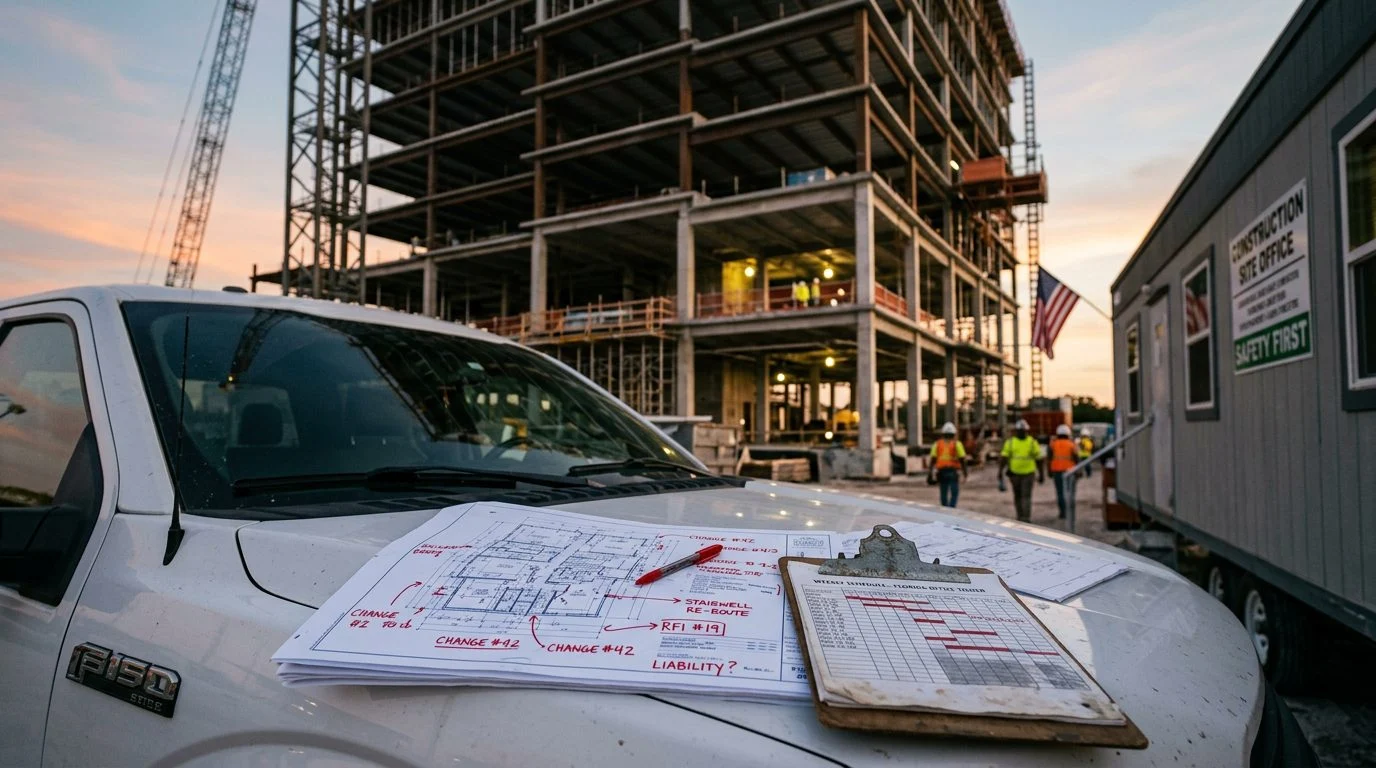
Liability on a Florida construction project usually follows the contracts. The owner, general contractor, subcontractors and design professionals each answer first to the parties they signed with. Some claims reach further, and this page explains who can be sued, for what, and which deadlines can end a claim first.
The Short Answer: Liability Follows the Contract Chain
Liability usually follows who contracted with whom. The typical chain runs from the property owner to the general contractor. From there, it runs to subcontractors and suppliers. Design professionals, such as architects and engineers, usually contract with the owner.
Some claims don’t depend on a contract at all. Each claim type has its own deadline, and the earliest one can decide whether a claim survives. Paperwork often decides who is responsible.
How this applies to your project depends on the facts, including the contracts, notices and permits involved. For an overview of your options, read our Florida construction dispute options guide.
If a payment dispute with a general contractor, a lien notice on your property or a defect you found after a design was approved has you asking who owes you, our team can talk through your contracts and deadlines at (305) 570-2208. Talk it through with our team — we can walk you through how a situation like yours is usually handled and what your options are.
When the Property Owner Can Be Sued
An owner is usually sued first by the general contractor it hired. The owner’s main duties under that contract are to pay the agreed amounts and to manage its own changes and delays.
Owners also face construction liens.
That’s why owners should track who is working on the site and who has been paid.
Owners who run a project through a company have an added layer of protection. Under § 605.0304, a company’s debts belong to the company. A member or manager isn’t personally liable for them just because of that role.
Owners can also face claims from their own contract partners. A delay claim tied to changes the owner requested is one example.
The General Contractor: Often the Primary Defendant for Defective Work
The general contractor usually answers to the owner for the whole job. That includes work its subcontractors perform.
That duty comes from the construction contract. Most contracts require work that follows the plans, the specifications and the building code. When the finished work falls short, the owner’s most direct claim is often a breach of contract claim against the general contractor.
Some defect claims also turn on building code compliance. That question sits apart from the contract, so it needs its own review of the permits and inspections on the project.
Owners often build a stronger case by documenting defects early. Photos, inspection reports and written notices help show what went wrong and when. Keep copies of every notice sent and received.
Subcontractors: Contract Claims Against the GC and Lien Rights Against the Owner
A subcontractor usually gets paid through the general contractor, not the owner. Its main claim for unpaid work is a contract claim against the general contractor.
Subcontractors often have no direct contract with the owner. Florida courts generally don’t allow an unjust enrichment claim where an express contract covers the same subject matter.
A lien may still give a subcontractor a route to the property. Missing a notice can cost a lien right.
On bonded projects, a payment bond claim is another route. Under § 95.11, an action to enforce a claim against a payment bond on which the principal is a contractor, subcontractor, or sub-subcontractor, other than actions governed by s. 255.05(10), s. 337.18(1), or s. 713.23(1)(e), must be commenced within one year from the last time labor, services or materials were furnished. If the contractor is the principal on a bond on the same project and furnished work later, that later date controls. Section 713.23 governs some payment bond actions.
Pay-if-paid and retainage clauses often decide when a subcontractor gets paid. Read them together with the contract. See our guide to retainage and withholding in Florida construction.
Design Professionals: Architects and Engineers
Architects and engineers are usually liable to the party they contracted with, often the owner, for errors in their own design work.
A contractor that relied on the plans may also have a claim. That claim differs from a contract claim, so its elements and proof need a separate review.
The facts about how the work was contracted matter.
Design defect claims often turn on one question: did the defect come from the design, the construction, or both? Plans, change orders and site records help answer it. Sorting that out early helps a business choose the right defendant.
The timing rules in § 95.11 apply to design claims too. They cover actions founded on the design, planning or construction of an improvement to real property. Fla. Stat. § 95.11 reads: “(b) An action founded on the design, planning, or construction of an improvement to real property, with the time running from the date the authority having jurisdiction issues a temporary certificate of occupancy, a certificate of occupancy, or a certificate of completion, or the date of abandonment of construction if not completed, whichever date is earliest; except that, when the action involves a latent defect, the time runs from the time the defect is discovered or should have been discovered with the exercise of due diligence.”
Statutory Claims and Time Limits That Shape Who You Can Sue
Each claim has its own clock. The earliest deadline can end a claim before the others come into play.
For actions founded on the design, planning or construction of an improvement to real property, § 95.11 sets a four-year period. The time runs from the earliest of a temporary certificate of occupancy, a certificate of occupancy, a certificate of completion, or abandonment of unfinished construction. Fla. Stat. § 95.11 reads: “(b) An action founded on the design, planning, or construction of an improvement to real property, with the time running from the date the authority having jurisdiction issues a temporary certificate of occupancy, a certificate of occupancy, or a certificate of completion, or the date of abandonment of construction if not completed, whichever date is earliest; except that, when the action involves a latent defect, the time runs from the time the defect is discovered or should have been discovered with the exercise of due diligence.”
If the defect is latent, meaning hidden, the four years run from when it was or should have been discovered with due diligence. Even so, the action must start within 7 years of that certificate or abandonment date.
Repairs don’t restart the clock. Under § 95.11, correcting or repairing completed work, under warranty or otherwise, doesn’t extend the period for work within a duly issued building permit and certificate. Each building on a multi-building project counts as its own improvement.
Under § 95.03, a contract term that sets a shorter period than the statute allows is void.
Arbitration can change where a dispute goes. Under § 682.02, an arbitration agreement is generally enforceable. The court decides whether that agreement exists. Under § 682.03, a court can’t refuse to order arbitration because the claim lacks merit. If the court orders arbitration, it must also stay the court case on that claim, on just terms.
Not sure what your next step is?
Talk it through with our team — we can walk you through how a situation like yours is usually handled and what your options are.
How to Map Your Contracts to Likely Defendants
Start by listing every party in the chain and each contract that links you to them.
- List every party from owner to subcontractor, plus any design firm. Mark which contract, if any, connects you to each one.
- Match each relationship to its claims. These may include breach of contract, construction lien, payment bond, building code issues or professional negligence.
- Gather the records that set deadlines and order. These include notices, recorded liens, bonds, retainage statements, change orders and any arbitration clause.
With that map, you can see which defendants are most likely. You can also see which claims may fall away because of a missed deadline or notice.
Venue decides where you file. Under § 47.011, an action generally goes only in the county where the defendant resides, where the cause of action accrued, or where the property in litigation is located. That rule does not apply to actions against nonresidents. Under § 47.021, when two or more defendants live in different counties, suit may be brought in any county where one of them resides. A project in Hillsborough County may tie venue to that county, since the property or the work may be located there.
If a matter falls outside our practice areas, we may refer it to another lawyer or firm.

Talk With Our Team About Your Project’s Contract Chain
Eduardo A. Maura is the responsible lawyer for this page. Our office is in Tampa, Florida, at 1646 W Snow Ave, and we represent businesses in Tampa and Hillsborough County. Our team represents businesses in Tampa, Hillsborough County and the Tampa Bay area.
Our practice covers business litigation, commercial litigation, contract disputes, shareholder disputes, construction litigation, real estate litigation and international trade litigation.
Quick Answers
Can a subcontractor sue the property owner in Florida?
A subcontractor usually has no direct contract claim against the owner.
Latent defects run from discovery, but in any event suit must be commenced within 7 years after the date the authority having jurisdiction issues a temporary certificate of occupancy, a certificate of occupancy, or a certificate of completion, or the date of abandonment of construction if not completed, whichever date is earliest.
Which county can I file in?
Florida law generally points to where the defendant resides, where the claim arose, or where the property is located.
If a payment dispute, a lien notice on your property or a defect you found after a design was approved has you asking who owes you, reach out to our team at (305) 570-2208. We can talk through your contracts and deadlines with you.



