

A 50/50 shareholder dispute happens when two equal owners can’t agree on a decision, and the business slows down. Florida law gives owners several routes, from a negotiated exit to court action. The right route depends on the company’s documents. This page is written for owners in Tampa, Hillsborough County, Brandon, Riverview, Plant City, Temple Terrace and the wider Tampa Bay area. Eduardo A. Maura is the lawyer responsible for this page. Ayala Law PA’s only office is at 1646 W Snow Ave in Tampa, Florida.
How a 50/50 Ownership Deadlock Starts
A 50/50 deadlock starts when two equal owners disagree on a decision that needs a majority, and neither side can outvote the other.
Common triggers include:
- Budget and spending limits
- Hiring, firing or pay for an owner or manager
- New capital, loans or a new investor
- A new product, new market or major contract
Equal ownership with no tie-breaker makes a stalemate likely. Many small companies have no third director or neutral vote, so a split vote stays split.
A deadlock becomes a legal problem when it starts to hurt the business. Warning signs include missed filings, blocked bank access, unpaid vendors, lapsed licenses and contracts no one can sign. Florida’s statute lists deadlock as a ground for court dissolution when the directors are deadlocked, the shareholders cannot break the deadlock, and either the corporation faces irreparable injury or the business can no longer be run to the advantage of shareholders generally (Fla. Stat. § 607.1430).
If you and your co-owner are deadlocked and the company's work has slowed, our team can review your documents and options with you. Talk it through with our team — we can walk you through how a situation like yours is usually handled and what your options are.
What Paths Are Available When Equal Owners Cannot Agree?
The main paths are a negotiated exit, enforcing a buy-sell or deadlock clause, and asking a court for relief. Each one trades off cost, speed and control differently.
- Negotiated exit. Owners agree on who buys whose shares, how the shares are valued and how payment works. Owners may agree to pay in installments.
- Under Fla. Stat. § 607.1430, a deadlock sale provision in a shareholder agreement that complies with s. 607.0732 can apply instead of a dissolution order if it is started and carried out within the statute’s time periods.
- Court relief. A shareholder can ask a court to dissolve the corporation on deadlock grounds. Upon a showing of sufficient merit to warrant such remedy, the court may instead appoint a receiver, appoint a provisional director, order a purchase of the petitioner’s shares, or make another equitable order (Fla. Stat. § 607.1434).
LLCs follow different rules. An LLC’s dissolution grounds, including deadlock where irreparable injury is threatened, appear in Fla. Stat. § 605.0702.
A negotiated exit avoids a court schedule. Court relief can break a standoff, but it takes longer and gives up control over the result.
Does Oppression Give a 50% Owner Grounds for Relief?
A shareholder may seek judicial dissolution if the corporation has abandoned its business and has failed, within a reasonable period of time, to liquidate and distribute its assets and dissolve. That doesn’t end the analysis.
Some 50% owners aren’t in a stalemate at all. The other owner runs the company in a way that hurts them. Conduct owners often describe includes:
- Cutting an owner out of management or information
- Paying one owner while distributions to the other are held back
- Moving revenue or customers to another company
- Making major decisions without the required notice or vote
Whether these facts support a claim, and under what theory, depends on the company’s governing documents and the specific conduct. Timing matters too. An owner who waits should review the facts promptly.
How Is Shareholder Oppression Proven?
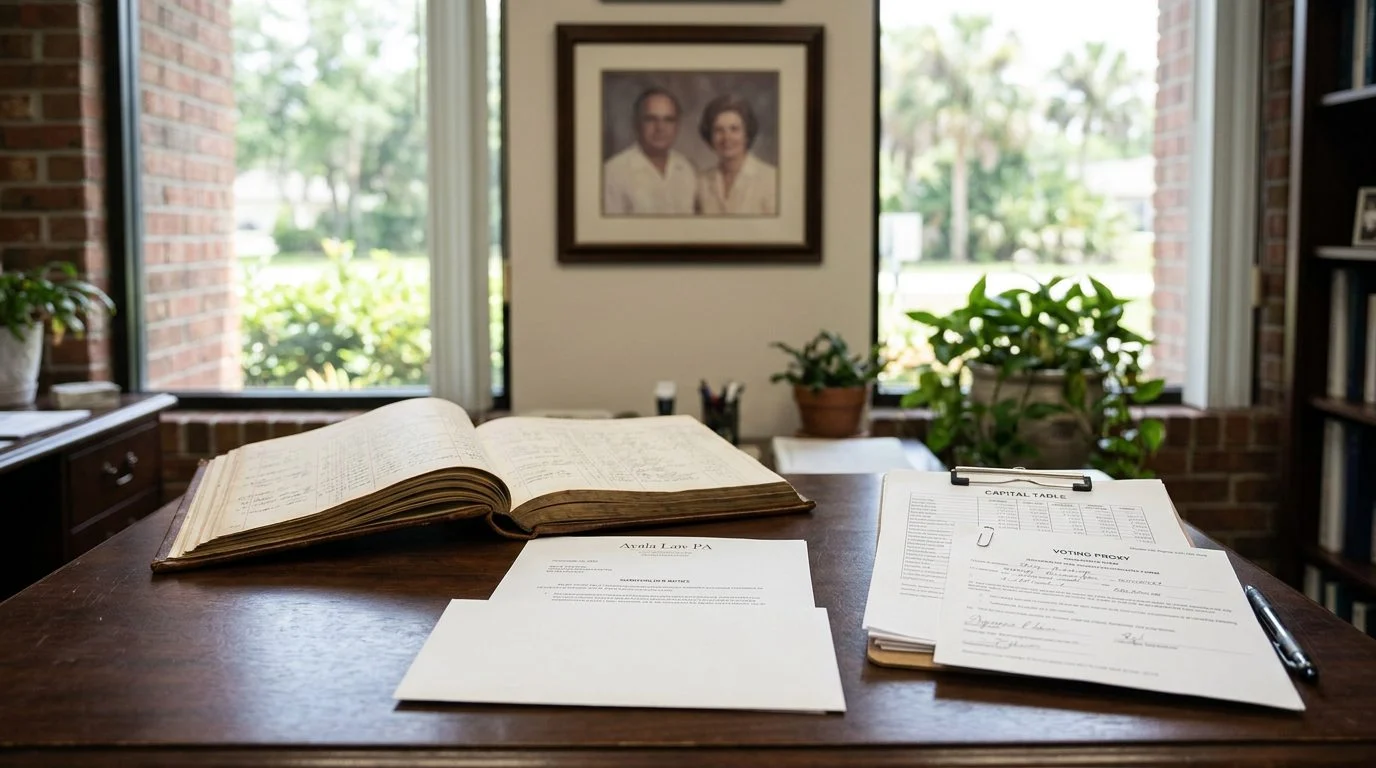
Proof usually comes from company records, written communications and the governing documents. Start gathering it as soon as the conflict begins.
- Minutes, written consents and vote records
- Bank, tax and accounting records
- Emails, texts and messages about company decisions
- The shareholder agreement, bylaws or operating agreement
Shareholders have inspection rights. A shareholder may be able to inspect and copy certain corporate records, subject to the notice and other requirements of the statute. For some of those records, a circuit court can order inspection at the company’s expense and order the company to pay reasonable attorney fees (Fla. Stat. § 607.1604).
Members of a member-managed LLC may inspect company records on reasonable notice (Fla. Stat. § 605.0410).
Write down the dates of failed votes, decisions made without you, and the effect on your ownership and income. Keep emails calm and factual.
How the Process Works and What to Expect
The process usually starts with a case evaluation, then moves to options, demand letters and, if needed, a court or arbitration filing.
- Case evaluation. We review the entity documents, ownership percentages, any shareholder or operating agreement, and the deadlock facts.
- Options review. We compare a negotiated exit, enforcement of a buy-sell clause and court relief.
- Demand and negotiation. Demand letters often come before any filing, and talks may lead to a buyout.
- Filing. A dissolution case is heard in the circuit court in the applicable county (Fla. Stat. § 607.1431). Whether a written arbitration agreement is valid or enforceable is not addressed by Fla. Stat. § 607.1431, which places venue for a dissolution proceeding in the circuit court in the applicable county (Fla. Stat. § 607.1431).
- Court process. Discovery, mediation and hearings follow where needed.
Deadlines matter.
Bad-faith conduct carries risk. No one can promise how a case will end.
Why Ayala Law PA for Shareholder and Business Disputes
Ayala Law PA focuses on business litigation, including shareholder disputes, in Florida courts and arbitration.
The firm’s practice areas include business litigation, commercial litigation, contract disputes, shareholder disputes, construction litigation, real estate litigation and international trade litigation. Many deadlock cases also involve a company contract or co-owned property. Those fall within the firm’s contract and real estate work.
Our only office is at 1646 W Snow Ave in Tampa, Florida, and we invite Tampa Bay businesses to contact us to discuss their dispute. We represent businesses in Tampa, Hillsborough County and the Tampa Bay area. Eduardo A. Maura is the lawyer responsible for this page. Our support staff handles office and scheduling work. Our team explains the documents and options in plain language.
Not sure what your next step is?
Talk it through with our team — we can walk you through how a situation like yours is usually handled and what your options are.
Frequently Asked Questions About 50/50 Shareholder Disputes
What should I do when my co-owner and I disagree?
Keep records, avoid informal side deals, and review your governing documents before you act.
How does a majority-in-interest vote work in a member-managed LLC?
Under Fla. Stat. § 605.04073, except as otherwise provided in the chapter, the affirmative vote or consent of a majority-in-interest of the members is required to undertake an act, whether within or outside the ordinary course of the company’s activities and affairs. The bylaws, operating agreement and state law control the details.
Do we need a buy-sell agreement to resolve a deadlock?
No. A clause can help, but other routes may apply if none exists.
Can a court dissolve a company because owners are deadlocked?
Florida’s statute lists deadlock as a ground for court dissolution of a corporation. Whether it applies to your company depends on the facts.
Will I lose my ownership stake in court?
Not necessarily. The process for agreeing on fair value and purchase terms, and for court involvement if the parties cannot agree, depends on the facts of each case and the procedures in the statute.
Talk With Our Team About Your Deadlock
If your company has slowed because you and your co-owner can’t agree, the next step is a review of your documents and options. Call (305) 570-2208 or request a case evaluation with our team.



