
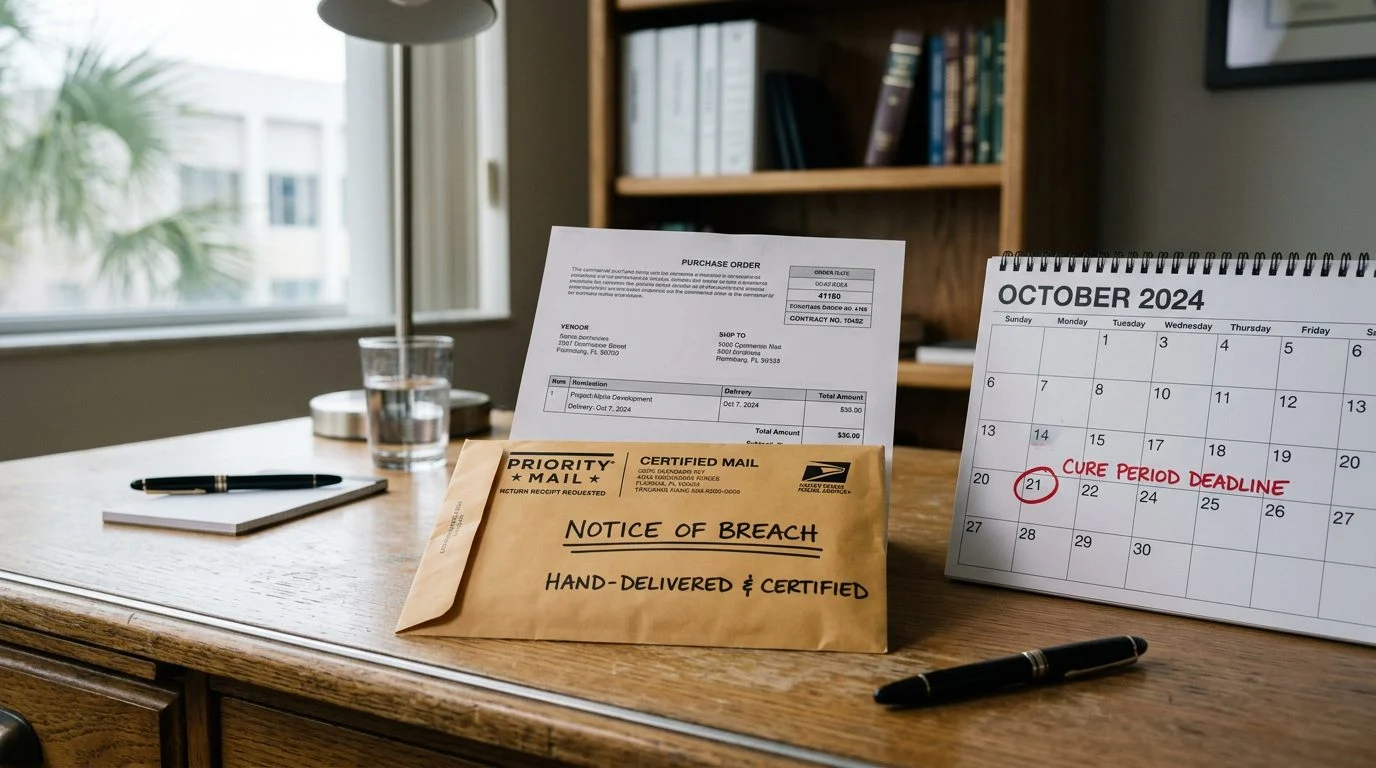
An attorney fee clause is a sentence in a contract that says who pays legal fees if a dispute ends up in court or arbitration. In Florida, the clause can let the winning side recover its fees, but only when the wording and the facts support it. This page explains how Florida courts read these clauses, how one rule can make a one-way clause work both ways, and what to check in your own agreement.
What an attorney fee clause does in a Florida contract
An attorney fee clause decides who pays legal fees when a contract fight starts. Without one, the default rule usually applies. Florida follows the American rule. Under it, each side generally bears its own attorney fees unless a contract or statute provides otherwise, as the Florida Supreme Court explained in Price v. Tyler.
Fees are a separate question from damages. Damages are the money owed for the breach itself, such as an unpaid invoice. Fees are what you spent on lawyers to get that money. A business can win its damages claim and still pay its own legal bills. That gap surprises many owners. The fee clause is what closes it, if the clause says so.
Prevailing-party clauses and how they are worded
A prevailing-party clause awards fees to whichever side wins the dispute. A common version says the winner of any lawsuit over the agreement may recover its reasonable attorney fees. The clause does not say who wins. The court decides that from the claims and the result.
Wording matters. Some clauses cover only court cases. Others also reach arbitration, appeals, or collection work. A clause that is silent on those points may leave you arguing about its reach. Read the exact words, not a summary of them.
A one-way clause is different. It names only one party as entitled to fees, such as “Customer shall pay Vendor’s fees if Vendor must sue to collect.” On its face, only the vendor can recover. Florida law can change that result, as the next section explains.
How Fla. Stat. 57.105(7) makes a one-way fee clause reciprocal
If a contract lets only one party recover fees, the other side may gain the same right when it wins. Under Fla. Stat. § 57.105, when a contract allows fees to a party that must act to enforce it, the court may also allow reasonable fees to the other party when that party prevails, as plaintiff or defendant, on the contract.
Two points matter here. First, the word “may” makes this discretionary, not automatic. Second, the statute applies to any contract entered into on or after October 1, 1988.
The practical effect is simple. A business that signs a one-way clause in its favor may still owe fees if the other side wins the contract case. Read the exact wording and the timing of the agreement before relying on how this rule fits your facts.
Why fee recovery is not automatic
A fee clause does not ensure a fee award. The court decides who prevailed and whether the fees requested are reasonable. Under Fla. Stat. § 57.104, courts start from a strong presumption that a lodestar fee (a figure based on the work performed) is sufficient and reasonable. That presumption can be overcome only in a rare and exceptional circumstance, with evidence that competent counsel could not otherwise be retained.
Proof matters too. Winning some claims and losing others can also make “prevailing party” harder to pin down. The court may have to weigh the mixed result.
A separate route exists outside the contract. Under Florida Statute § 57.105(1), a court shall award a reasonable attorney’s fee, including prejudgment interest, to be paid to the prevailing party in equal amounts by the losing party and the losing party’s attorney, when it finds that a claim or defense was not supported by the material facts or by then-existing law, and that the losing party or its attorney knew or should have known this when the claim or defense was first presented or at any time before trial. Under Fla. Stat. § 57.105(3)(b), monetary sanctions may not be awarded under paragraph (1)(a) or paragraph (1)(b) against the losing party’s attorney if he or she has acted in good faith, based on the representations of his or her client as to the existence of those material facts. The award applies where the court finds that the losing party or its attorney knew or should have known that the claim or defense, when initially presented to the court or at any time before trial, was not supported by the material facts necessary to establish it, or would not be supported by the application of then-existing law to those material facts. However, notwithstanding subsections (1) and (2), monetary sanctions may not be awarded under the then-existing-law ground if the court determines that the claim or defense was initially presented to the court as a good faith argument for the extension, modification, or reversal of existing law, as it applied to the material facts, with a reasonable expectation of success. Court costs are a separate category from attorney fees, so check them apart from the fee request.
Checking the fee provision in your own agreement
Start by reading who the clause names and what proceedings it covers. Check whether it reaches lawsuits, arbitration, appeals, and collection work. Look for any notice or timing requirements the clause includes. Each of these changes how the clause applies.
Dispute-resolution terms matter as well. Under Fla. Stat. § 682.02, a written agreement to arbitrate is valid, enforceable, and irrevocable, except on a ground that exists for revoking a contract. An arbitrator also decides certain threshold questions, such as whether a condition precedent has been met. So an arbitration clause can change where the fight happens and who decides the early issues.
Venue is the last check. Under Fla. Stat. § 47.011, actions must be brought only in the county where the defendant resides, where the cause of action accrued, or where the property in litigation is located, though this section does not apply to actions against nonresidents. For a Hillsborough County business dispute, that rule helps set the proper court.
Connecting fee clauses to damages and the right forum
The fee question follows the underlying claim. The type of breach, the amount of damages, and any limits the contract puts on remedies all shape the overall financial picture. A fee award on a small claim can cost more than the claim itself, so the numbers need a clear look.
Contract terms also affect which claims are available. In Williams v. Johnson, the Third District stated that, given an express contract covering the same subject matter, claims arising from that contractual relationship will not support a claim for unjust enrichment. A business may need to rely on the contract rather than a side theory.
Read the fee clause alongside the whole agreement, not in isolation. Notice provisions, remedy limits, and forum terms all affect how a fee dispute plays out.
Talk with our team about the fee clause in your agreement
Suppose you signed a vendor or contractor agreement with a fee clause. The other side has stopped paying, and you must decide whether to send a demand letter, file suit, or respond to a claim. Those choices depend on the wording of your contract and the facts behind it.
Call Ayala Law PA at (305) 570-2208 or use the contact page to discuss how the fee language in your agreement may apply. We cannot promise any outcome, but we can review the clause with you. The firm concentrates in business litigation, commercial litigation, contract disputes, and construction and real estate litigation. Eduardo A. Maura is the responsible lawyer for this page. The firm’s office is in Tampa at 1646 W Snow Ave, and it represents business clients in Tampa and Hillsborough County.
Does an attorney fee clause in a Florida contract entitle the winner to recover fees?
No. The clause sets the rule, but the court decides whether the winner prevailed and whether the fees are reasonable.
Does a one-way fee clause work both ways in Florida?
It may. Under Fla. Stat. § 57.105(7), if the contract contains a provision allowing attorney’s fees to a party when he or she is required to take any action to enforce the contract, the court may also allow reasonable attorney’s fees to the other party when that party prevails in any action with respect to the contract, for contracts entered into on or after October 1, 1988.
Who pays attorney fees in a Florida contract dispute?
Each side generally pays its own, unless the contract or a statute says otherwise.



