
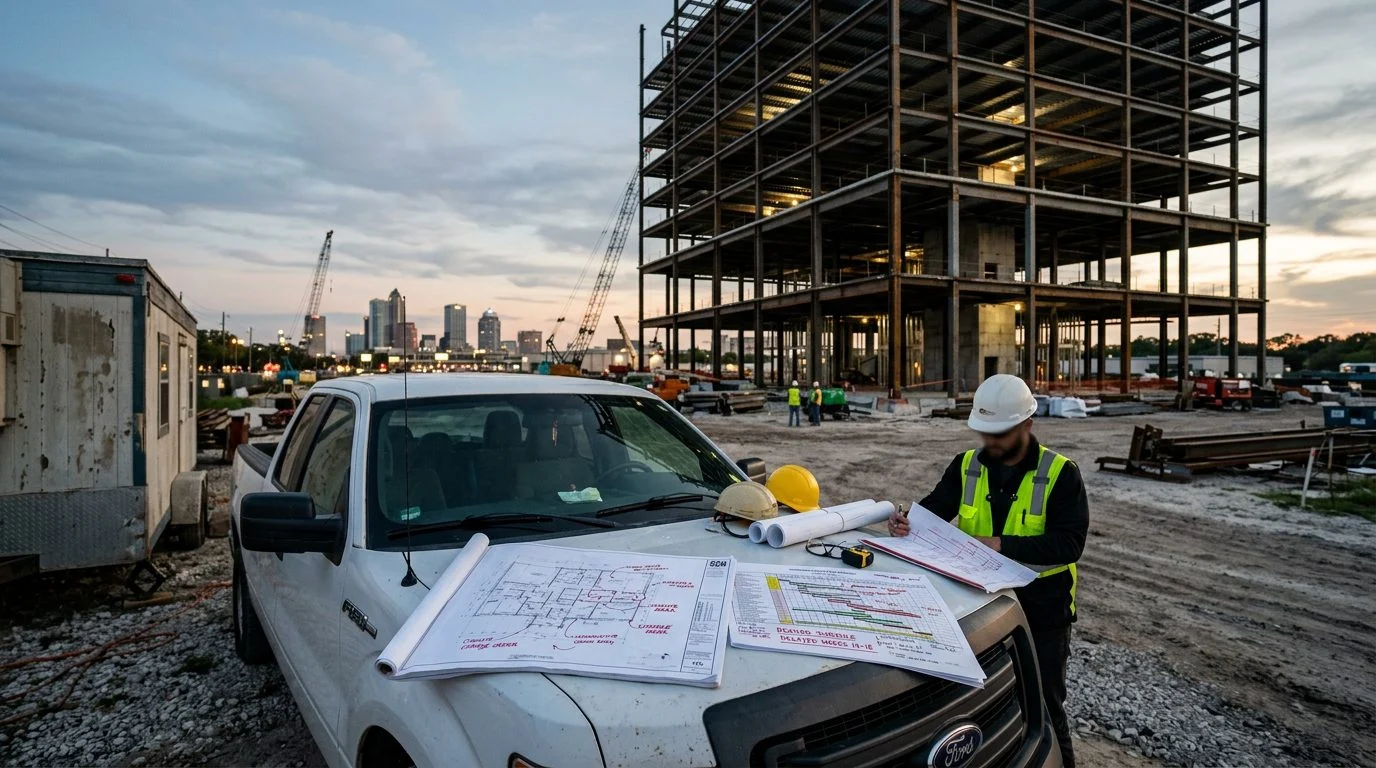
A construction payment dispute is a fight over money owed for work, materials, or a finished project. The main options are a written demand, a lien claim against the property, a breach of contract suit, or arbitration. The right path depends on the contract and the deadlines.
Ayala Law PA handles these disputes for contractors, subcontractors, suppliers, and property owners in Hillsborough County and the Tampa Bay area, in Florida courts and arbitration. This page explains how a construction payment dispute attorney in Hillsborough County approaches a claim, from the first document review to resolution. Our office is in Tampa, at 1646 W Snow Ave, and we represent businesses in Tampa and Hillsborough County. Eduardo A. Maura is the responsible lawyer for this page.
What a Construction Payment Dispute Involves
A construction payment dispute starts when money due on a building project goes unpaid or is held back. You’ll usually see one of these forms:
- Unpaid invoices for work already done
- Progress payments that were withheld
- Retainage, the part of each payment held back until the job nears its end
- Unpaid change orders for extra or altered work
- A disputed final payment at project closeout
General contractors, subcontractors, suppliers, and owners all end up on either side. Disputes come up on residential and commercial jobs across Hillsborough County.
These cases often turn on paper. The written contract sets the payment schedule, the notice steps, and any deadline to dispute an invoice. Keep every change order, pay application, and email. A missing notice or a late invoice can change the whole case.
If an unpaid invoice or a withheld final payment has you worried about a lien notice or a filing date, reach out to our team and we'll start by reviewing your contract and notices. Talk it through with our team — we can walk you through how a situation like yours is usually handled and what your options are.
Claims We Handle in Construction Litigation
Construction litigation covers lawsuits and arbitration demands that seek payment or address a broken construction contract. The firm’s construction work includes these claim types:
- Contractor claims against an owner for nonpayment or wrongful withholding of the contract sum
- Subcontractor and supplier claims against a general contractor for unpaid work or materials
- Owner claims for defective or incomplete work, overpayment, or construction contract fraud
- Claims tied to real estate issues on the same project, such as a lien that clouds the property title
Fraud claims run on a different clock. Under Fla. Stat. § 95.031, a fraud action runs from when the facts were discovered or should have been. It must still start within 12 years after the fraud was committed.
Calling a dispute “fraud” does not turn it into a tort claim. Florida’s Third District Court of Appeal has held that a party generally cannot recover in tort for what is really a contract dispute, unless the tort is independent of the breach. See Frutafino v. Dole Chile.
Mechanic’s Liens and Payment Recovery in Florida
Construction payment disputes can involve several different tools, and each one has its own procedural requirements. Some construction payment disputes involve claims that relate to the property itself. Because those steps carry their own timing, the dates need an early review.
Lien foreclosure is a court action to enforce a recorded lien against the property. It is not the only route. A breach of contract claim or a written demand may fit a case better, depending on the facts.
Several deadlines matter here:
- Florida generally gives four years to sue over the design, planning, or construction of an improvement to real property. The clock starts at the earliest certificate of occupancy, certificate of completion, or abandonment.
- For a latent defect, the four years run from when the defect was discovered or should have been found with due diligence.
- A claim against a payment bond follows its own timing under the same statute, running from the last furnishing of labor, services, or materials.
- A contract clause that sets a shorter filing period than the statute allows is void (Fla. Stat. § 95.03).
How a Payment Dispute Moves Forward
A payment dispute usually moves from document review to a written demand. If the other side does not pay, the case moves to a lawsuit or an arbitration demand. Here is the typical path:
- Intake and documents. We review the contract, change orders, pay applications, invoices, lien documents, and correspondence.
- Deadline check. We check lien notice and filing dates, plus any contract notice or dispute clause.
- Written demand. A letter states the amount owed, the basis for it, and a payment date.
- Filing or arbitration. A written arbitration agreement is generally enforceable (Fla. Stat. § 682.02). A court may not refuse to order arbitration just because the claim lacks merit (Fla. Stat. § 682.03). Suits must be brought only in the county where the defendant lives, where the claim arose, or where the property sits; this rule does not apply to actions against nonresidents (Fla. Stat. § 47.011).
- Mediation and settlement. On one party’s request, a court must refer most filed money damages cases to mediation, provided the requesting party is willing and able to pay the costs or the costs can be equitably divided between the parties, with listed exceptions (Fla. Stat. § 44.102). Under Fla. Stat. § 44.102(2)(a), a court must, upon request of one party, refer to mediation any filed civil action for monetary damages, provided the requesting party is willing and able to pay the costs of the mediation or the costs can be equitably divided between the parties, unless a listed exception applies (Fla. Stat. § 44.102). Mediation talks are confidential, but a signed settlement agreement generally is not (Fla. Stat. § 44.405).
Under Fla. Stat. § 45.061, a settlement offer stays open for 45 days unless it is withdrawn earlier by a writing served on the offeree before acceptance, and an offer that is neither withdrawn nor accepted within 45 days is deemed rejected. Under Fla. Stat. § 45.061(6), this section does not apply to causes of action that accrue after the effective date of this act (Fla. Stat. § 45.061), so whether these offer rules apply to a particular claim depends on when that claim accrued. The timeline changes with the case, the forum, and the other side’s response.
Why Work With Ayala Law PA on Construction Payment Claims
Ayala Law PA concentrates its practice in business, commercial, contract, and construction disputes. The firm does not handle general practice matters outside those areas.
- Responsible lawyer. Eduardo A. Maura is responsible for this page. Our lawyers and support staff handle document review, deadlines, and court filings.
- Office. The firm’s bona fide office is in Tampa, at 1646 W Snow Ave, and the firm handles matters for clients in the Tampa Bay area. The firm serves Hillsborough County and Tampa Bay businesses through Florida courts and arbitration.
- Forum clauses. An arbitration clause can shift where a dispute is heard. We review those clauses early.
- Written communication. We explain your options, likely costs, and next steps in writing so you can decide how to proceed.
Common Questions About Construction Payment Claims
Owners and contractors usually ask about deadlines, lawsuits, and fees first. Short answers follow.
Can a subcontractor sue the owner if the general contractor didn’t pay?
Possibly. Lien rights and contract claims may both apply, depending on notices and contract terms.
How long do I have to act?
Florida deadlines can run from dates that are easy to miss. An early review matters.
Will this always end in court?
No. Many disputes settle through a demand, negotiation, or mediation. Court is one option.
Who pays the attorneys’ fees?
Florida generally follows the American Rule: each party pays its own fees unless a contract or statute says otherwise (Price v. Tyler). Under Fla. Stat. § 57.105(7), if a contract entered into on or after October 1, 1988 allows attorney’s fees to a party that must take action to enforce the contract, the court may also allow reasonable attorney’s fees to the other party when that party prevails in any action, as plaintiff or defendant, with respect to the contract.
What does a case evaluation involve, and how are fees handled?
A case evaluation reviews your documents, notices, and deadlines. Fee terms are explained in writing before any engagement.
Not sure what your next step is?
Talk it through with our team — we can walk you through how a situation like yours is usually handled and what your options are.

Talk to Our Team About Your Payment Dispute
If an unpaid invoice, a withheld final payment, or a lien notice needs a response, the next step is a review of your papers. Gather your contract, change orders, pay applications, invoices, lien documents, and correspondence before you reach out. That lets the review start right away.
Call (305) 570-2208 or send a request through our contact page to start your case evaluation.



