
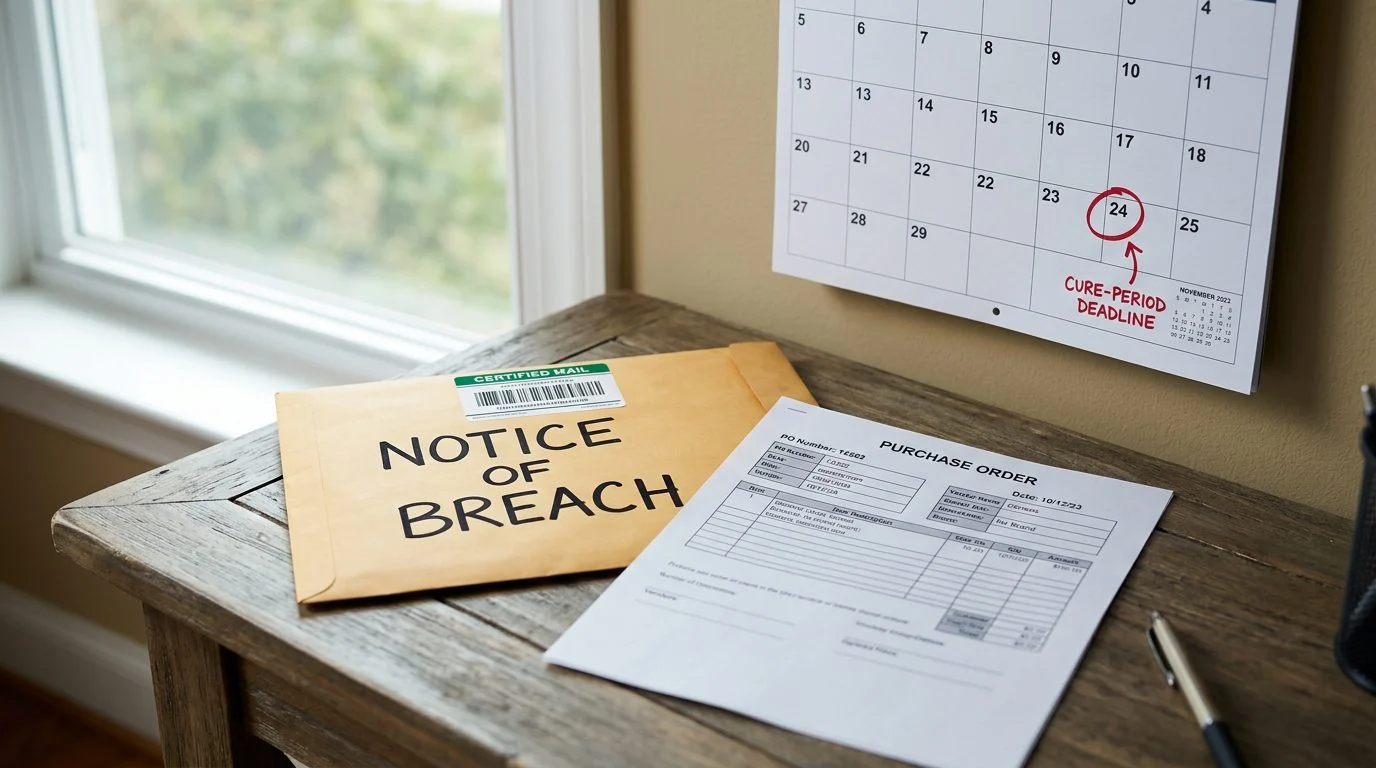
Most contracts in Florida do not have to be in writing to be binding. For goods, a deal can be enforceable when the parties agreed on it, even if nothing was signed, but a contract for the sale of goods for the price of $500 or more is not enforceable by way of action or defense unless there is a record sufficient to indicate that a contract was made and signed by the party against whom enforcement is sought. A short list of agreements does need a signed writing, though, and an unwritten deal can be hard to prove later. Business owners in Tampa, Hillsborough County and across the Tampa Bay area ask, “Do contracts always have to be in writing?” Here is how the rules work.
The short answer: most contracts in Florida do not have to be in writing
In general, a contract does not need to be written to be binding. Florida law lets a sale of goods be made in any manner sufficient to show agreement, including conduct by both sides. Florida’s writing rules cover a limited list of situations.
Keep two questions apart. Enforceable is a legal question: can a court enforce the deal? Provable is an evidence question: can you show what was agreed? A verbal deal can be enforceable and still be hard to prove.
If a verbal deal you thought was settled is now in dispute, you don't have to sort it out alone; reach out to our office to talk through the facts. Talk it through with our team — we can walk you through how a situation like yours is usually handled and what your options are.
What makes an agreement a contract
A contract needs the basic building blocks of contract law: an offer, an acceptance, consideration and enough detail on the essential terms. The Florida Supreme Court has said an oral contract is subject to these same basic requirements, in St. Joe Corp. v. McIver.
An offer is a clear proposal, such as selling equipment for a set price. Acceptance is a clear yes to that proposal. Consideration is something of value each side gives or promises, such as payment for work. Courts also look for enough detail on terms like price, scope and the parties.
For goods, a deal does not fail just because some terms are open. It can still stand if the parties meant to make one and there is a reasonably certain basis for a remedy, under Fla. Stat. § 672.204.
Are all written contracts enforceable?
No. A signed writing does not automatically make a deal enforceable. The paper still has to reflect a real contract with the basic elements in place. Contract disputes often turn on the specific wording of the agreement and the circumstances under which it was made.
A vague writing creates its own problem. If key terms are missing or unclear, the other side may argue that no complete deal was ever made. Read the document against your emails and notes before you sign it.
The writing also has to match what the parties actually agreed. If the document states one price and the talks covered another, the dispute moves to what was really agreed.
Agreements Florida’s Statute of Frauds requires in writing
Florida’s Statute of Frauds requires a signed writing for certain agreements. Under Fla. Stat. § 725.01, no action can be brought on these deals unless the agreement, or a note or memorandum of it, is in writing and signed by the party to be charged or by some other person lawfully authorized by that party. The covered deals include:
- A promise to pay or answer for another person’s debt, default or miscarriage. Fla. Stat. § 725.01 reads: “unless the agreement or promise upon which such action shall be brought, or some note or memorandum thereof shall be in writing and signed by the party to be charged therewith or by some other person by her or him thereunto lawfully authorized.”
- A contract for the sale of land or an uncertain interest in land. Fla. Stat. § 725.01 reads: “unless the agreement or promise upon which such action shall be brought, or some note or memorandum thereof shall be in writing and signed by the party to be charged therewith or by some other person by her or him thereunto lawfully authorized.”
- A lease of real property for longer than 1 year.
- An agreement that cannot be performed within 1 year of when it is made.
Real estate transfers follow a stricter rule. Under Fla. Stat. § 689.01, a freehold interest, or an interest for a term of more than 1 year, in real property must be created, made, granted, transferred, or released by a signed written instrument, signed in the presence of two subscribing witnesses by the party or the party’s lawfully authorized agent, unless by will and testament or other testamentary appointment; the witness requirement may be satisfied by witnesses being present and electronically signing by audio-video communication technology. Leases do not need witnesses.
Whether a reliance argument can rescue a deal that falls under the statute depends on the facts and on which exceptions apply. Every dispute turns on its own facts, so the details of a specific agreement matter.
Sales of goods and the UCC writing requirement
For goods, the writing rule starts at $500. Under Fla. Stat. § 672.201, a contract for goods priced at $500 or more is not enforceable unless a record shows a contract was made and is signed by the party against whom enforcement is sought, or by that party’s authorized agent or broker, and then only up to the quantity of goods shown in the record. This text was amended in 2025 under ch. 2025-92, so older summaries may be out of date.
The statute also has exceptions. Between merchants, a written confirmation can count against the recipient if, within a reasonable time, a record in confirmation of the contract that is sufficient against the sender is received and the recipient has reason to know its contents, unless the recipient objects in a record within 10 days after receiving it.
Check the dollar amount and the exceptions before you rely on a handshake. A phone order for $800 in parts is a different situation than one for $300.
Why a verbal agreement is hard to prove
A verbal agreement can be enforced, but the party bringing the claim must prove that it existed and what its terms were. When two people remember a conversation differently, the dispute turns on evidence.
Useful proof includes emails, text messages, invoices, purchase orders, bank records and what both sides did after the talk. Under Fla. Stat. § 672.207, conduct by both parties that recognizes a contract can establish a sale of goods, even when their writings do not.
Save records as they happen. Send a short email to confirm any deal made by phone. Whether the proof is enough turns on what the records actually show.
Not sure what your next step is?
Talk it through with our team — we can walk you through how a situation like yours is usually handled and what your options are.
How to put an agreement in writing that holds up
Yes, parties can write their own agreements. An incomplete one, though, can lead to a dispute. Make the document cover the basics:
- Full legal names of every party.
- A clear description of the work, goods or interest.
- Price, payment terms and due dates.
- Start and end timing.
- Signatures and dates from every party.
- How disputes will be handled.
For the last item, the AAA clause drafting guidance notes that commercial contracts can call for arbitration and can require the parties to try mediation first.
Keep signed copies and write down any changes. Real estate, construction, shareholder and overseas deals carry more risk when the terms are loose.
When a verbal deal turns into a business dispute
A verbal deal becomes a dispute when one side says the terms were different, or says no deal existed at all. Common examples include an unpaid invoice on a contractor job, co-owners who disagree about what they agreed, or a dispute over selling or leasing an interest in property.
Litigation or arbitration may be one route. The right path turns on the contract terms and the evidence. Our contract disputes page explains how these matters are handled.
For payment problems on a Florida construction project, see the construction lien and bonding page. Owners and shareholders with ownership or governance disagreements can read the shareholder derivative suit page. Parties with an international dispute or a foreign judgment can read the enforcing foreign money judgment page.
Talk with our office about your agreement
Whether a verbal deal is binding depends on the facts, the type of agreement and the proof.
You may be looking at a handshake deal that has turned sour. You may also be reading this for a partner, a relative or a co-owner caught in a disagreement you did not expect.
Are verbal contracts enforceable in Florida?
They can be, if the essential terms were agreed upon and can be proven. Certain agreements still need a signed writing under Florida’s Statute of Frauds.
Does a sale of goods over $500 need a written contract?
Generally yes. Under Fla. Stat. § 672.201, such a contract needs a signed record unless an exception applies.
Does a contract have to be signed to be enforceable?
Not always. Some agreements, such as a lease longer than 1 year, need a signed writing. Others do not.
Eduardo A. Maura is the responsible lawyer for this page. Our office is at 1646 W Snow Ave in Tampa. The firm serves businesses in Tampa, Hillsborough County and the Tampa Bay area. If a deal you thought was settled is now in dispute, get in touch with our Miami office or call (305) 570-2208 to talk through the facts. For an overview of these matters, read our business litigation page.



