
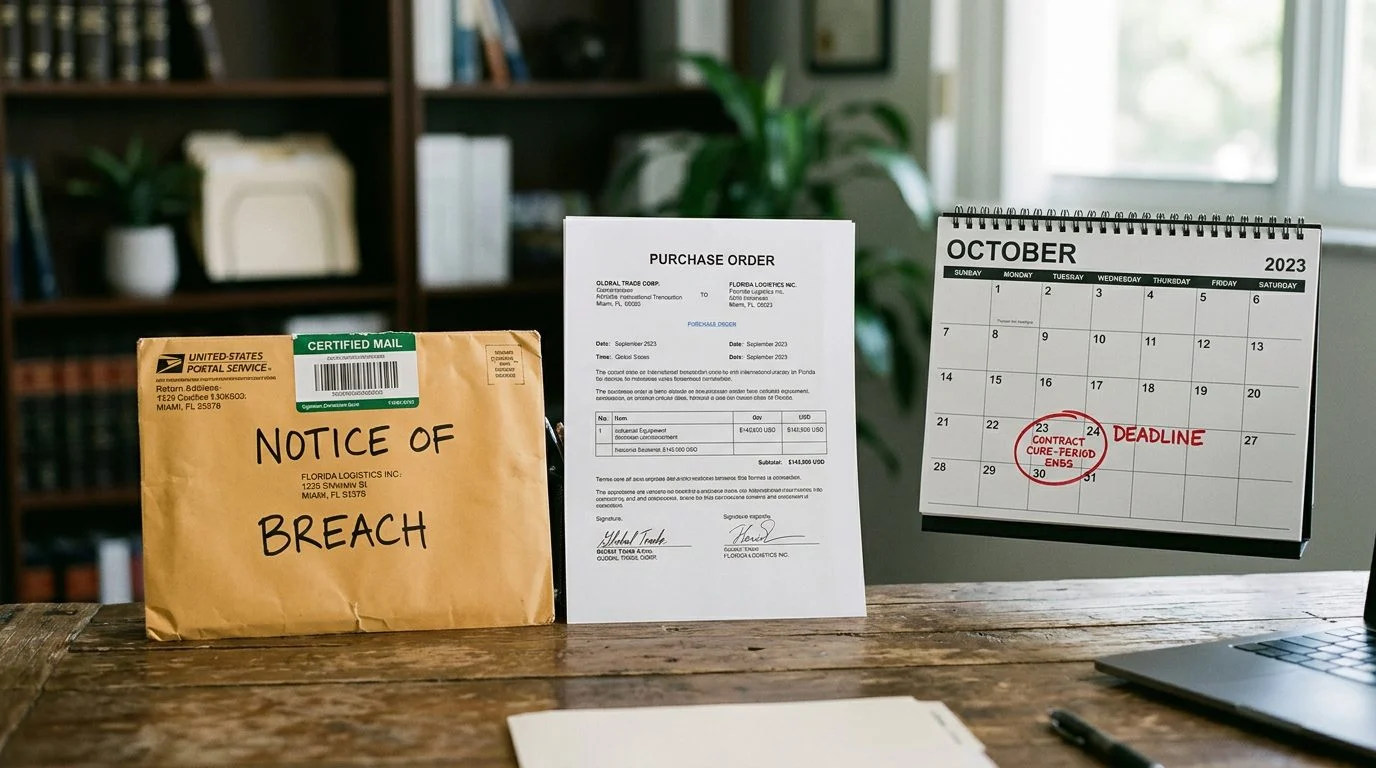
A foreign buyer stops paying, or a foreign distributor stops taking product, and the contract doesn’t say clearly where to sue. In most international sales contract disputes in Florida, three clauses decide the next step: the governing law clause, the forum selection clause and the arbitration clause. Read those clauses before you send a demand, hold a shipment or file anything.
Who This Service Covers and Who It Is For
An international sales contract dispute is a disagreement over goods sold across a national border. Common examples include:
- A foreign buyer that accepts goods and doesn’t pay the invoice.
- A seller that delivers late, delivers short, or sends goods that don’t match the contract.
- A foreign distributor or sales agent whose agreement is terminated.
- A buyer that refuses delivery and wants out of the deal.
This page is written for Florida importers, exporters, distributors and manufacturers, and for the owners and managers who run those deals. Ayala Law PA focuses on business litigation, commercial litigation, contract disputes and international trade litigation in Florida courts and arbitration. Our office is at 1646 W Snow Ave in Tampa, Florida. We serve businesses in Tampa and Hillsborough County from that Tampa office. Your own contract is the first document to review, and no web page can replace that review.
If a foreign buyer or distributor has stopped paying, delivering or performing, our team can talk through your contract and options at (305) 570-2208. Talk it through with our team — we can walk you through how a situation like yours is usually handled and what your options are.
Governing Law, Forum and Arbitration: Which Clauses Decide Where the Claim Goes
Three clauses usually decide which law applies and where a claim is heard. Each one works differently, so check all three.
- Governing law. This clause names the law that interprets the contract. For a transaction with a reasonable relation to Florida and also to another state or nation, Fla. Stat. § 671.105 lets the parties agree that the law of Florida or of the other state or nation will govern.
- Forum. This clause says where suit must be filed. Florida’s venue rule in Fla. Stat. § 47.011 does not apply to actions against nonresidents. For a party residing or located outside Florida, Florida may hear a suit under Fla. Stat. § 685.102 where the contract chooses Florida law under § 685.101 and contains a provision by which that party agrees to submit to the jurisdiction of Florida courts. A § 685.101 choice is available only for transactions involving in the aggregate at least $250,000, with listed exceptions.
- Arbitration. Under Fla. Stat. § 682.02, an agreement in a record to arbitrate is valid, enforceable and irrevocable, except on a ground that exists at law or in equity for revoking a contract. The federal rule in 9 U.S.C. § 2 is similar for contracts involving commerce. A court decides whether an arbitration agreement exists, and under Fla. Stat. § 682.03, a court may not refuse to order arbitration because the claim lacks merit.
The American Arbitration Association describes arbitration as a private, legally binding option for commercial disputes, including international ones. Wording on scope, rules and the number of arbitrators shapes how the case runs. Florida courts may also refuse to enforce a term that is unconscionable, meaning unfair in how the deal was made and unfair in its terms. See Basulto v. Hialeah Automotive.
Florida’s Sale-of-Goods Rules: Notice, Price and Cure
Florida’s sale-of-goods rules set duties and timing that can decide a claim early. Act on notice quickly and document what happened.
- Notice. If the buyer accepted the goods, Fla. Stat. § 672.607 requires the buyer to notify the seller of a breach within a reasonable time after he or she discovers or should have discovered it. Otherwise the buyer may be barred from any remedy. The buyer must also pay the contract rate for goods accepted, and carries the burden to prove any breach.
- Price. When a buyer fails to pay as the price becomes due, Fla. Stat. § 672.709 lets the seller recover the price of goods accepted, plus incidental damages.
- Cure. If a delivery is rejected as nonconforming and the time to perform has not expired, Fla. Stat. § 672.508 lets the seller notify the buyer it intends to cure. The seller may then make a conforming delivery within the contract time.
Whether these rules govern a given deal depends on the facts and on the law the contract chooses.
What the Claim Typically Covers
A cross-border sales claim usually involves unpaid goods, bad deliveries or a terminated distributor. Here is what those disputes often look like.
- Unpaid invoices for goods the buyer accepted, including open-account terms.
- Late, short or nonconforming deliveries, including disputes over quality, quantity and paperwork.
- Distributor terminations, where notice, cure periods and termination grounds drive the early questions. See our foreign distributor termination lawsuit guide.
- Held or stopped shipments, where payment and delivery terms decide what a seller can do next. Check those terms before you hold or stop any shipment.
- Fallback claims, such as unjust enrichment. In Williams v. Johnson, a Florida appellate court said an express contract covering the same subject will not support an unjust enrichment claim.
Example: a foreign manufacturer cuts off a Florida distributor without the notice its contract requires. The notice clause, any cure period and the termination grounds shape the first questions.
How a Cross-Border Sales Dispute Usually Proceeds
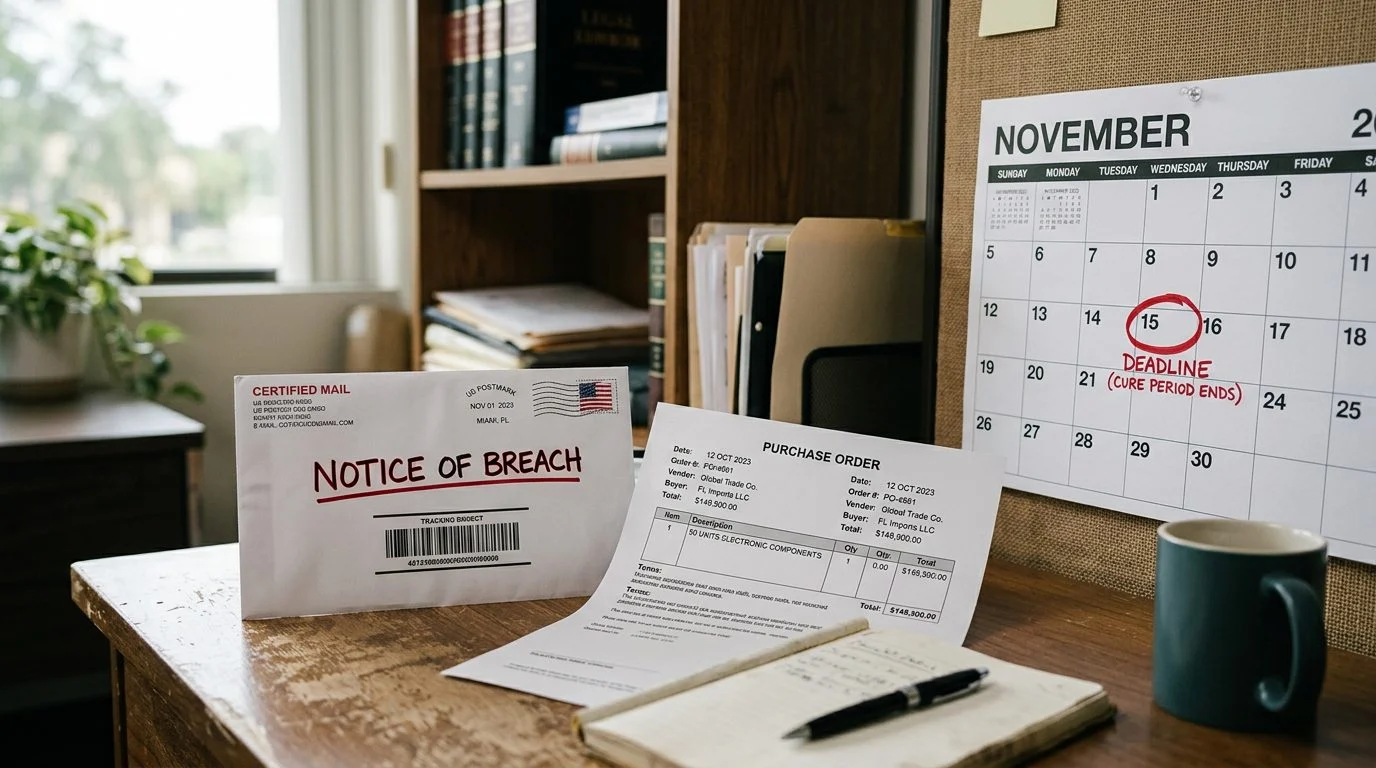
Most of these matters follow the same early steps: review, written notice, preservation, then a filing in court or arbitration.
- Review the paperwork. Gather the contract, purchase orders, invoices, shipping and payment records, and every notice exchanged.
- Send written notice. Follow the contract’s notice clause. A written record matters under the notice rules above.
- Preserve evidence. Keep emails, messages and shipping records. Tell your own staff in writing to keep them too.
- Weigh options. Compare negotiation, mediation or a demand for payment against filing. Identify any deadlines that may apply.
- File in the right place. Sue in the forum the clauses and Florida statutes allow, or file an arbitration demand under the agreed rules.
- Plan for the long run. Service abroad, document exchange and timing vary by forum. Enforcement abroad follows that country’s law and where the other party’s assets are.
Why Work With Ayala Law PA on Cross-Border Sales Disputes
Ayala Law PA focuses on business litigation and contract disputes, and lists international trade litigation among its practice areas. The firm also handles commercial, shareholder, construction and real estate litigation.
- Responsible lawyer. Eduardo A. Maura is the lawyer responsible for this page.
- Office. Our office is at 1646 W Snow Ave, Tampa, Florida.
- Our team. Our team includes assistants and office staff who support the lawyers on each matter.
- Our approach. We read the contract first, find the clauses that control forum and governing law, and explain your options in plain language before anything is filed.
Not sure what your next step is?
Talk it through with our team — we can walk you through how a situation like yours is usually handled and what your options are.
Frequently Asked Questions
What is an example of a contract dispute in an international sale?
A foreign buyer accepts a shipment, stops paying the invoice, and the contract names a court abroad. That mix of unpaid goods and a foreign forum is a common starting point.
Can I sue a foreign company from Florida?
It turns on the forum clause, the foreign party’s ties to Florida and service rules. Florida jurisdiction rules are summarized in Fla. Stat. § 48.193.
Is an arbitration clause enforceable in Florida?
Generally yes, when the agreement is in writing. Under Fla. Stat. § 682.02, an agreement contained in a record to submit to arbitration stays enforceable unless a ground exists to revoke any contract. Fla. Stat. § 682.02 reads: “(1) An agreement contained in a record to submit to arbitration any existing or subsequent controversy arising between the parties to the agreement is valid, enforceable, and irrevocable except upon a ground that exists at law or in equity for the revocation of a contract.”
What should I do first if a foreign buyer stops paying?
Gather the contract, invoices, shipping records and notices. Then send written notice under the contract’s notice clause, and check the contract before you hold any shipment.
What fees apply?
Under Florida law, each side generally pays its own attorney’s fees unless a contract or statute provides otherwise, as stated in Price v. Tyler. Our fees depend on the matter, and we explain them when you contact us.
Talk With Our Team About Your Cross-Border Contract
If a foreign buyer, seller or distributor has stopped paying, delivering or performing, the decisions about notice, shipments and filing can’t wait. Call (305) 570-2208 or send a request through our contact page. Bring the contract, any governing law and forum clauses, and the dates of key notices.



