
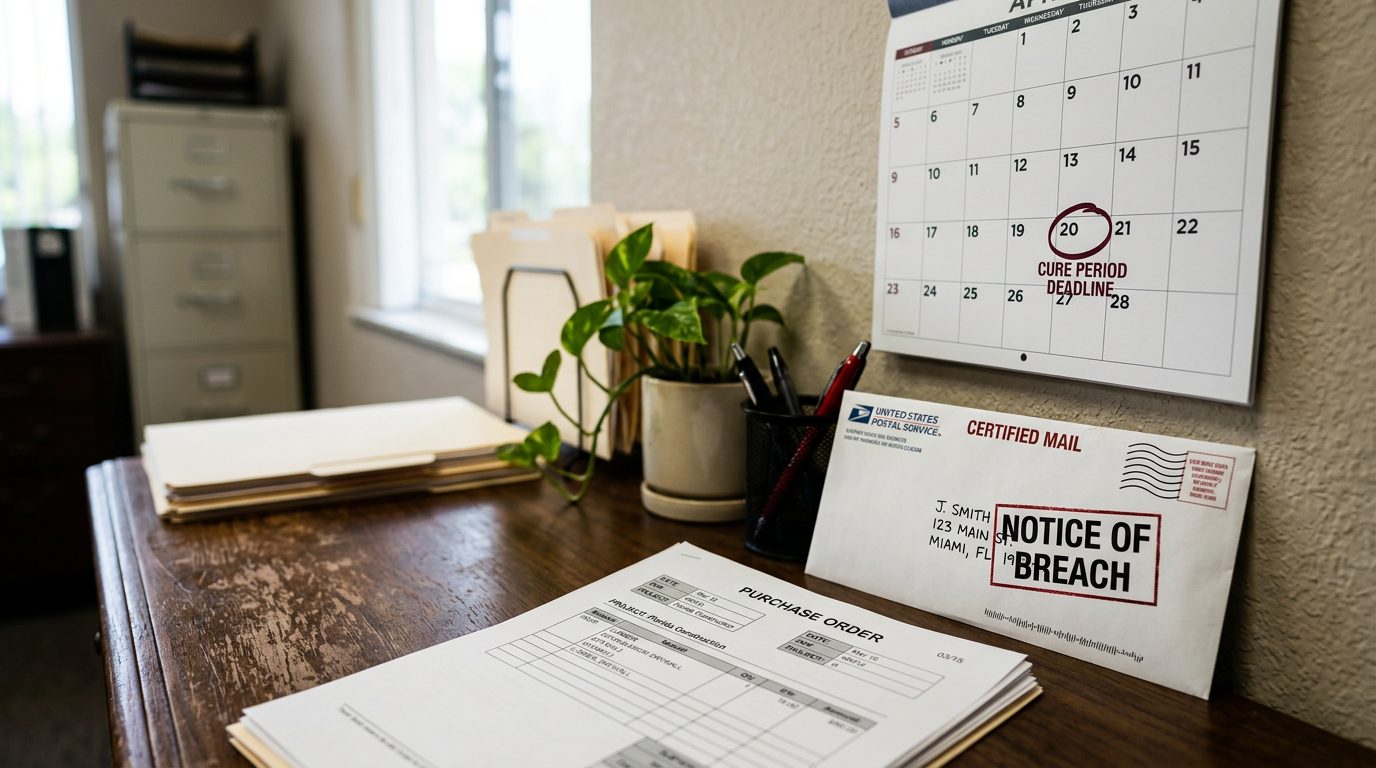
Why Florida Lien Deadlines Matter So Much
If you miss the lien foreclosure deadline in Florida, a court may bar your claim. The exact answer depends on which clock applies and when it started. Those dates are easy to get wrong, so check them early.
Florida sets time limits for lawsuits. These are called statutes of limitations (laws that cap how long you have to sue). Fla. Stat. § 95.11 sets these limits for many types of claims. An action to enforce an equitable lien arising from furnishing labor, services, or material for a real property improvement, a construction defect claim, and a payment bond claim each have their own period. Payment bond claims governed by s. 255.05(10), s. 337.18(1), or s. 713.23(1)(e) follow the periods in those sections instead. Owners and contractors both need to check their dates, because the clock affects both sides of a project.
If a lien notice on your property or an unpaid job has you counting days, we can talk through your dates with you and help you see where you stand. Talk it through with our team — we can walk you through how a situation like yours is usually handled and what your options are.
Lien Dates Start From Specific Events
Lien deadlines do not start on a day you pick. They start on an event. Under Fla. Stat. § 95.031, a cause of action accrues “when the last element constituting the cause of action occurs.” In plain terms, the clock starts at the last event that completes the claim.
Many people count from the wrong day. They start from the date an invoice went unpaid, or the date someone promised to pay. A later bill date is not the trigger the statute names.
Mistakes often come from memory. Pull your job logs, delivery tickets, sign-off sheets, and the contract. These records show the actual dates, and they matter more than your recollection.
Construction Claims Run on a Four-Year Clock
Claims about the design or construction of an improvement to real property follow a longer period. Under § 95.11, these actions run four years. Under Fla. Stat. § 95.11, for an action founded on the design, planning, or construction of an improvement to real property, the time runs from the date the authority having jurisdiction issues a temporary certificate of occupancy, a certificate of occupancy, or a certificate of completion, or the date of abandonment of construction if not completed, whichever date is earliest. Fla. Stat. § 95.11 reads: “(b) An action founded on the design, planning, or construction of an improvement to real property, with the time running from the date the authority having jurisdiction issues a temporary certificate of occupancy, a certificate of occupancy, or a certificate of completion, or the date of abandonment of construction if not completed, whichever date is earliest; except that, when the action involves a latent defect, the time runs from the time the defect is discovered or should have been discovered with the exercise of due diligence.” If construction is abandoned before it’s finished, the abandonment date counts instead.
Hidden flaws, called latent defects, work differently. For a latent defect, the time runs from when the defect is discovered or should have been discovered with due diligence. Even then, the action must be started within seven years after the certificate or abandonment date.
Fixing a defect does not automatically restart the clock. For work done under a duly issued building permit, the statute says correction or repair “does not extend the period of time within which an action must be commenced.”
The One-Year Period for Equitable Lien Actions
Section 95.11(6)(b) of the Florida Statutes sets a one-year period for an action to enforce an equitable lien arising from the furnishing of labor, services, or material for the improvement of real property. Under § 95.11(6)(b), an action to enforce an equitable lien arising from furnishing labor, services, or material for the improvement of real property has a one-year period.
A payment bond claim has its own one-year rule. Under § 95.11(6)(e), the period runs from the last furnishing of labor, services, or materials. If the contractor is the principal on a bond on the same project, the contractor’s last furnishing can control instead, whichever is later. That subsection also carves out certain public-project and lien-specific actions.
Starting talks or sending a demand letter is not the same as filing suit. The lawsuit must be commenced within the period.
What Happens If a Deadline Is Missed
A late lawsuit can be barred. The statute says the period for a payment bond claim runs from the last furnishing of labor, services, or materials, and a late suit can be barred. If the suit comes late, the claim may fail even when the work was finished and the bill is unpaid.
Each claim has its own clock. A missed one-year date tells you nothing about a separate four-year construction period. Check each claim on its own dates.
Owners should check the same dates from the other side. Look at when the work ended, when any notice was served, and when any lawsuit was filed. Compare those dates against the periods above. Whether a claim survives depends on the facts and on whether a pause applies, which the next section explains.
When the Clock Can Pause
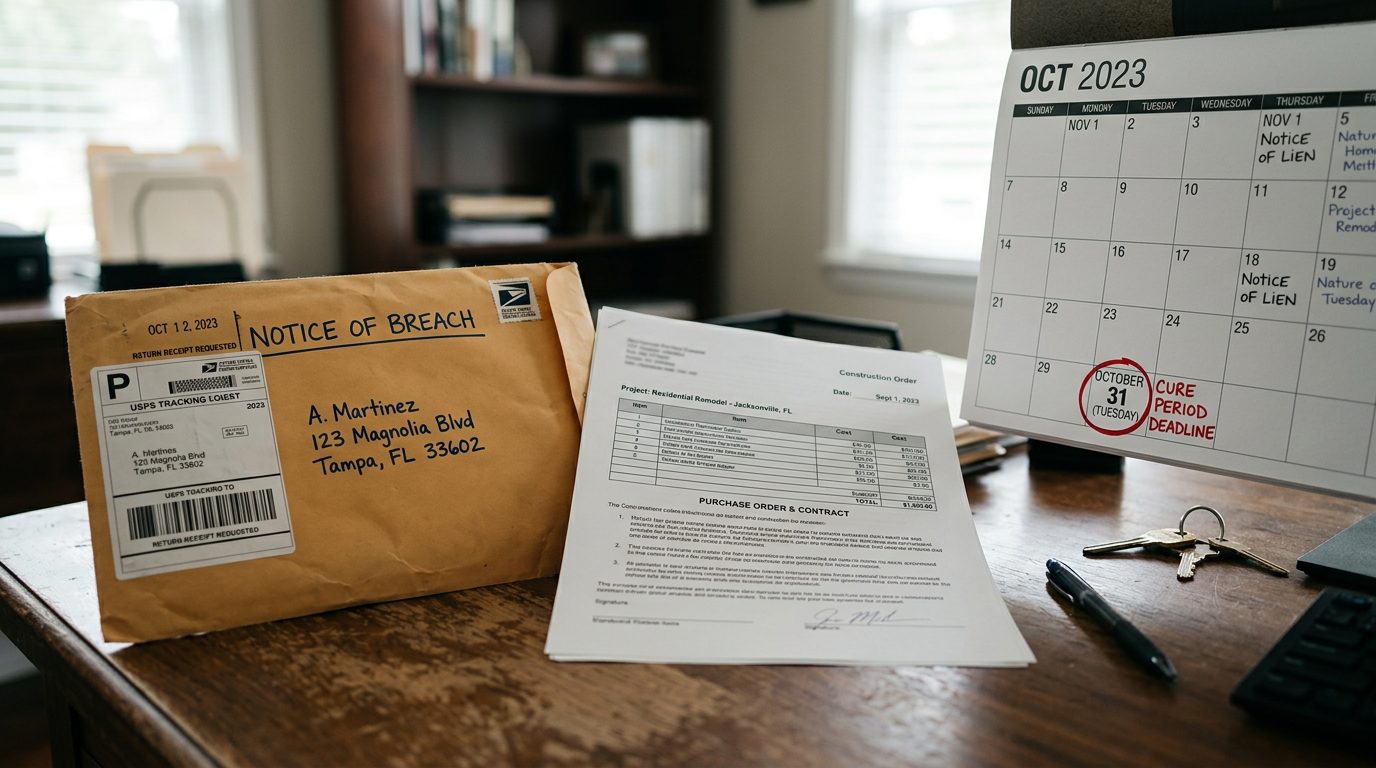
Tolling means the clock stops running for a period. Under § 95.051(1), the running of time is tolled by the pendency of any arbitral proceeding about the dispute that is the subject of the action. Paying part of the principal or interest on a written obligation also tolls the period.
The statute lists other pauses too, such as the defendant’s absence from Florida or concealment. Those apply only where process cannot be served on the person to be sued.
A hardship does not pause the clock. Don’t assume a missed date will be excused.
Not sure what your next step is?
Talk it through with our team — we can walk you through how a situation like yours is usually handled and what your options are.
Where a Lien Foreclosure Suit Is Filed
Florida lawsuits must be brought in a specific county. Under Fla. Stat. § 47.011, actions “shall be brought only in the county where the defendant resides, where the cause of action accrued, or where the property in litigation is located.” The statute does not apply to actions against nonresidents.
For property in Hillsborough County, the county where the property sits is one of the places the statute names. The county where the defendant lives or where the claim arose may also qualify, so the facts decide the right county.
Serving Tampa and Hillsborough County Businesses
Ayala Law PA focuses on business litigation. That includes construction litigation, such as contractor and subcontractor disputes, lien foreclosure, and construction contract fraud. The firm also handles real estate and commercial contract disputes.
Eduardo A. Maura is the responsible lawyer for this page. The firm’s only office is at 1646 W Snow Ave, Tampa, Florida. The firm serves businesses and property owners in Tampa, Hillsborough County, Brandon, Riverview, Plant City, Temple Terrace, and the Tampa Bay area.
Talk Through Your Lien Dates With Ayala Law PA
Many readers are looking at these deadlines for a project they did not plan for. You may have received a lien notice on property you own or manage. You may be the unpaid contractor or supplier trying to protect a claim.
How long do I have to foreclose a construction lien in Florida?
Under the general rule in § 95.031, the time to bring an action runs from when the cause of action accrues, except as provided in subsection (2), in s. 95.051 and elsewhere in these statutes.
What happens if I miss the lien foreclosure deadline?
A late lawsuit can be barred, so the claim may fail even if the work was completed. Pause rules are limited, so review your dates early.
If a lien notice on your property or an unpaid job has you counting days, reach out to Ayala Law PA at (305) 570-2208 or through our contact page to talk through your dates.



