
You finished the work, sent the invoices, and the payments stopped. Now you need to know whether you still have a claim against the property.
Florida notice to owner lien rights depend on taking the notice steps on time. A missed step can cost a lien even when the unpaid balance is real.
This guide covers what the notice is, which property a lien can reach, how the time limits work, the mistakes that cost lien rights, and what happens when a dispute becomes a lawsuit.
What a Florida Notice to Owner Is and Who Needs to Send One
A notice to owner is a written notice sent to the property owner before a lien is recorded. It is not a lien itself.
Subcontractors and suppliers are the usual senders.
A general contractor who signs directly with the owner sits in a different position. The rules for that role can differ.
Can a construction lien be asserted in Florida?
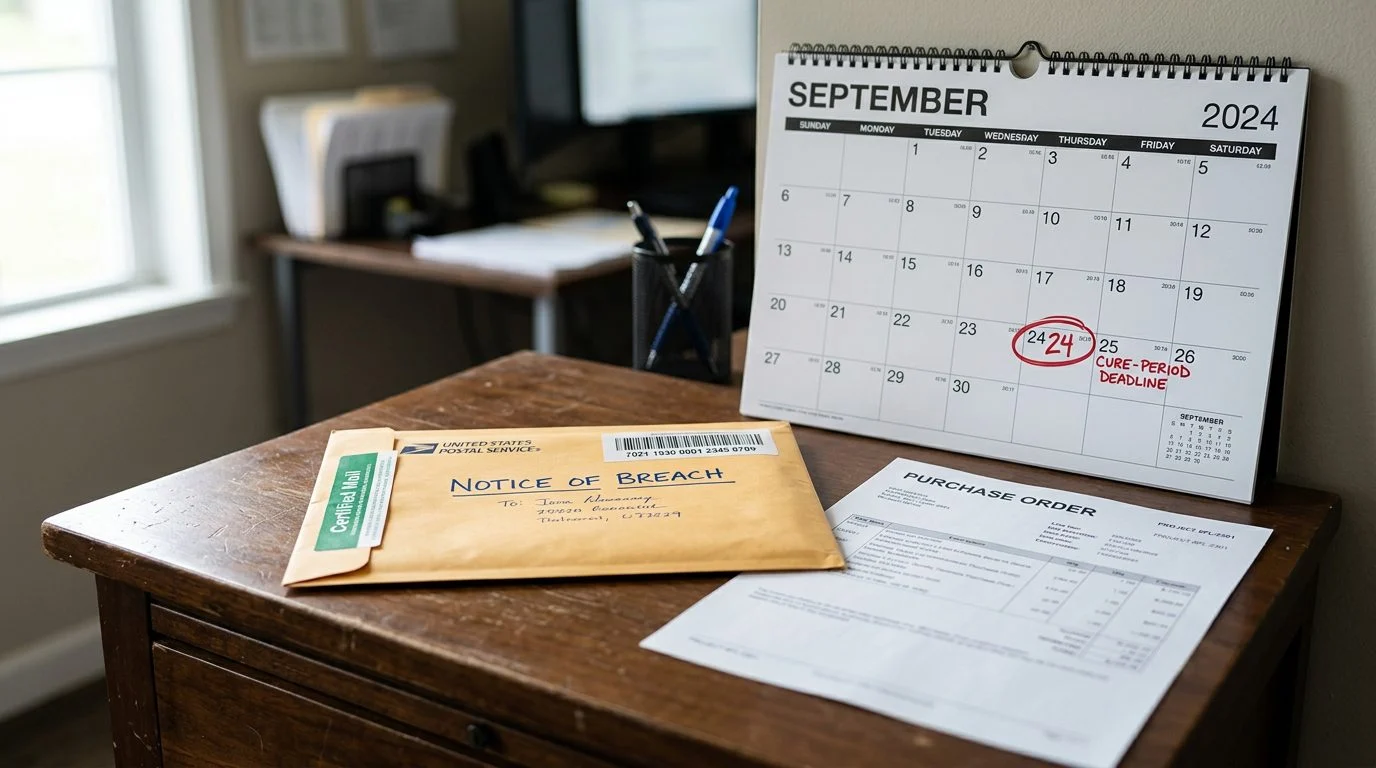
Many contractors treat the notice as paperwork. It is the step that keeps the lien claim available, so put it on the calendar from the first day of work. The notice also gives the owner written proof that a supplier or subcontractor is on the job.
If an unpaid balance has you counting the days on a lien step, our team can talk through the dates on your project with you. Talk it through with our team — we can walk you through how a situation like yours is usually handled and what your options are.
What Property Interests a Florida Construction Lien Can Reach
A construction lien is aimed at the property where the work was done. That makes the ownership of the property central to the analysis.
Who holds title matters. So does the contract. The owner named in the contract and the owner of record may not be the same person.
Some properties split the interests. A leased building, a condominium, and shared common areas can each raise different questions about who can be reached.
Start with the title records, the lease, and the contract. Then look at the invoice.
A lawsuit can reach more than the lien. Under Florida law, property subject to levy and sale includes stock in corporations. That matters when the owner is a business with shareholders.
Lien questions and collection questions are different. Each needs its own check of the facts.
Florida Notice to Owner Deadlines and the Time Limits That Apply
Lien steps run on short, fixed clocks. Lawsuit deadlines run on separate tracks.
Chapter 713 sets its own timing for the notice and the lien claim. Work them out from your own records.
Lawsuit deadlines are longer, but they are not the same. The main ones include:
- Equitable lien claims: one year. An action to enforce an equitable lien for labor, services, or materials must be brought within one year (Fla. Stat. § 95.11).
- Payment bond claims: one year. For claims against a payment bond on which the principal is a contractor, subcontractor, or sub-subcontractor, the action must be brought within one year, except for actions governed by s. 255.05(10), s. 337.18(1), or s. 713.23(1)(e). The clock generally runs from the last furnishing of labor, services, or materials, or from the contractor’s last furnishing if the contractor is the principal on a bond on the same construction project, whichever is later (Fla. Stat. § 95.11). Listed exceptions apply (Fla. Stat. § 95.11).
Missed dates are a common way lien rights are lost.
Common Notice to Owner Mistakes and How to Prevent Them
The most common lien mistakes involve wrong dates, wrong recipients, bad details, and missing proof.
- Missing the start date. Counting from the wrong day can close the window early. Write down your first day on site or first delivery, and check it against your invoices.
- Confirm every name and address from the contract and recorded documents before sending.
- Incomplete or incorrect information. A wrong property description, owner name, or amount invites dispute. Check the legal description and names word by word.
- Check the requirement before you rely on it.
- No proof of delivery. If the owner disputes service, proof is your evidence. Use a delivery method that creates a record, and keep copies.
Put each date on your calendar as soon as you know it.
What Happens When a Lien Dispute Becomes a Lawsuit
A dispute that does not settle often becomes a lawsuit. Florida law generally requires suit in the county where the defendant lives, where the claim arose, or where the property sits, but this section does not apply to actions against nonresidents (Fla. Stat. § 47.011).
Most disputes follow a similar path. You review the contract, pay applications, notices, and recorded documents. Then you send a demand and negotiate. If that fails, suit has to start before the time limit runs.
Under Fla. Stat. § 44.102, a court must, upon request of one party, refer a filed civil action for monetary damages to mediation, provided the requesting party is willing and able to pay the costs or the costs can be equitably divided between the parties. Fla. Stat. § 44.102 reads: “(2) A court, under rules adopted by the Supreme Court: (a) Must, upon request of one party, refer to mediation any filed civil action for monetary damages, provided the requesting party is willing and able to pay the costs of the mediation or the costs can be equitably divided between the parties, unless: 1.” Exceptions include suits to collect a debt and cases the parties agreed to send to binding arbitration.
If a dispute goes to arbitration, the time the arbitration is pending can pause the limitations clock (Fla. Stat. § 95.051).
If a contract allows attorney’s fees to a party that must enforce it, a court may allow reasonable fees to the other side if that side prevails, for contracts entered into on or after October 1, 1988 (Fla. Stat. § 57.105).
Claims that overlap a written contract often face a hurdle. When an express contract covers the same subject, claims arising from that relationship will not support an unjust enrichment claim (Williams v. Johnson).
How Ayala Law PA Approaches Construction Lien Rights Matters
Ayala Law PA focuses on business litigation, including construction litigation such as contractor and subcontractor disputes, lien foreclosure, and construction contract fraud.
The firm also handles commercial and contract disputes, shareholder and partnership disputes, real estate litigation, and international trade disputes in Florida courts and arbitration.
Eduardo A. Maura is the responsible lawyer for this page. The firm’s lawyers and support staff review the documents, notices, and dates in each matter.
The firm’s only office is at 1646 W Snow Ave in Tampa, Florida. It serves businesses in Tampa, Hillsborough County, Brandon, Riverview, Plant City, Temple Terrace, and the wider Tampa Bay area.
Lien questions often sit alongside payment and contract questions. The firm reviews them together.
Not sure what your next step is?
Talk it through with our team — we can walk you through how a situation like yours is usually handled and what your options are.
Frequently Asked Questions About Florida Notice to Owner Lien Rights
Do subcontractors and suppliers need to send a notice to owner in Florida?
Whether it applies to a given job turns on your position and the timing of your work.
What is the difference between a notice to owner and a claim of lien?
A notice to owner is a warning sent to the owner before a lien. A claim of lien is recorded against the property, and each step has its own deadline.
What if I missed the notice deadline?
Your rights may be affected. The dates, the contract, and the payment records decide which options may remain.
Can a lien reach a property if the owner already paid the general contractor?
The contracts and payment records determine how that plays out.
Does the notice have to come from a lawyer?
If an unpaid balance has you counting days on a lien step, reach out to Ayala Law PA at (305) 570-2208 or request a case evaluation.



