
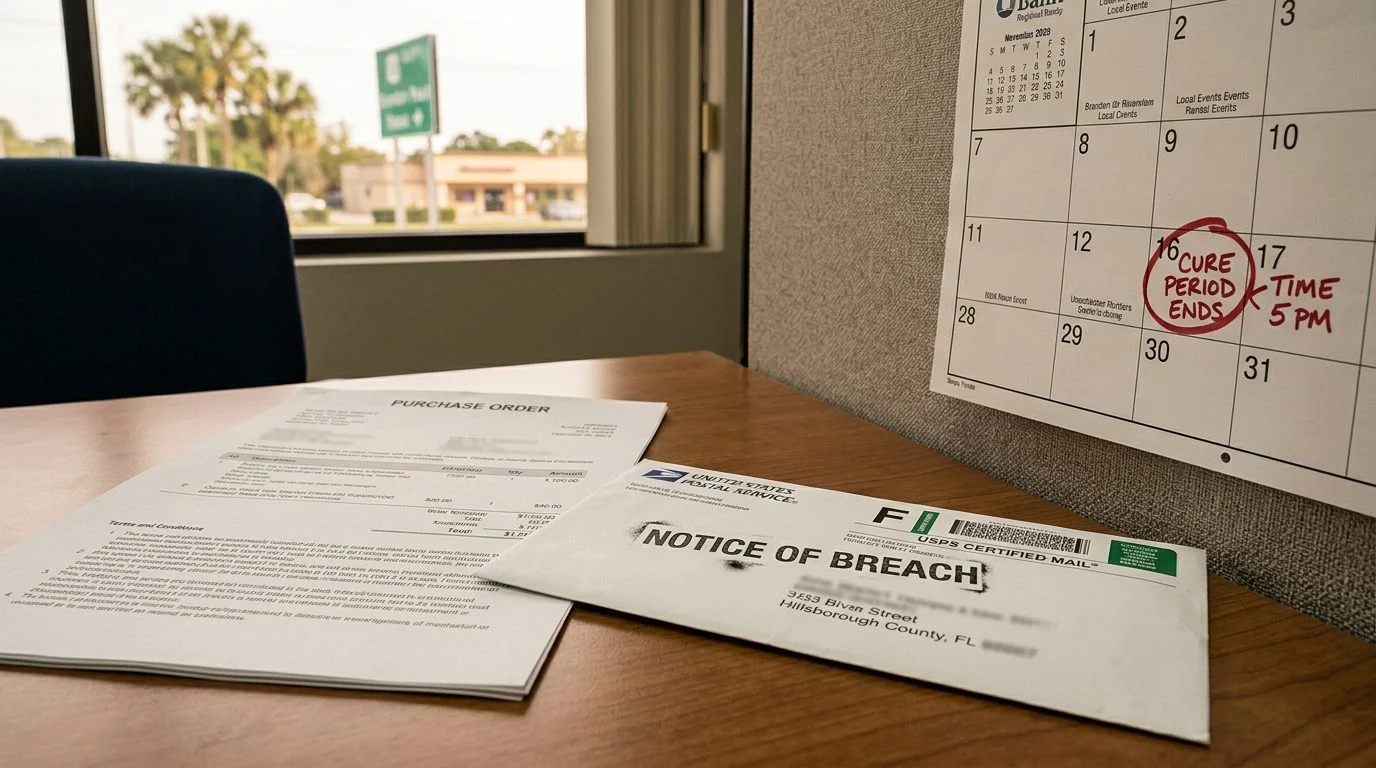
If an arbitration award just landed in your inbox, you may have a short window to respond. The deadline to vacate an arbitration award in Florida is generally 90 days after you receive notice of the award.
This page explains when that clock starts, what a court can review, and what to do while the window is open.
How Much Time Do You Have to Challenge an Arbitration Award in Florida?
Generally, you have 90 days after you receive notice of the award to file a motion to vacate. The same 90-day limit applies to a motion to modify or correct it. Under Fla. Stat. § 682.13, upon motion of a party to an arbitration proceeding, the court shall vacate an arbitration award if one of the listed grounds applies, such as an award procured by corruption, fraud, or other undue means; a motion to vacate generally must be filed within 90 days after the movant receives notice of the award, unless the movant alleges corruption, fraud, or other undue means, in which case the 90 days run from when the ground is known or would have been known with reasonable care.
Florida’s arbitration law is Chapter 682 of the Florida Statutes. The Revised Florida Arbitration Code governs agreements to arbitrate made on or after July 1, 2013. See § 682.013.
Ninety days is short, and it runs fast in a busy company. Put the date on your calendar the day the award arrives.
If an arbitration award just arrived in your contract, partnership, construction or real estate dispute, our team can help you check whether the 90-day window is still open. Talk it through with our team — we can walk you through how a situation like yours is usually handled and what your options are.
When Does the 90-Day Clock Start, and How Do You Prove It?
The clock starts when you receive notice of the award.
Keep proof of it. Save the email with the award attached, the courier receipt, any signed delivery slip, and the cover letter. Note the exact time you received it.
Some motions follow a different starting point. If the claim is that the award was procured by corruption, fraud or other undue means, the 90 days run from when that ground is known, or would have been known with reasonable care. See § 682.13.
A modified or corrected award starts its own 90-day count when you receive notice of that award. Fla. Stat. § 682.13 reads: “(2) A motion under this section must be filed within 90 days after the movant receives notice of the award pursuant to s. 682.09 or within 90 days after the movant receives notice of a modified or corrected award pursuant to s. 682.10, unless the movant alleges that the award was procured by corruption, fraud, or other undue means, in which case the motion must be made within 90 days after the ground is known or by the exercise of reasonable care would have been known by the movant.” Track each version separately.
What Is the Difference Between Vacating, Modifying and Confirming an Award?
Vacating sets the award aside. Modifying or correcting fixes specific errors. Confirming means the court approves the award as it stands.
Modification covers narrow problems. On a motion made within 90 days after receiving notice of the award, a court shall modify or correct an award for an evident miscalculation of figures, an evident mistake in describing a person, thing or property, an award on a matter not submitted that may be corrected without affecting the merits of the decision upon the issues submitted, or a form defect that does not affect the merits. See § 682.14.
You can ask for both relief types together. Under the same section, a motion to modify may be joined in the alternative with a motion to vacate.
If the motion to vacate is denied and no motion to modify is pending, the court shall confirm the award. An order confirming an award, vacating it without a rehearing, or modifying it can be appealed. See § 682.20.
Which Grounds Can a Florida Court Use to Vacate an Award?
The list in § 682.13 includes:
- The award was procured by corruption, fraud or other undue means.
- Evident partiality by a neutral arbitrator, or corruption by an arbitrator.
- Arbitrator misconduct that prejudices a party’s rights.
- Refusal to postpone for sufficient cause, refusal to hear material evidence, or conducting the hearing contrary to s. 682.06 so as to substantially prejudice a party.
- An arbitrator who exceeded the arbitrator’s powers.
- No agreement to arbitrate, unless the party took part without raising the objection in time.
- Arbitration conducted without proper notice that it had started, causing substantial prejudice.
For fraud, partiality, corruption or misconduct, the rehearing must be before a new arbitrator.
These grounds are specific. A disagreement with the arbitrator’s view of the facts is not on the list.
Can a Court Overturn an Award Just Because the Arbitrator Got It Wrong?
Your challenge has to fit one of the listed grounds.
Florida law makes a written arbitration agreement valid, enforceable and irrevocable. The exception is a ground that exists for revoking any contract. See § 682.02.
Challenges to the agreement itself are narrow too. Section 682.02 does not address unconscionability; its exception is that the agreement is enforceable except upon a ground that exists at law or in equity for the revocation of a contract. For the Florida Supreme Court’s unconscionability holding, see Basulto v. Hialeah Automotive.
Under the same statute, an arbitrator decides whether a condition precedent to arbitrability has been met. An arbitrator also decides whether a contract with a valid arbitration agreement is enforceable.
How Do You Preserve Your Record While the Deadline Runs?
Collect the full arbitration file now. Gather the pleadings, the arbitration agreement, exhibits, hearing transcripts or recordings, orders and the signed award. You need these to show which ground applies.
Raise objections as they come up. If you take part in the hearing without objecting to the existence of an arbitration agreement in time, you may lose that ground. See § 682.13.
If you need more time, ask in writing and state the cause. The statute addresses an arbitrator’s refusal to postpone upon a showing of sufficient cause.
Keep a dated log of calls and emails with the arbitrator, the administrator and the other side’s counsel.
Not sure what your next step is?
Talk it through with our team — we can walk you through how a situation like yours is usually handled and what your options are.
What Happens if You Miss the 90-Day Deadline?
If you miss the window, you may lose the right to challenge the award on these grounds.
The award may then move toward confirmation. If a motion to modify is not granted and no motion to vacate is pending, the court shall confirm the award as made. See § 682.14.
An enforceable award can affect cash flow, ownership interests, lien or bond exposure, and relationships with lenders and vendors. How much it matters depends on the facts of your dispute.
Don’t count on negotiation to fix a missed window. The statute sets the time limit.
How Can Ayala Law PA Help With Your Arbitration Award Deadline?
Ayala Law PA focuses on business disputes, including commercial and contract disputes, shareholder and partnership disputes, construction litigation, real estate litigation and international trade litigation. These matters can proceed in Florida courts or in arbitration.
Eduardo A. Maura is responsible for this page’s content. The firm’s office is at 1646 W Snow Ave, Tampa. The firm serves businesses in Tampa, Hillsborough County and the Tampa Bay area.
Your matter may be referred to another lawyer or law firm. No outcome is promised, and each dispute turns on its own facts.
Under Rule 4-1.5 of the Rules Regulating The Florida Bar, when the lawyer has not regularly represented the client, the basis or rate of the fee and costs must be communicated to the client, preferably in writing, before or within a reasonable time after commencing the representation. Ask about fees and costs when you reach out.
How many days do I have to vacate an arbitration award in Florida?
Generally, a motion to vacate must be filed within 90 days after you receive notice of the award. If you allege the award was procured by corruption, fraud, or other undue means, the 90 days run from when that ground is known or would have been known with reasonable care. Count from the day you actually received notice. Count from the day you actually received it.
Can I modify an arbitration award instead of vacating it?
Yes. A motion to vacate must be filed within 90 days after you receive notice of the award, unless you allege the award was procured by corruption, fraud, or other undue means; in that case the 90 days run from when that ground is known or would have been known with reasonable care. The 90-day period for a motion to modify or correct is set by s. 682.14(1) itself. Under s. 682.14(1), if a motion to modify or correct is made within 90 days after you receive notice of the award, or within 90 days after you receive notice of a modified or corrected award under s. 682.10, the court shall modify or correct the award when one of the listed grounds applies.
Does the deadline start when the arbitrator signs the award?
The statute counts from when you receive notice of the award. Keep proof of that date.
If an award has arrived in your business dispute and the 90 days are running, call (305) 570-2208 or send a request through the Ayala Law PA contact page so we can check the dates with you.



