

Shareholder oppression in a Florida corporation means insiders run the company in a way that unfairly hurts a minority owner. Florida doesn’t treat it as one named lawsuit. Instead, the Florida Business Corporation Act lists specific grounds, remedies and procedures. The right path changes with the facts. Ayala Law PA focuses on business and shareholder disputes. This page is general information, not legal advice.
What Shareholder Oppression Means Under Florida Law
Shareholder oppression is the everyday name for insiders treating a minority owner unfairly. It isn’t a single claim you can file by that name. Florida’s main statute on court-ordered dissolution is § 607.1430. It lists specific grounds. One, in a proceeding by the Department of Legal Affairs, is that the corporation obtained its articles of incorporation through fraud. Another is that it keeps exceeding or abusing its legal authority.
The first group of grounds applies to proceedings the Department of Legal Affairs brings. The statute also says its list doesn’t exclude other causes set out in other statutes.
Whether a case fits any ground turns on the facts.
If you hold a minority stake and feel shut out of decisions or information, we can review your options with you. Talk it through with our team — we can walk you through how a situation like yours is usually handled and what your options are.
Common Causes of Minority Shareholder Disputes
Most minority disputes start with a few familiar patterns. An owner gets shut out, cut off from information, left out of payments, or diluted. Each pattern can point to a different remedy.
Exclusion from management is the most common starting point. An owner who was promised a role, a board seat or a voice in major decisions may find those promises ignored.
Denied information is another pattern. Shareholders can inspect and copy certain corporate records, including accounting records and financial statements, if the shareholder’s demand is made in good faith and for a proper purpose. They must give written notice at least 5 business days before the inspection date. The demand must describe its purpose with reasonable particularity. § 607.1602 sets out these conditions, and for these records it also requires that the demand describe the records sought and that the records be directly connected with the shareholder’s purpose.
Withheld distributions while insiders collect salaries, bonuses or perks form a second pattern. New share issues or restructuring that shrink a minority owner’s percentage and voting power form a third. Some insiders push an owner toward a low-value exit, often called a freeze-out.
For the broader picture, read our guide to shareholder disputes in Florida. Waiting can make the record harder to rebuild, so early steps matter.
Breach of Fiduciary Duty and Breach of the Shareholder Agreement
Under Fla. Stat. § 607.0830(1), each director must act in good faith and in a manner the director reasonably believes to be in the best interests of the corporation. A shareholder agreement can add separate contract rights. These two sources often sit alongside an oppression-style complaint.
Under § 607.0830, each director must act in good faith. The director must also act in a way the director reasonably believes is in the corporation’s best interests. Board members must use the care an ordinary prudent person in a like position would reasonably believe appropriate under similar circumstances when becoming informed for a decision or devoting attention to an oversight function. When insiders move company money to themselves, the facts may support a claim based on those duties.
A written shareholder agreement can do a lot. Under § 607.0732, an agreement among the shareholders that complies with the section is effective and can limit the board’s powers, require dissolution at a shareholder’s request, or set up a way to break a deadlock.
Check the documents for an arbitration clause. Under § 682.02, a written agreement to arbitrate is valid and enforceable, with limited exceptions. The court decides whether the agreement exists. If your agreement requires arbitration, the dispute may proceed there instead of in court.
Remedies a Minority Owner Can Pursue
The right one turns on the facts and the governing documents.
The statute lets a court choose remedies short of dissolution. Under § 607.1434, in a proceeding under § 607.1430 and upon a showing of sufficient merit to warrant such remedy, a court may, as an alternative to dissolution, appoint a receiver or custodian. It may appoint a provisional director or order a purchase of the petitioning shareholder’s shares. It may also make any other equitable order it considers appropriate, once the case shows sufficient merit.
Buyouts follow set steps. Under § 607.1436, the corporation may elect to buy the petitioning shareholder’s shares at fair value. If it doesn’t, one or more shareholders may. The election may be filed within 90 days after the petition, or later if the court allows. Once filed, it is irrevocable unless the court finds it equitable to set it aside.
If the parties can’t agree, the court sets fair value. It uses the day before the petition was filed, unless it picks another date. The court can order payment in installments when necessary in the interests of equity, and require security. Interest may be allowed. Valuation disputes often turn on careful records.
Damages are a separate remedy. No outcome is promised in advance.
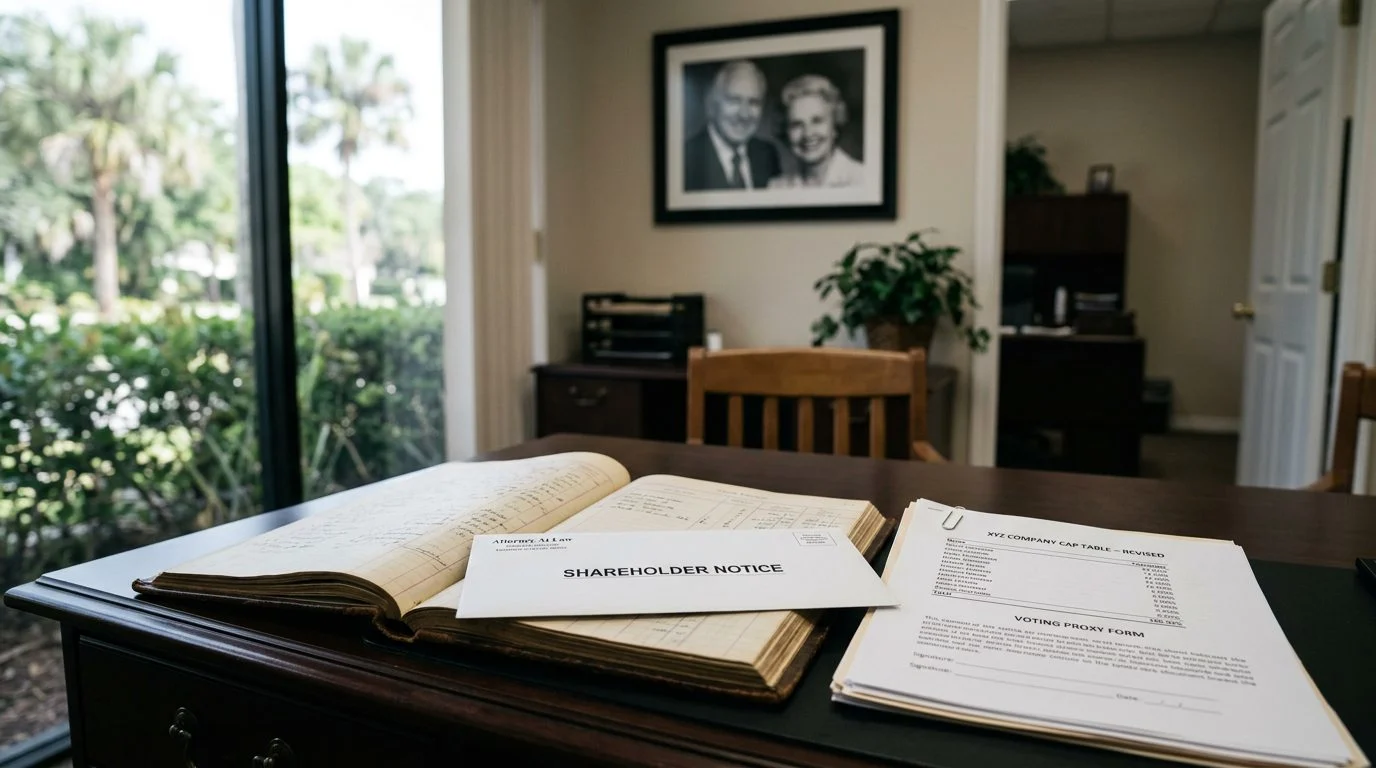
If you co-own a Florida company and have been pushed out of management or cut off from distributions, you may have a claim worth reviewing. Talk it through with our team — we can walk you through how a situation like yours is usually handled and what your options are.
Interim Relief While a Dispute Is Pending
A court can act before the case ends to protect company assets and operations. Interim relief is a request the court decides, not a promise.
Under § 607.1431, venue for a judicial dissolution proceeding lies in the circuit court in the applicable county. In that proceeding, the court may issue injunctions. It may appoint a receiver or custodian. It may take action to preserve corporate assets wherever located. It may carry on the business until a full hearing can be held.
A receiver or custodian isn’t appointed casually. Under § 607.1432, the court holds a hearing, with notice to all parties, before making the appointment. A receiver may sell assets if the court authorizes it. A custodian may exercise all of the powers of the corporation, through or in place of its board of directors or officers, to the extent necessary to manage the affairs of the corporation in the best interests of its shareholders and creditors.
Interim relief matters most when a transaction, asset transfer or new share issue could change the company before a final decision. Timing counts, so raise the issue early.
Preserving Records and Evidence Early
Keep what you already have, and keep it unchanged. Governing documents, financial statements, bank records, emails and meeting notices are the starting point.
Write down dates and conversations as they happen. A short note made the same day beats a memory from months later. Don’t delete or edit company files, and don’t forward confidential records to outsiders.
Owners can also request records. As noted above, § 607.1602 gives shareholders a right to inspect and copy certain records on written notice given at least 5 business days in advance, while access to other records, such as board minutes and other books and records, also requires that the demand be made in good faith and for a proper purpose. If a company refuses a proper request, § 607.1604 lets a circuit court order inspection and copying. If a corporation does not allow a shareholder to inspect and copy records that the shareholder may inspect under § 607.1602(1) and the court orders inspection, the court must also order the corporation to pay the shareholder’s expenses, including reasonable attorney fees, incurred to obtain the order and enforce those rights. For records covered by § 607.1602(2), the court may impose reasonable confidentiality restrictions and must also order the corporation to pay those expenses, unless the corporation establishes that it refused inspection in good faith because it had a reasonable basis to doubt the shareholder’s right to inspect, or because it required reasonable confidentiality restrictions that the demanding shareholder was unwilling to agree to.
A company may deny certain demands made for an improper purpose. So a demand should state a clear, proper reason tied to your interest as an owner.
Once a dispute is expected, a litigation hold (a written instruction to keep relevant records) helps stop routine deletion. Preserve anything that could matter.
Ordinary Business Disagreement Versus Oppression
A disagreement about strategy, pricing or hiring is not, by itself, oppression. Owners can disagree and still act in good faith.
The key question is usually whether a decision serves the company or serves insiders at the minority owner’s expense. Courts look at whether directors acted in good faith and with reasonable care, as § 607.0830 describes.
Conflict-of-interest deals get special treatment. Under § 607.0832, a director’s conflict-of-interest transaction that is fair to the corporation at the time it is authorized, approved, effectuated, or ratified is not void or voidable. If the material facts of the transaction and the director’s interest were disclosed or known, and the transaction was approved by a majority of the qualified directors or by a majority of the votes cast by disinterested shareholders, the person challenging the transaction has the burden of proving the lack of fairness of the transaction. The challenger can still show that a director or shareholder wasn’t disinterested. Document the approval process.
Timing matters too. A derivative complaint is one brought for the corporation. Under § 607.0742, it must be verified. It must also allege any demand made on the board and either that the board refused, rejected, or ignored the demand prior to the expiration of 90 days from the date the demand was made, or why waiting that period would cause irreparable injury or misapplication or waste of corporate assets causing material injury to the corporation, or why no demand was made. Deadlines differ by claim, so raise timing questions early.
Not sure what your next step is?
Talk it through with our team — we can walk you through how a situation like yours is usually handled and what your options are.
Talking Through Your Situation With Ayala Law PA
Ayala Law PA focuses on business litigation, commercial litigation, contract disputes and shareholder disputes in Florida courts and arbitration. The firm’s bona fide office is at 1646 W Snow Ave, Tampa, Florida. The firm handles matters for businesses and owners in Tampa, Hillsborough County, Brandon, Riverview, Plant City, Temple Terrace and the wider Tampa Bay area.
Eduardo A. Maura is the responsible lawyer for this page. Depending on the facts, a matter may be referred to another lawyer or firm. This page is general information, not legal advice. Fee terms vary by matter, and we discuss them when you reach out.
Frequently asked questions
Is shareholder oppression a lawsuit in Florida?
Not by that name. Florida’s statute lists specific grounds and remedies. A claim may also rest on fiduciary duties or a shareholder agreement.
Can a minority shareholder inspect the company’s books?
Yes, certain records can be inspected after written notice at least 5 business days ahead. The purpose must be proper and clearly stated.
How long does a buyout election have?
The election may be filed within 90 days after the petition is filed. The court can allow a later filing.
If you co-own a Florida company and have been pushed out of management or cut off from distributions, you may have a claim worth reviewing. Our team can talk through your facts with you. Call (813) 414-5715 or request a case evaluation.



