
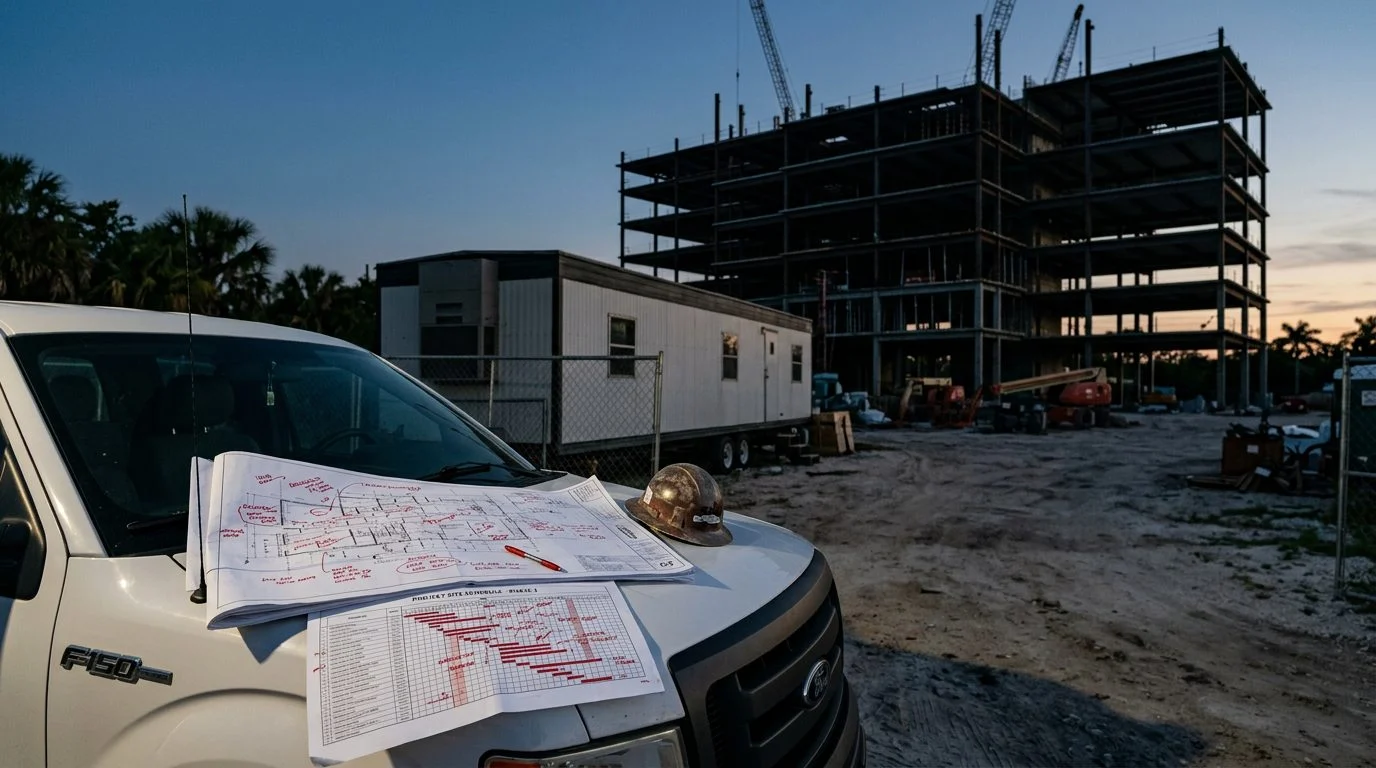
When a contractor walks off a Florida job, your options depend on what the contract says and what the contractor did. An abandoned job lawsuit in Florida usually turns on the stoppage date, the notice history, and the schedule. This page explains how these cases are built and what to do first.
What Counts as an Abandoned Job or Delay Claim?
Abandonment means the contractor stops work without a contract reason and does not come back. Unreasonable delay is different. The work keeps moving, but it falls months behind the schedule the contract set.
The distinction matters. Whether you can end a construction contract, and what damages you may be able to pursue, depends on the specific facts and the terms of your agreement. Reviewing the notice and cure terms in your contract is a practical first step when a termination is being considered.
This page is written for owners, developers, and general contractors with a Florida construction contract. That includes commercial property owners in Hillsborough County, Brandon, Riverview, Plant City, Temple Terrace, and across the Tampa Bay area.
Timing matters too. Under Florida’s statute of limitations, a claim founded on the design, planning, or construction of an improvement to real property generally must be brought within four years. That period usually runs from the earliest of these dates: when the authority having jurisdiction issues a temporary certificate of occupancy, a certificate of occupancy, or a certificate of completion, or when construction is abandoned if it was never completed. The period runs from whichever of these comes first: the date the authority having jurisdiction issues a temporary certificate of occupancy, a certificate of occupancy, or a certificate of completion, or the date construction is abandoned if it was not completed. When the claim involves a latent defect, the four years instead run from the time the defect is discovered or should have been discovered with the exercise of due diligence, but the action must in any event be commenced within 7 years after that earliest certificate or abandonment date. The clock starts at the earliest of the certificate of occupancy, certificate of completion, or the date construction was abandoned. For latent defects, the time runs from discovery, and the action must be started within seven years of that earliest date.
If a contractor has walked off your Florida job, you may be weighing termination, a replacement contractor, or a notice of default. Our team can review your contract and timeline, so reach out to book a case evaluation. Talk it through with our team — we can walk you through how a situation like yours is usually handled and what your options are.
What Claims and Remedies Are Involved?
Most abandoned-job cases combine a breach claim with a claim for the extra cost of finishing the work. The main pieces are below.
- Breach or wrongful termination: Whether an owner may end a contract depends on the contract’s terms and the facts of the dispute. Timing matters when a contract is being ended, so it is worth discussing the steps before acting.
- Cost to complete: This is the difference between the original contract price and what a replacement contractor charges to finish the work.
- Delay damages: These can include extra loan interest, lost rent, and added site costs. Schedules, invoices, and daily records are the proof.
- Liquidated damages: Some contracts set an agreed amount for each day of delay. Read that wording closely before you rely on it.
- Liens and bonds: Lien and bond rights on construction projects depend on the parties involved and the facts of the project. A payment bond may also respond. Florida’s construction lien law sets its own deadlines for responding.
- Counterclaims: A contractor may claim unpaid work or disputed change orders. Those claims need a response too.
Owners sometimes try a quasi-contract theory when the written contract is silent on a point. Florida courts apply a limit here. In Williams v. Johnson, the Third District stated that an express contract covering the same subject matter will not support an unjust enrichment claim.
What Should You Do to Protect Your Position Now?
Start by gathering the record and reading the contract before you take any step that could be called a termination.
- Collect the file: Pull the signed contract, change orders, the schedule, payment applications, lien waivers, and all written messages about the delay.
- Document the stoppage: Keep dated photos, daily logs, and notes of site visits and days no one showed up.
- Check notice terms: Review the default, notice, and cure provisions before you terminate or send a notice.
- Review before you pay or withhold: Confirm what the contractor has earned, what is disputed, and what waivers were signed. Stopping payment without that review can create a counterclaim.
- Calendar the deadlines: Owners and general contractors can lose lien and bond rights by missing statutory notice or filing periods.
How Does a Matter Typically Proceed?
Most matters move in stages, from document review to demand, then to negotiation, and then to court or arbitration if talks fail.
- Intake and document review: The responsible lawyer reads the contract and project record to identify the claims and defenses that appear available.
- Written demand or notice to cure: A written notice, sent under the contract’s terms, sets the record and can open a path to resolution.
- Negotiation or mediation: Talks may focus on cost to complete, delay damages, and any liens. In a filed civil action for money damages, a party may ask the court to refer the case to mediation under Fla. Stat. § 44.102, and the court must make the referral if the requesting party is willing and able to pay the mediation costs or the costs can be equitably divided between the parties, unless an exception applies.
- Otherwise, the case proceeds in court. Venue lies only in the county where the defendant resides, where the claim arose, or where the property is located, under Fla. Stat. § 47.011. That venue rule does not apply to actions against nonresidents. Discovery and motions follow.
Timelines vary with project size, the contract’s dispute clause, and how the other side responds. Expect months, not days, for a contested matter.
How Does Ayala Law PA Handle These Matters?
Ayala Law PA focuses on construction litigation and commercial contract disputes in Florida courts and arbitration. Eduardo A. Maura is the responsible lawyer for this page.
The firm’s only office is at 1646 W Snow Ave in Tampa, Florida. Businesses in Hillsborough County, Brandon, Riverview, Plant City, Temple Terrace, and the wider Tampa Bay area can contact the firm about their matters.
The practice also covers commercial and contract disputes, shareholder and partnership disputes, real estate litigation, and international trade litigation. A single project dispute often touches several of these areas, so the matter can be reviewed as a whole.
Our team organizes the documents early. The schedule, the payment record, and the notice history often shape how a delay claim is presented. No outcome is promised, because each matter turns on its own contract language and facts.
Frequently Asked Questions
Can I hire another contractor to finish the job?
Possibly, but only after the contract’s termination and notice terms are reviewed. Hiring a replacement too early can create its own problems.
Do I have to keep paying the original contractor?
Not automatically. Review what has been earned, what is disputed, and which lien waivers were signed before you pay or withhold.
What if the contract requires arbitration?
Florida enforces written arbitration agreements, so the contract usually sets the forum. If a court orders arbitration, it must, on just terms, stay any lawsuit involving a claim subject to that arbitration, though it may limit the stay to a severable claim, under Fla. Stat. § 682.03.
How is delay damage calculated?
Proof usually compares the baseline schedule, actual progress, and the costs you can document.
Who pays attorney’s fees in a Florida contract dispute?
Under Florida law, each party generally pays its own fees unless a contract or statute provides otherwise, as stated in Price v. Tyler. A contract’s fee clause can allow the prevailing party to recover fees.
What does a case evaluation cost?
Case evaluations are a paid service. Fees and costs, including filing fees and other expenses, are explained in writing before any engagement.
Not sure what your next step is?
Talk it through with our team — we can walk you through how a situation like yours is usually handled and what your options are.
Talk Through Your Project With Our Team
If a contractor has stopped work or the schedule has slipped for months, you may be deciding whether to terminate, bring in a replacement, or send a formal notice. Those choices carry deadlines and risks. Book a case evaluation or call (305) 570-2208 to review your contract and timeline with Eduardo A. Maura, and bring your paperwork with you.



