
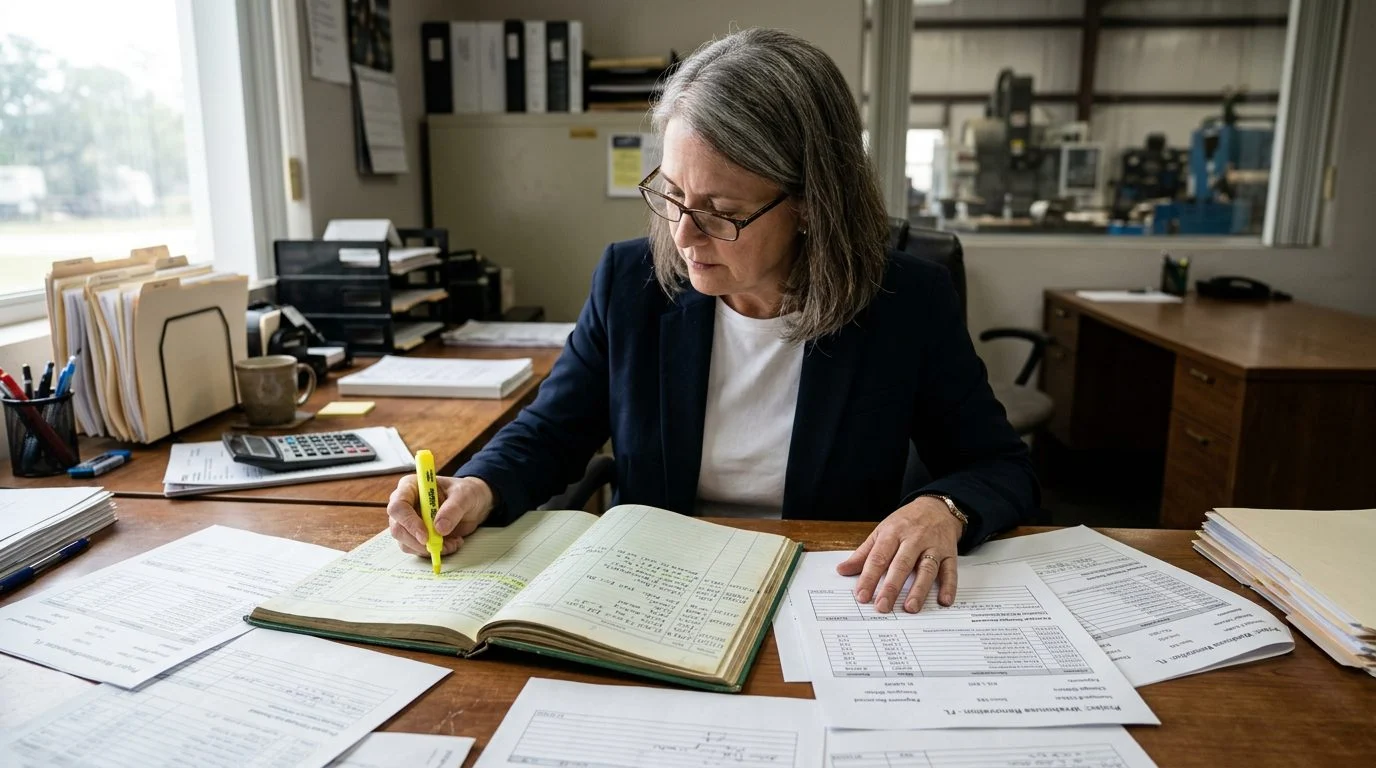
Payment in a change order dispute Florida contractor cases usually turns on three questions. What does the signed contract require for changes? Is the disputed work outside the original scope? What records prove the approval and the work? Florida courts and arbitrators look at the contract language and the facts of each project, so the answer depends on those details. This page explains each question in plain terms, along with the proof problems that often decide these fights. It’s written for contractors, subcontractors, and owners in Hillsborough County and the wider Tampa Bay area.
Start with what the construction contract says about changes
The change order clause is the first place to look. It often sets how changes are proposed, priced, and approved.
Many construction contracts describe a step-by-step process. The contractor may have to submit a written proposal. The owner may have to sign it before work starts. Some contracts set a notice deadline for claiming extra cost or time, and some require a specific form.
Check these terms closely:
- Written change order forms and who must sign them
- Whether work can start before a signed approval
- Notice deadlines for claiming added cost or time
- How the change is priced, such as a fixed sum or cost plus a markup
A missed step can weaken a claim. How much it matters depends on the exact clause and the other facts on the job. The same words can play out differently on different projects. Start with the signed agreement and any amendments.
Not sure what your next step is?
Talk it through with our team — we can walk you through how a situation like yours is usually handled and what your options are.
Why written approval matters in a change order dispute Florida contractor
A signed change order is the clearest proof that the owner agreed to added work and its price.
It shows three things at once. The owner saw the change, agreed to it, and accepted the price. Without a signed form, each of those points becomes something to argue about.
Contractors often start extra work to keep a job moving. That’s understandable on a tight schedule. But if the contract requires written approval first, starting early can make payment harder to collect.
Email, text messages, and signed field tickets sometimes count as written approval. Whether they do depends on the contract’s wording and what the messages say. A text that says “go ahead” may or may not match a clause that calls for a signed change order. Save every message, and don’t assume a casual reply is enough.
Scope: is the disputed work actually outside the contract?
For a dispute over extra work, it helps to gather the contract, any change orders, and the emails, texts or site notes showing who asked for the added work and when.
The base price covers the scope of work. That scope usually comes from the plans, the specifications, and any allowances. An allowance is an amount set aside for an item, such as a fixture, whose final choice wasn’t made at signing. Changes to allowances often cause disputes.
The most common fight is over whether the work was needed to finish the original job. A contractor may say a site condition was not visible in the plans. An owner may say the same work was obvious from the drawings and included in the price. Both sides point to the same documents.
Requests for information (RFIs), site condition records, and revised drawings often show which reading fits. They show what was asked, what was known, and when.
Verbal approvals and the proof problem
A verbal promise to pay for extra work is harder to prove than a written change order.
When an owner says “do it, we’ll pay,” there’s no document showing what was said. The two sides often remember the conversation differently. One may recall a price range. The other may recall no price at all.
Witnesses, timing, and surrounding conduct can support an oral approval. A foreman who heard the instruction helps. So does a text sent that day that refers to the call. The other side will usually challenge that evidence.
Florida treats oral contracts under the basic rules of contract law. In St. Joe Corp. v. McIver, the Florida Supreme Court said an oral contract still needs an offer, acceptance, consideration, and enough detail on essential terms. Those elements are hard to show when the price and scope were never written down.
Whether an oral agreement can be enforced often depends on what the parties put in writing, so reviewing the documents early is worthwhile. That depends on the terms and the facts.
Course of dealing and conduct on the project
How the parties acted on the project can show what they expected.
If the owner approved earlier change orders without objection, that pattern can suggest the owner expected the same process for later changes. Paying an earlier change, accepting finished work, or letting work continue without protest can all be read as conduct. Each side will read the same conduct to fit its own story.
Courts and arbitrators weigh this evidence alongside the written contract. It does not automatically override the contract’s terms.
Some contractors also seek payment under unjust enrichment, a claim based on fairness. Reviewing any signed contract that covers the same work is a sensible early step.

Records that support or defend a change order claim
Signed change orders, daily logs, photos, time sheets, delivery tickets, and invoices usually matter most.
A pricing breakdown that ties each cost to the changed work makes a claim easier to evaluate. Gaps hurt. If crew hours for the extra work were never logged, the claim turns into a matter of memory.
Keep records as the work happens. Records reconstructed weeks later are often questioned. Photo date stamps, message timestamps, and a daily log kept on site can all show when work happened.
Owners need records too. A copy of the change order sent for signature, the response, and any notes on why the work was refused can matter as much as the contractor’s file.
Not sure what your next step is?
Talk it through with our team — we can walk you through how a situation like yours is usually handled and what your options are.
Pricing disputes versus entitlement disputes
Entitlement asks whether the work is payable at all. Pricing asks how much it’s worth.
Keep these questions apart. The parties may agree the work was extra but fight over the price. Or they may dispute whether the change was approved at all. Each question needs its own proof.
Pricing fights often involve markup, overhead, delay costs, and credits for deleted work. The contract’s pricing method and the parties’ records usually drive these arguments. A contract with a unit price or a set markup gives a clearer starting point than one that says nothing about price.
Settlement talks can help. Under § 90.408, an offer to compromise a disputed claim, and statements made in those talks, are generally inadmissible to prove liability or the claim’s value. Where interest accrues and no contract sets the rate, § 687.01 points to § 55.03, which sets the rate of interest payable on judgments or decrees.
How Ayala Law PA handles these disputes
Ayala Law PA focuses on business litigation, including construction litigation.
The firm handles contractor and subcontractor disputes, lien foreclosure, and construction contract disputes in Florida courts and arbitration. Under section 95.11(6)(b) of the Florida Statutes, an action to enforce an equitable lien arising from the furnishing of labor, services, or material for the improvement of real property must be commenced within one year.
Eduardo A. Maura is the responsible lawyer for this page. The firm’s only office is at 1646 W Snow Ave, Tampa. The firm represents businesses in Tampa, Hillsborough County, and the Tampa Bay area in Florida courts and arbitration, and businesses in those areas are welcome to contact the firm to discuss a matter.
Arbitration can matter too. Under § 682.02, a written agreement to arbitrate is valid and enforceable, except on grounds that exist for revoking any contract. If your contract has an arbitration clause, the forum may be part of the analysis.
Some matters may be referred to another lawyer or firm when that’s appropriate. Fees depend on the matter, and the firm explains its fee arrangement when it discusses a case.
Next steps if your change order payment is in dispute
If an owner refuses to pay for added work, or you hold an unsigned change order, start by gathering the records.
Pull together the signed contract, any amendments, change order forms, daily logs, photos, invoices, and every message about the extra work. Write down when each change was requested and when the work was done.
Deadlines matter. Under § 95.03, a contract provision that sets a shorter time to sue than the statute allows is void. § 95.11 requires actions founded on the design, planning, or construction of an improvement to real property to be commenced within 4 years, running from the date the authority having jurisdiction issues a temporary certificate of occupancy, a certificate of occupancy, or a certificate of completion, or the date of abandonment of construction if not completed, whichever is earliest; for a latent defect, the time runs from when the defect is discovered or should have been discovered with due diligence. In any event, the action must be commenced within 7 years after that same date, although counterclaims, cross-claims, and third-party claims arising from the same transaction may be brought up to 1 year after the related pleading is served, even if they would otherwise be time barred.
Frequently asked questions
Do I need a signed change order to get paid for extra work in Florida?
A signed change order is the clearest proof of approval. Whether another record counts depends on the contract’s wording and the facts.
Can a contractor get paid for extra work if the owner only approved it verbally?
It may be possible, but a verbal approval is harder to prove. The answer depends on the contract terms and the evidence.
If an owner won’t pay for work you did beyond the contract, reach out to Ayala Law PA at (305) 570-2208 or through the contact page to talk through your project documents.



