
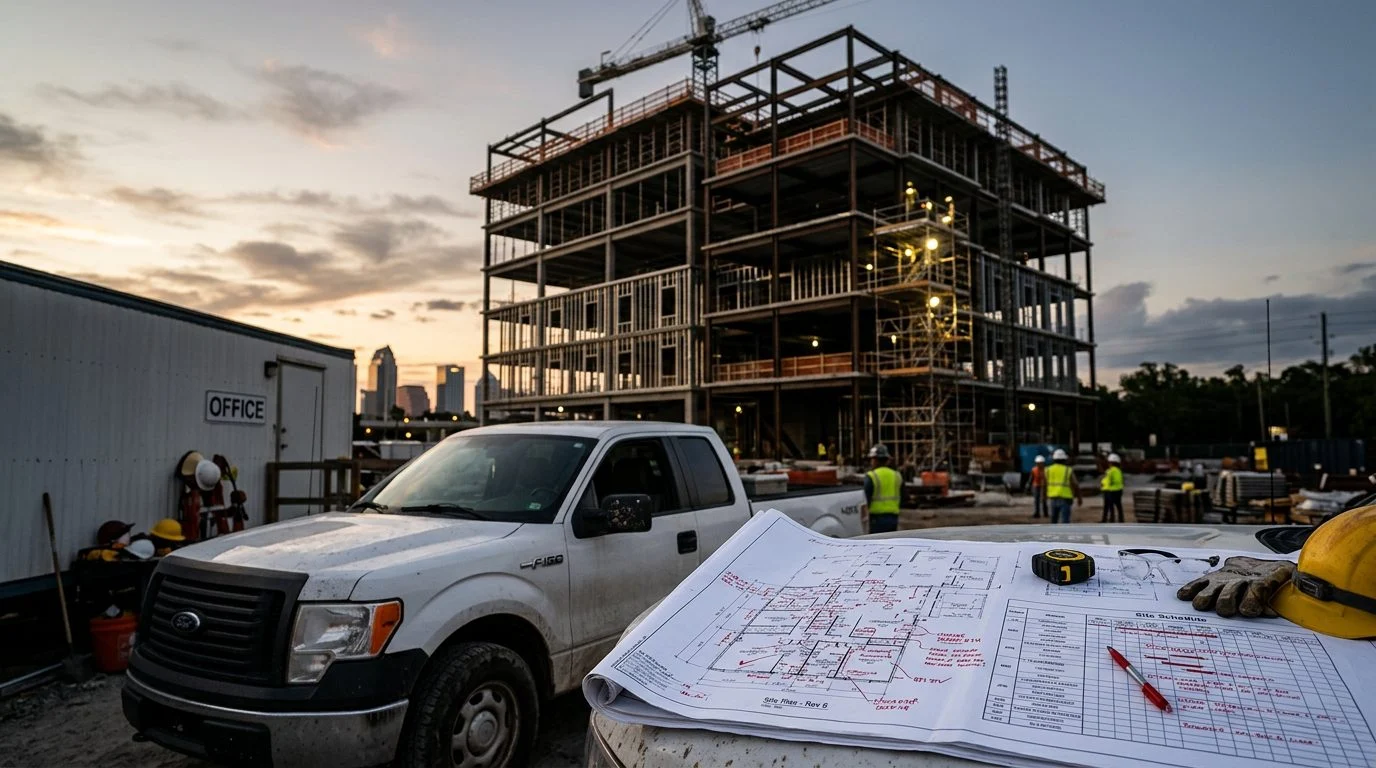
Tampa Construction Litigation vs Commercial Litigation: What Changes for Building Disputes
Not sure what your next step is?
Talk it through with our team — we can walk you through how a situation like yours is usually handled and what your options are.

Where You Are Right Now
Maybe a payment has stopped. Maybe a lien notice showed up, or a job has gone sideways and the contractor isn’t answering calls. You’re trying to figure out whether this is a building dispute or an ordinary business fight.
That label matters more than it seems. For Tampa construction litigation vs commercial litigation questions, it decides which rules apply. Florida applies rules that are specific to construction, and those rules come with their own clocks. Guessing wrong can cost you time.
Many readers are looking into this for a company they own or work for, or for a family member who runs a contracting business. That’s common. The facts still come down to what work was done, when it ended, and what paperwork exists.
This page explains the differences in plain terms. Every matter turns on its own facts.
How Does a Construction Litigation Practice Differ From a General Commercial Litigation Practice for Building and Contractor Disputes?
A construction litigation practice focuses on disputes over building work. That includes unpaid contractors, subcontractor payment fights, lien foreclosure and construction contract fraud. A general commercial litigation practice handles contract and business disputes across many industries and usually works from general contract principles.
The difference shows up in which deadlines apply, where a case can be filed, and how the evidence is built.
Ayala Law PA focuses on construction litigation alongside commercial and contract disputes. We represent businesses in Tampa and Hillsborough County in Florida courts and arbitration. Eduardo A. Maura is the responsible lawyer for this page. Our lawyers handle matters in Florida courts and arbitration.
Which Florida Rules Are Specific to Building Projects?
Building cases run on their own clock. The period generally runs from the earliest of the certificate of occupancy, certificate of completion, or date of abandonment of unfinished construction. Exceptions apply for latent defects, and there is an outer limit of seven years.
The start date is the earliest of several events. Those include a temporary certificate of occupancy, a certificate of occupancy, a certificate of completion, or abandonment of unfinished construction.
Hidden problems change the start point.
Timing also depends on when the cause of action is complete. Under Fla. Stat. § 95.031, a claim accrues when its last element occurs. That is not always the first problem on the job. Deadlines vary by claim type and by facts, so check the dates in your own file.
Venue matters for lien foreclosure. Under Fla. Stat. § 47.011, actions must be brought in the county where the defendant resides, where the cause of action accrued, or where the property is located. That rule does not apply to actions against nonresidents. For property in Hillsborough County, the property’s location is a key fact.
Where Commercial Litigation Covers Ground Construction Cases Do Not
Commercial litigation covers a wider area. Shareholder and partnership disputes, international trade disputes and many business-to-business contract disputes don’t involve a building at all.
Take a fight between co-owners of a contractor over control or money. That is a business-ownership matter, even though the company works in construction. Florida’s rules on corporate records show the difference.
A supply or service deal between businesses that never touched a job site usually follows contract law.
Payment disputes framed as fraud follow their own timing rule. Under Fla. Stat. § 95.031, the period for an action founded upon fraud runs from when the facts were discovered or should have been discovered with due diligence. In any event, the action must begin within 12 years after the fraud.
How to Tell Which Track Your Dispute Is On
Start with a few plain questions. Did labor or materials go into an improvement to real property? Is there a recorded lien or a project notice? Is a payment bond involved? Is the dispute about how the company is owned or run, or about a commercial deal that never involved a site?
Some cases mix both tracks. A contractor owed money may also be in a fight with its own investors. The project facts decide how each claim is framed.
Procedure can differ too. Fla. Stat. § 44.102 provides that, under Supreme Court rules, a court must, upon request of one party, refer a filed civil action for monetary damages to mediation, provided the requesting party is willing and able to pay the costs of mediation or the costs can be equitably divided between the parties, unless a listed exception applies. This applies when the requesting party is willing and able to pay the costs of mediation, or the costs can be equitably divided between the parties. Exceptions apply, such as an action where “[t]he action is filed for the purpose of collecting a debt.”
Contracts may also send disputes to arbitration. Under Fla. Stat. § 682.02, an agreement in a record to arbitrate is valid and enforceable, except on a ground that exists to revoke a contract. Read any arbitration or notice clause in your contract closely.
Not sure what your next step is?
Talk it through with our team — we can walk you through how a situation like yours is usually handled and what your options are.
Preparing Your Records and Next Steps
Gather the signed contract and any change orders. Add pay applications, invoices, lien or notice papers, and correspondence. Include daily logs and proof of delivery, plus any certificate dates for the project.
Keep these in date order. A clear timeline helps show which dates may control the case. The certificate date and the last delivery date are often the most important.
Ayala Law PA charges for case evaluations, and fee terms are explained when you call.
Quick answers
Is every construction dispute handled differently?
Not always. Some building disputes follow general contract rules, and some business disputes involve a job site. The project facts decide the track.
How long do I have to sue over defective work in Florida?
That period runs from the earliest of these dates: issuance of a temporary certificate of occupancy, a certificate of occupancy, or a certificate of completion, or abandonment of construction if the work was never completed. Either way, the claim faces an outer limit of 7 years from that same earliest date. Latent defects follow a discovery rule, with a 7-year outer limit.
Can a debt-collection suit be sent to mediation?
Under Fla. Stat. § 44.102, a court acting under rules adopted by the Supreme Court must, upon request of one party, refer any filed civil action for monetary damages to mediation, provided the requesting party is willing and able to pay the costs of the mediation or the costs can be equitably divided between the parties, unless a listed exception applies. One exception is an action filed for the purpose of collecting a debt, and the court may still refer all or any part of such a case to mediation under the same section.
Talk Through Your Project Facts With Ayala Law PA
If a payment has stopped or a lien now sits on the property, the next few weeks matter. You may be the one holding the paperwork while the job sits half finished. Call Ayala Law PA at (305) 570-2208 or request a case evaluation, and we will review your project documents and dates with you.



