
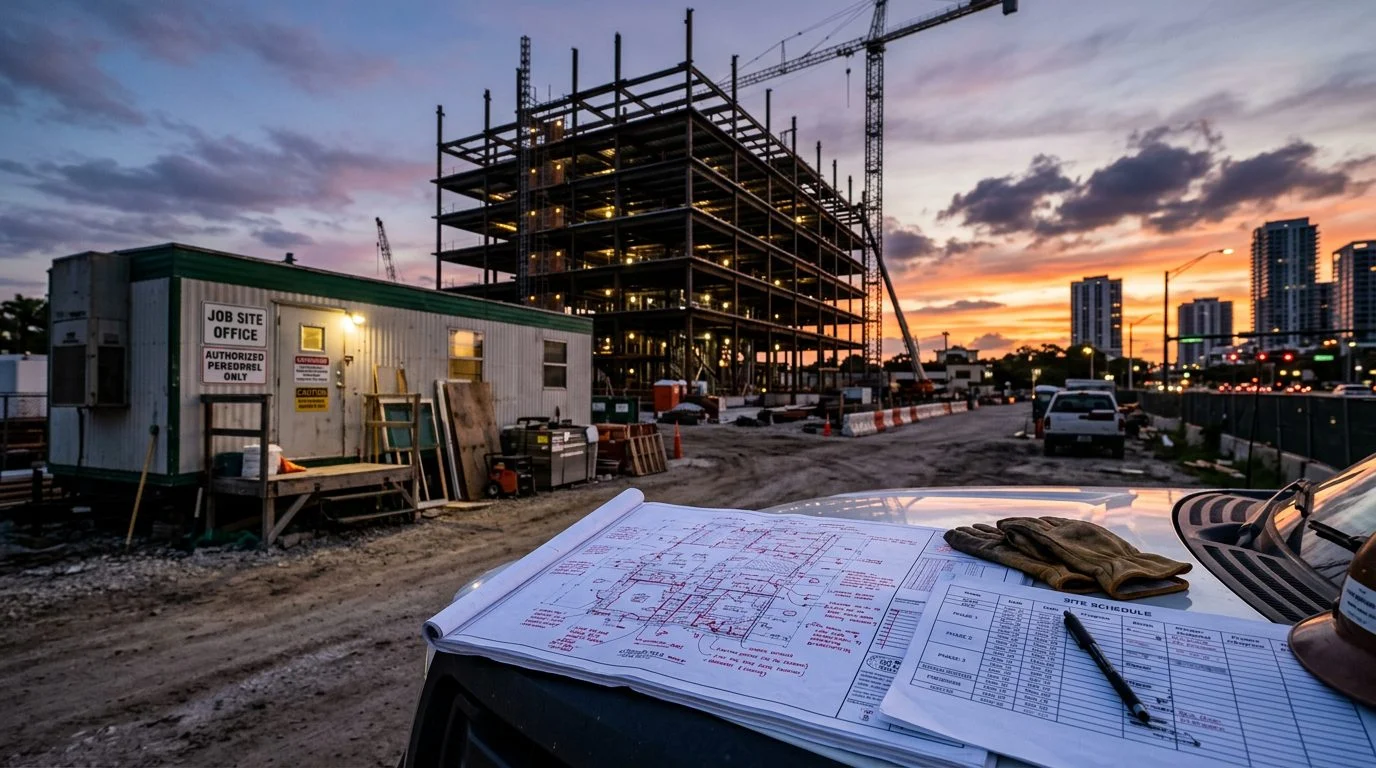
What does construction litigation mean? It means a court case or arbitration over construction work, or over the money owed for that work. The term covers disputes that come up while planning, building, or paying for an improvement to real property.
Business owners, property owners, and contractors often run into this term after a payment stops or a lien notice arrives. This guide explains the term in plain language, who is usually involved, and how a case generally moves in Florida. Ayala Law PA focuses its practice on business and construction disputes in Florida courts and arbitration.
What construction litigation means
Construction litigation is a dispute over building work that is decided in court or in arbitration. It covers claims between any parties on a project, not only suits against a builder.
A property owner may sue a contractor. A subcontractor may sue a general contractor for unpaid work. A supplier may pursue a claim tied to the property that was improved. Each of these is a construction dispute.
Florida construction disputes usually go to a Florida circuit court. They can also go to arbitration when the contract requires it. Under Fla. Stat. § 682.02, a written agreement to arbitrate is valid, enforceable, and irrevocable, except on a ground that exists for revoking any contract.
If a payment has stopped or a lien notice has landed on your project, you don't have to sort out the deadlines alone; call Ayala Law PA at (305) 570-2208. Talk it through with our team — we can walk you through how a situation like yours is usually handled and what your options are.
Who is involved in a construction dispute
Usually the owner, the general contractor, and the subcontractors and suppliers below them are involved. Each party may have a different role in the job.
Owners and developers hire general contractors. The general contractor hires subcontractors, and they buy materials from suppliers. Money usually flows down this chain, so a missed payment can affect everyone below it.
Design professionals, sureties, and lenders can also end up in a dispute. They get pulled in when their role affects the project or its payments.
The contract between each pair of parties usually sets the rights and remedies available. Read that contract first. It often controls notice steps, payment terms, and whether arbitration applies.
Common types of construction disputes
The most common types are payment disputes, contract disputes, lien claims, defect claims, and fraud allegations. Each one raises different questions.
- Payment disputes: unpaid invoices, retainage (money held back until the work is finished), pay applications, and change orders (written changes to the scope of work).
- Contract disputes: disagreements over scope, schedule delays, termination, and extra work.
- Lien claims: claims against the property and the lien foreclosure lawsuits that can follow.
- Defect claims: disputes over workmanship or materials.
- Construction contract fraud: allegations that a party misled the other side in making or performing the contract.
A dispute over a purchase that never touched a building project is usually a general business dispute instead.
How construction lien claims fit into construction litigation
A construction lien is a claim against the property that was improved. If it is not resolved, it can lead to a lien foreclosure lawsuit.
It covers notices to the owner, claims of lien, deadlines, lien foreclosure, and fraudulent liens. Each step has its own timing.
Missing a required step can affect whether a lien holds up. Review deadlines promptly instead of waiting until the last month.
Enforcement deadlines are set elsewhere too. Deadlines to enforce a claim against a payment bond are time-sensitive, and the period that applies depends on the facts of the project and the governing statute.
A recorded lien raises its own questions. It is worth reviewing right away.
Construction defect claims and what they involve
A construction defect claim says the work or materials fell short of the contract or accepted building standards. These claims are about what was built, not only what was paid.
Defect cases often rely on plans, specifications, inspection records, photos, and correspondence. Those documents show what was promised and what was delivered.
Timing depends on the facts. Under § 95.11, an action founded on the design, planning, or construction of an improvement to real property must be commenced within four years, with the time running from the date the authority having jurisdiction issues a temporary certificate of occupancy, a certificate of occupancy, or a certificate of completion, or the date of abandonment of construction if not completed, whichever date is earliest; for a latent defect, the time runs from when the defect is discovered or should have been discovered with the exercise of due diligence, and in any event the action must be commenced within 7 years after the date the authority having jurisdiction issues a temporary certificate of occupancy, a certificate of occupancy, or a certificate of completion, or the date of abandonment of construction if not completed, whichever date is earliest. That time runs from the earliest of a temporary certificate of occupancy, a certificate of occupancy, a certificate of completion, or abandonment of unfinished work.
When a defect is latent (hidden), the clock runs from when it was discovered or should have been found with due diligence. Even then, the action must start within seven years after that earliest date.
Tort claims can also be part of a defect case. In Tiara Condominium Ass’n v. Marsh & McLennan Cos., the Florida Supreme Court limited the economic loss rule to products liability cases. So that rule does not by itself bar a tort claim between parties in a contract.
How a construction case generally moves forward
A typical case moves from a written demand and contract review to a filing. Then come discovery (exchanging documents and testimony) and a settlement or decision.
Start with the early steps. Review the contract, notices, and payment records, and send written demands. Look for any clause that requires notice, mediation, or arbitration before a lawsuit.
If the contract has an arbitration clause, the dispute may go to arbitration. Under Fla. Stat. § 682.03, a court may not refuse to order arbitration just because the claim lacks merit. When a party asks the court to order arbitration, the court must, on just terms, stay any judicial proceeding that involves a claim alleged to be subject to the arbitration until the court renders a final decision on the motion.
Under § 95.051, a limitations period is tolled while an arbitral proceeding on the same dispute is pending.
Where a case is filed matters too. Under § 47.011, an action must be brought in the county where the defendant resides, where the cause of action accrued, or where the property in litigation is located; this section does not apply to actions against nonresidents. A dispute over a job site in Brandon or Riverview may therefore belong in Hillsborough County.
Court-ordered mediation is another step. Under § 44.102, on one party’s request, a court must refer most civil money-damage cases to mediation, provided the requesting party is willing and able to pay the costs of the mediation or the costs can be equitably divided between the parties. Fla. Stat. § 44.102 reads: “(2) A court, under rules adopted by the Supreme Court: (a) Must, upon request of one party, refer to mediation any filed civil action for monetary damages, provided the requesting party is willing and able to pay the costs of the mediation or the costs can be equitably divided between the parties, unless: 1.” Exceptions apply, including an agreement to binding arbitration.
Public road work follows its own rules. The Florida Department of Transportation publishes dispute procedures for its construction contracts.
Cases end in negotiated settlement, mediation, arbitration, or trial. Which path fits depends on the contract terms and the record.
Not sure what your next step is?
Talk it through with our team — we can walk you through how a situation like yours is usually handled and what your options are.
Why the facts and documents matter early
Early records decide what can be shown later. They also help you track deadlines.
Records that commonly matter include the signed contract, change orders, pay applications, daily logs, photos, notices sent, and emails. Keep them in one place and in date order.
Deadlines often start on a specific date. Under § 95.031, a cause of action accrues when its last element occurs. Under § 95.03, a contract clause that sets a shorter time to sue than the statute allows is void.
Common mistakes include relying on verbal promises and waiting too long to send written notice.
Ayala Law PA’s office is in Tampa, Florida, at 1646 W Snow Ave. The firm focuses its construction litigation work on Florida courts and arbitration. It serves businesses in Tampa and Hillsborough County from its Tampa office.
Common questions
What does construction litigation mean?
It is a court or arbitration case over construction work or the payment for it. The term covers disputes among all parties on a project.
Where is a construction lawsuit filed in Florida?
Under Florida’s venue statute, it is generally filed where the defendant lives, where the claim arose, or where the property is located.
Does a construction contract require arbitration?
Only if the contract says so. Florida law generally enforces a written arbitration agreement.
Talk with Ayala Law PA about your construction dispute
If a payment has stopped, a lien notice has arrived, or a defect problem is holding up your project, you may be the one who has to decide what comes next. You don’t have to work out the deadlines and paperwork alone.
Eduardo A. Maura is the responsible lawyer for this page. Call (305) 570-2208 or use the contact page to describe your situation. Ask about the firm’s evaluation terms before you schedule one.
No outcome can be promised in any dispute.
Ayala Law PA | Responsible lawyer: Eduardo A. Maura | Office: 1646 W Snow Ave, Tampa, Florida | Attorney advertising.



