
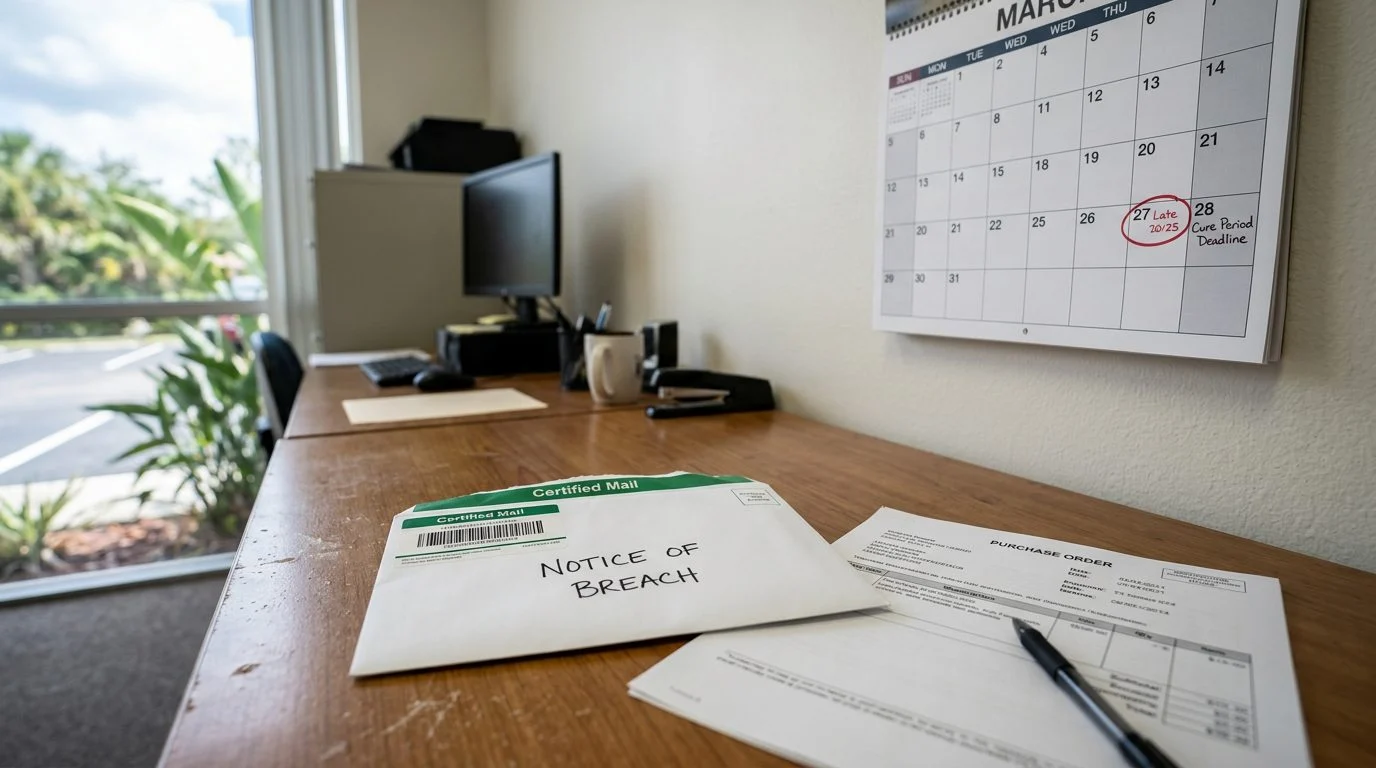
Your business partner, vendor or buyer just said it won’t pay or perform, and the due date hasn’t arrived yet. Whether it applies to your deal turns on the wording of the statement and the type of contract.
This page explains the rule in plain terms, what counts, your choices, and what to write down while the facts are fresh.
What Anticipatory Repudiation Means in Florida
The word “anticipatory” means the problem shows up early. The other side hasn’t missed a payment or a delivery yet. It has said it won’t.
Here is a common case. A supplier emails that it will not ship next month’s order, and it offers no new date. Your business now has a decision to make before the ship date arrives.
Keep two things separate. The statement is one event. Your response to it is another. Owners who act too slowly or too fast can weaken later claims.
Florida’s sale-of-goods chapter, Chapter 672, covers many of these disputes. General contract principles cover the rest.
If a vendor, buyer or partner has said it won't pay or deliver, our team can help you weigh your options before the due date arrives. Talk it through with our team — we can walk you through how a situation like yours is usually handled and what your options are.
What Counts as a Clear and Unequivocal Statement
Compare two messages. “We will not deliver the order on the 15th” is a flat refusal. “We’re reviewing our options and may need more time” is not. The second message leaves room for performance.
Questions about terms, requests for an extension, and complaints about price are different. They can read as negotiation rather than refusal.
Courts read emails, texts and call notes together. The exact words, who said them, and what happened next all matter. A later “let’s talk” can change how an earlier message reads.
Whether a particular message is clear enough turns on its wording and context. Write down the words exactly as they were said, with the date and time. Notes written the same day are stronger evidence than summaries written weeks later.
Where the Rule Comes From: Chapter 672 for Goods and Common Law for Services
Contracts for the sale of goods fall under Florida’s Chapter 672.
The scope statute explains the line for mixed deals. Florida Statute 672.102 says that if the sale-of-goods aspects predominate, the chapter applies to the transaction, though other law may still apply in appropriate circumstances to aspects that do not relate to the sale of goods. If they do not predominate, only the parts that relate primarily to goods apply.
Take an equipment deal that includes installation and a service plan. The first question is whether the equipment is the main event or the add-on. That answer shapes which rules you start with.
Repudiation shows up in the goods chapter too. Florida’s action-for-price statute refers to a buyer that repudiates under section 672.610. It says a seller who cannot recover the price can still be awarded damages for nonacceptance once the buyer has wrongfully rejected or revoked acceptance, failed to make a payment due, or repudiated.
Service contracts, construction work and many real estate deals usually fall outside the goods chapter. They are governed by general contract principles. Picking the wrong framework early can send a demand letter in the wrong direction.
Your Options When the Other Side Says It Will Not Perform
In most cases you have two main paths: keep the contract open and wait, or act on the statement now.
Keep proof that you stayed ready to perform. Waiting too long can cost you, because the other side may argue you accepted its position.
Get replacement quotes, keep invoices, and track the extra costs you pay to cover the gap.
Pausing your own payments or shipments while you decide is a common step. Check the contract first, since some clauses set notice rules.
Your later conduct matters. In Florida, a party that could cancel a contract but keeps dealing under it after learning the key facts can be found to have ratified it. See Flaherty v. Flaherty.
If the other side made promises it never meant to keep, a fraud claim may be possible. Florida courts recognize that a promise of future action can be fraudulent when the promisor had no intention of performing. See Frutafino v. Dole Chile.
Can the Other Side Take Back Its Statement?
Sometimes it can, but timing and your response decide a lot. Whether a retraction works depends on the facts.
A party that said it won’t perform may later say it will. One offered after you have signed a replacement vendor, cancelled orders or told your customers is harder to accept.
Ask a few questions. Was the retraction in writing? Is it clear and unconditional? Did you already act on the first statement? Your answers shape the next step.
Don’t assume a retraction erases the problem. Ask for it in writing, check the date against your own records, and keep it in the same file as the original statement.
Asking for Written Assurance Before You Act
A short written request is a practical way to learn whether the other side will still perform. It doesn’t cancel anything, and it puts the question on paper.
Build the request in three parts. State your concern in plain words. Name the contract term at issue, such as the delivery date or payment schedule. Set a reasonable deadline for a written reply.
For example: “Your March 3 email said the order will not ship on April 15. Please confirm in writing by March 10 whether you will perform under Section 4 of our agreement.”
Send it through the same channel as the original statement, or send it by both email and mail. A silent counterparty or a vague reply is still useful information. Save it. Don’t assume silence means the other side agreed to change the deal.
Not sure what your next step is?
Talk it through with our team — we can walk you through how a situation like yours is usually handled and what your options are.
What to Document Right After the Statement Is Made
Save the statement and write down the facts while they are fresh.
- The original email, text or letter, with its date and sender.
- Call notes: who spoke, when, and the exact words, written the same day.
- The contract, plus delivery dates, payment terms, notice clauses and any dispute clauses.
- Costs you incur, such as replacement quotes, expedited shipping and lost sales.
Deadlines matter. Under § 95.11(3)(j), a Florida action on an oral or other unwritten contract, including one for the sale and delivery of goods, must be brought within four years. A contract clause that fixes a shorter period than the statute is void under § 95.03.
Buyers who accepted goods have a notice duty. Under § 672.607, a buyer must notify the seller of a breach within a reasonable time after discovering or should have discovered it, or be barred from that remedy.
Avoid emails that agree to excuse or change performance until you have reviewed them.
Talk With Ayala Law PA About Your Contract
A written refusal to perform before the due date deserves a prompt legal review. Waiting too long can narrow your options.
Ayala Law PA focuses on business litigation, commercial litigation, contract disputes, shareholder disputes, construction litigation, real estate litigation and international trade litigation in Florida courts and arbitration. Eduardo A. Maura is the responsible lawyer for this page. The firm’s only office is at 1646 W Snow Ave in Tampa. The firm serves businesses in Tampa, Hillsborough County, Brandon, Riverview, Plant City, Temple Terrace and the wider Tampa Bay area.
A matter may sometimes be referred to another lawyer or firm. If yours may be, we will say so at the outset.
Does a vague email count as anticipatory repudiation?
Often not.
Does this rule apply to a services contract?
Services contracts generally follow general contract principles rather than Chapter 672.
Can I keep working with the other side while I decide?
You can, but keep records and check your contract. Continuing to deal can affect your later claims.
If a business partner, vendor or buyer has told you it won’t pay or deliver, you don’t have to sort out the next step alone. Call (305) 570-2208 or send a request through the case evaluation request form to talk about your contract.



