
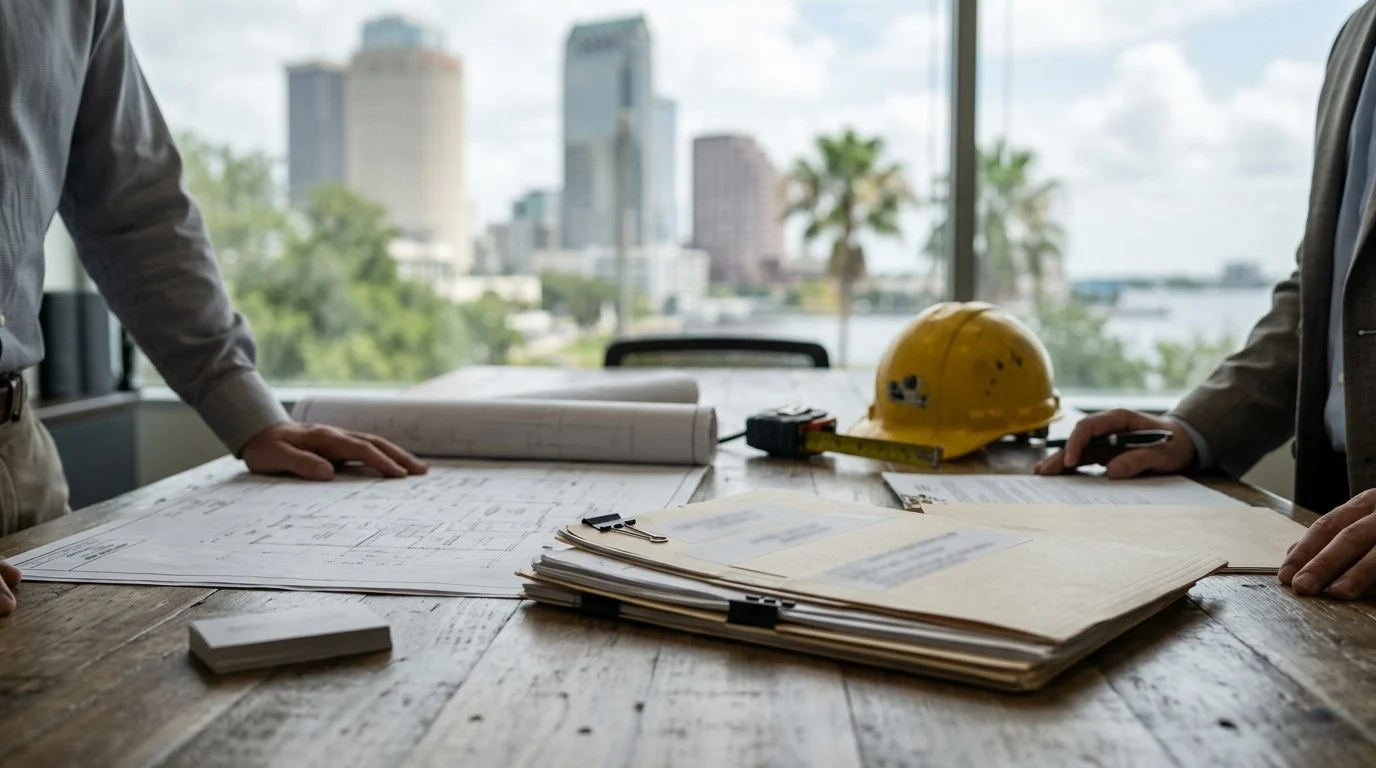
Construction contract litigation is the lawsuit or arbitration used to collect payment or settle disputes over a construction agreement. Subcontractors, general contractors, suppliers and owners bring these cases when a job stalls and the money stops.
Ayala Law PA concentrates in business litigation, and construction contract disputes are one of the practice areas the firm handles. The firm’s only office is in Tampa, at 1646 W Snow Ave. The firm serves businesses in Tampa, Hillsborough County and the Tampa Bay area.
What Construction Contract Litigation Covers for Contractors and Subcontractors
Construction contract litigation covers lawsuits and arbitration over payment, performance and the terms of construction agreements. It fits prime contractors, subcontractors, suppliers and owners on private Florida projects.
Most of these fights start with paperwork. A subcontract or purchase order sets the price and scope. Change orders, pay applications and emails show what changed and what was approved. When those records disagree, the case often turns on what was signed and when.
Some construction matters go to Florida courts. Others go to arbitration when the contract calls for it. Florida’s arbitration statute says a written agreement to arbitrate existing or future disputes is valid and enforceable, except on grounds that allow a contract to be revoked. § 682.02
If an unpaid subcontract balance or a lien deadline is pressing on your business, call (305) 570-2208 or request a case evaluation with our team now. Talk it through with our team — we can walk you through how a situation like yours is usually handled and what your options are.
Disputes the Firm Handles in Construction Contract Litigation
Construction contract litigation handles disputes over money owed, work performed and the terms that connect them. Common matters include:
- Unpaid progress payments and final payments under a subcontract or purchase order.
- Pay-when-paid and pay-if-paid clauses, where the question is whether the owner’s payment must come first.
- Change orders and extra work, including whether the change was approved in writing.
- Backcharges and offsets, and claims for defective or incomplete work.
- Termination, abandonment or a contractor walking off the job, and the losses that follow.
- Construction contract fraud claims, such as billing for work that was never done.
- Real estate or commercial disputes that grow out of a construction project.
Pay-if-paid and pay-when-paid fights are common. The clause wording and the payment record shape how each side argues the claim. Get those documents together before you call.
Construction Lien Rights and Lien Foreclosure in Florida
A construction lien is a claim against property for unpaid work. Lien foreclosure is the lawsuit used to enforce a recorded claim against that property.
Lien steps are technical. A missed notice or recording step can put a right at risk, so start gathering dates early. Useful documents include:
- Signed contracts, purchase orders and change orders
- Invoices and pay applications
- Notices sent and proof of delivery
- Lien releases and payment records
A separate limitations period applies to certain construction claims. Under § 95.11, an action founded on the design, planning, or construction of an improvement to real property must be commenced within 4 years, with the time running from the date the authority having jurisdiction issues a temporary certificate of occupancy, a certificate of occupancy, or a certificate of completion, or the date of abandonment of construction if not completed, whichever date is earliest; when the action involves a latent defect, the time runs from when the defect is discovered or should have been discovered with the exercise of due diligence. In any event, the action must be commenced within 7 years after that earliest date. The clock starts on the earliest of a temporary certificate of occupancy, a certificate of occupancy, a certificate of completion, or the date construction was abandoned. For a latent defect, the time runs from when the defect is discovered or should have been discovered with the exercise of due diligence. Even then, the action must be started within seven years of that earliest date.
How Construction Contract Litigation Works: Step by Step
The process moves from fact review to demand, then filing if needed, then resolution. The usual sequence looks like this:
- Intake. You describe the project, the parties, the amounts in dispute and the key dates.
- Document review. Contracts, change orders, schedules, payments and emails are organized to identify claims and defenses.
- Deadline check. Lien, notice and limitations dates are identified so no right is lost while the matter is reviewed.
- Demand. A written demand is often sent to seek payment before any filing.
- Filing. If needed, a complaint, lien foreclosure action or arbitration demand is filed in the proper forum.
- Litigation or arbitration. Discovery, motions and, where required, mediation take place. Under § 44.102, a court must refer any filed civil action for monetary damages to mediation when one party asks, if that party is willing and able to pay the costs of mediation or the costs can be equitably divided between the parties, unless an exception applies.
- Resolution. The case ends in settlement, judgment or award, followed by enforcement if needed.
Offers of judgment also carry cost risk. Under § 768.79, if a defendant’s written offer is not accepted within 30 days, the defendant can recover reasonable costs and attorney’s fees if the judgment is one of no liability or the plaintiff’s judgment is at least 25 percent less than the offer; if a plaintiff’s demand is not accepted within 30 days and the plaintiff recovers at least 25 percent more, the plaintiff can recover reasonable costs and attorney’s fees. Timing varies with the court’s calendar, the forum and how complex the dispute is.
Who the Firm Serves and Where Matters Are Handled
The firm serves businesses in Tampa, Hillsborough County, Brandon, Riverview, Plant City, Temple Terrace and the wider Tampa Bay area. It also handles Florida matters statewide. The firm’s bona fide office is in Tampa, at 1646 W Snow Ave.
Under § 47.011, actions must be brought in the county where the defendant resides, where the cause of action accrued, or where the property in litigation is located. That statute does not apply to actions against nonresidents. For a Hillsborough County project, the location of the work often bears on where a case can be filed.
Eduardo A. Maura is the lawyer responsible for this page. Our support staff help with scheduling, document organization and case administration. Your matter may be referred to another lawyer or law firm.
Why Contractors and Subcontractors Work With Ayala Law PA
Ayala Law PA concentrates in business litigation. That includes construction, commercial, contract, shareholder, real estate and international trade matters. Construction disputes sit inside that focus, and the firm handles them in Florida courts and arbitration.
Our approach starts with documents. We review the contract, change orders, payment history and notices before we talk through options. We explain those options in plain language so you can weigh them against your business goals.
Owners’ personal exposure is a common question. A subcontractor owed money by a contractor’s company may find it hard to reach the owners. Courts look for a “showing of improper conduct,” which requires proof that “the corporation was actually organized or used to mislead creditors or to perpetrate a fraud upon them” (Wurtzebach v. Flooring Depot FTL, Inc.). That means proof the company was organized or used to mislead creditors or defraud them. Wurtzebach v. Flooring Depot explains that rule.
Not sure what your next step is?
Talk it through with our team — we can walk you through how a situation like yours is usually handled and what your options are.
Construction Litigation Questions Answered
Here are short answers to questions we hear from contractors and subcontractors.
How long do I have to sue over unpaid construction work?
Florida’s four-year period covers claims founded on construction of an improvement to real property. The start date and exceptions matter, and whether it fits your claim depends on the facts.
Can a subcontractor sue an owner without a direct contract?
Lien rights and other remedies may be available in some cases. The paperwork and project dates set the options.
Will my case go to trial?
Some cases settle or go to mediation first. No lawyer can promise how a matter will end.
Should I stop work on unpaid invoices?
Whether to pause or stop work turns on your contract terms. Review them before you decide.
Does a case evaluation cost money?
Contact the office to discuss your matter and the terms of representation.
What should I bring to the first call?
Bring contracts, change orders, invoices, payment history, lien notices and a written timeline of key events.

Talk With Our Team About Your Construction Payment Dispute
If you’re holding an unpaid subcontract balance, a lien deadline or a termination notice on an active job, time matters. Gather the contract, change orders, invoices, payment history and a timeline of key dates. Then call (305) 570-2208 or use our contact page to request a case evaluation. Our only office is in Tampa, Florida, at 1646 W Snow Ave.



