
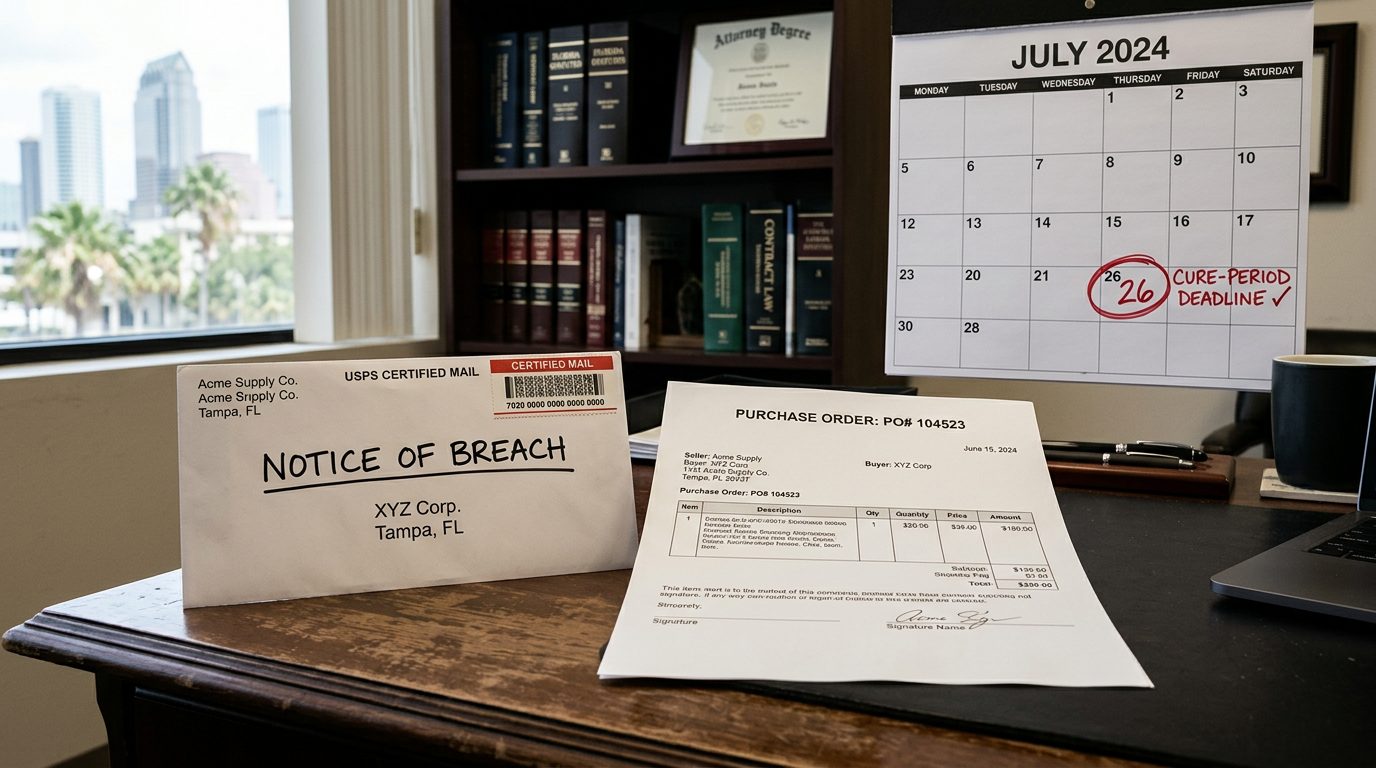
Before a Tampa business sues over a contract, it should check four things: what the contract says, what the records show, when the deadline runs, and whether the deal can be enforced at all. Those answers shape almost every next step.
Common contract disputes Tampa businesses face
A contract dispute starts when one side says the other did not do what the deal required. Common examples include an unpaid invoice, a customer or vendor that walks away from a signed deal, a supplier that misses delivery terms, and a partner that breaks an agreement.
These disputes rarely rest on one document. A signed contract often sits beside purchase orders, emails, text messages and invoices. Sorting those records early shows what each side agreed to, and when.
Ayala Law PA focuses on business litigation, including commercial litigation, contract disputes, shareholder and partnership disputes, construction litigation, real estate litigation and international trade litigation. The firm serves businesses and entrepreneurs in Tampa, Hillsborough County, Brandon, Riverview, Plant City, Temple Terrace and the Tampa Bay area, in Florida courts and arbitration. The firm’s office is located at 1646 W Snow Ave in Tampa. Eduardo A. Maura is the responsible lawyer for this page.
Is it worth suing for breach of contract?
Suing can make sense when the contract, the paper trail and the loss are clear enough to evaluate. Whether it makes sense depends on the facts.
Start with the numbers. Compare the amount owed with the cost of litigation, the time it takes, and whether the other side can pay a judgment. A court win helps little if the money cannot be collected.
Many disputes move through a demand letter or a negotiated payment before a lawsuit is filed. Once a case is pending, a written offer of settlement carries weight, but it may be served only at any time more than 60 days after the summons and complaint are served on a party and not less than 60 days (or 45 days if it is a counteroffer) before trial. Under Florida’s offer statute, an offer stays open for 45 days unless withdrawn sooner. An offer neither withdrawn nor accepted in that time is deemed rejected (§ 45.061).
Plan for legal fees too. Florida generally follows the rule that each side pays its own attorneys’ fees, unless a contract or statute provides otherwise (Florida fee rule). Gather the signed contract, change orders, payment records, correspondence and any notice the contract requires.
Can I sue a contractor for bad work in Florida?
Yes. A business can bring a breach of contract claim when a contractor does not perform as the written agreement requires, including defective or incomplete work.
The contract sets the yardstick. Look at the scope of work, the specifications, the permit and inspection terms, and any warranty language. The gap between what the contract promised and the finished job is the core of the claim.
Construction claims also run on their own clock. Florida sets a four-year period for actions founded on the design, planning or construction of an improvement to real property. The period starts at the earliest of the certificate of occupancy, certificate of completion, or abandonment of unfinished work (§ 95.11). Fla. Stat. § 95.11 reads: “(b) An action founded on the design, planning, or construction of an improvement to real property, with the time running from the date the authority having jurisdiction issues a temporary certificate of occupancy, a certificate of occupancy, or a certificate of completion, or the date of abandonment of construction if not completed, whichever date is earliest; except that, when the action involves a latent defect, the time runs from the time the defect is discovered or should have been discovered with the exercise of due diligence.” If a defect is hidden, the clock starts when it was discovered or should have been found with due diligence. Fla. Stat. § 95.11 reads: “(b) An action founded on the design, planning, or construction of an improvement to real property, with the time running from the date the authority having jurisdiction issues a temporary certificate of occupancy, a certificate of occupancy, or a certificate of completion, or the date of abandonment of construction if not completed, whichever date is earliest; except that, when the action involves a latent defect, the time runs from the time the defect is discovered or should have been discovered with the exercise of due diligence.” Even then, the action must be commenced within seven years after the date the authority having jurisdiction issues a temporary certificate of occupancy, a certificate of occupancy, or a certificate of completion, or the date of abandonment of construction if not completed, whichever date is earliest.
Contractor and subcontractor disputes often turn on notices, payment schedules and records of the work. Lien rights follow their own rules, so raise them early.
What voids a contract in Florida?
A Florida contract needs the basics of contract law. That includes an offer, an acceptance, consideration and enough detail on the essential terms (St. Joe Corp. v. McIver). Some deals fail for other reasons.
- Illegal terms. A contract that violates the constitution or a statute is void and illegal. Florida courts will not enforce it (Taboada v. Duarte).
- Mistake. Rescission for a mutual mistake of fact is available only if the mistake is mutual and goes to the essence of the contract (Waterside at Boynton). Florida also allows rescission for a one-sided mistake in limited circumstances.
- Unfair terms. A court will not throw out a term as unconscionable unless it finds both an unfair process and unfair terms (Basulto v. Hialeah Automotive).
- Waiver by conduct. As a general rule, a party who can cancel a voidable contract can lose that right. This happens when the party does not cancel after learning the facts that justify it (Flaherty v. Flaherty).
- Goods. Sales of goods priced at $500 or more are not enforceable unless there is a record sufficient to show a contract was made between the parties and signed by the party against whom enforcement is sought or by that party’s authorized agent or broker, subject to the statute’s listed exceptions (§ 672.201).
Fraud claims need their own facts. Florida generally does not allow a contract fight to be relabeled as a tort, unless the tort is independent of the breach (Frutafino v. Dole Chile).
Types of breach and what they mean for your claim
A breach is a failure to do what the contract requires. The type of breach affects how the claim is framed and what the other side will argue.
Common business breaches include:
- Non-payment. One side does not pay the agreed amount on time.
- Partial performance. A party does part of the job or delivers part of the order.
- Anticipatory repudiation. One party clearly says it will not perform before the performance date.
Courts often ask whether a breach is material, meaning it goes to the heart of the deal, or minor. The answer shapes the argument on both sides.
If your deal involves goods you already accepted, Florida’s sales code sets a notice rule. Where a tender of goods has been accepted, the buyer must notify the seller of the breach within a reasonable time after discovering or should have discovered it, or be barred from any remedy (§ 672.607). Write down when you first noticed the problem.
Remedies and deadlines for contract claims in Florida
Breach of contract disputes often turn on what the agreement actually required and what losses, if any, followed from the other party’s performance. Some contracts also shift attorneys’ fees. Deadlines depend on the claim, so review the facts early.
If a contract lets one side recover fees for enforcing it, the court may also award reasonable fees to the other side when that side prevails, but this applies only to contracts entered into on or after October 1, 1988.
A contract clause that sets a shorter time to sue than the statute allows is void (§ 95.03). Judgments also carry interest. The Chief Financial Officer sets the statutory rate quarterly, but a judgment’s rate is fixed when the judgment is obtained and adjusted annually on January 1, unless a written contract sets a different rate (§ 55.03).
On one party’s request, a court must refer most civil actions for money damages to mediation. The requesting party must also be able to pay the mediation costs, or the costs must be shared (§ 44.102). Fla. Stat. § 44.102 reads: “(2) A court, under rules adopted by the Supreme Court: (a) Must, upon request of one party, refer to mediation any filed civil action for monetary damages, provided the requesting party is willing and able to pay the costs of the mediation or the costs can be equitably divided between the parties, unless: 1.”
How Ayala Law PA handles Tampa-area contract disputes
Ayala Law PA handles contract disputes for businesses in Tampa, Hillsborough County and nearby communities. The work takes place in Florida courts and arbitration.
Many commercial contracts include an arbitration clause. Florida law treats a written agreement to arbitrate as valid, enforceable and irrevocable, except on grounds that allow any contract to be revoked (§ 682.02). If a court finds an enforceable agreement to arbitrate, it must order the parties to arbitrate (§ 682.03). Read that clause early, because it can decide where a fight happens.
The firm serves businesses in Tampa and Hillsborough County from its Tampa office. Tampa-area businesses can reach our team by phone or through our contact form. If a matter may be referred to another lawyer or firm, we will say so.
Talk with our team about your Tampa contract dispute
If an unpaid balance or a vendor that stopped performing has you deciding whether to sue, contact our team. Call (305) 570-2208 or request a case evaluation through our contact page. Bring the signed contract, your emails and your invoices. Fee terms are explained when you call.
Frequently asked questions
Is it worth suing for breach of contract?
Suing can make sense when the contract, the records and the loss are clear enough to evaluate. The amount owed and the cost of litigation both matter.
Can I sue a contractor for bad work?
Yes. A business can bring a breach of contract claim when the work does not match what the written agreement requires.
What voids a contract in Florida?
A contract that violates the constitution or a statute is void, and Florida courts will not enforce it. Missing essential terms can also keep a deal from being enforceable.
Can a contract shorten the time to sue?
No. A clause that sets a shorter period than the statute allows is void under Florida law.



