
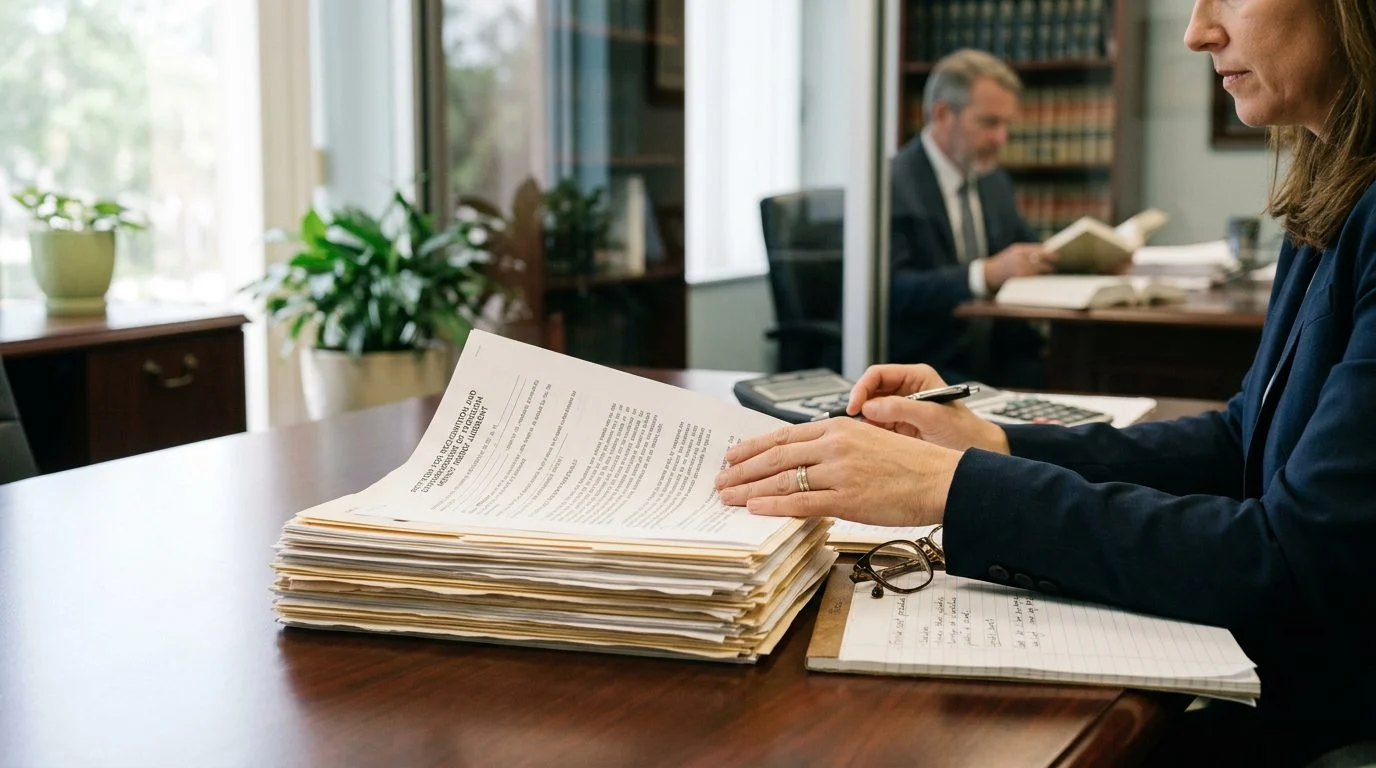
A foreign money judgment is not automatically enforceable in Florida. The holder usually has to bring it into a Florida court first, so it can be collected like a Florida judgment. This page explains that process, the objections a debtor may raise, and the collection tools that come next.
What Recognizing a Foreign Money Judgment Means in Florida
Recognizing a foreign money judgment means asking a Florida court to treat a judgment from another country as enforceable here. The party who won abroad is the judgment holder. The party who owes the money is the judgment debtor, and the debtor can object.
This issue tends to come up in a few ways. A supplier or distributor may win a payment award in a foreign court. A contract dispute may end in a judgment abroad. A trade-related money award may name a Florida company or its owners.
Whichever side you’re on, the foreign judgment is only the first step. Collecting it in Florida takes separate filings, deadlines and proof.
If a judgment from another country now has to be collected in Florida, or is being enforced against your company, you don't have to work through it alone. Reach out to our team to talk through your options. Talk it through with our team — we can walk you through how a situation like yours is usually handled and what your options are.

The Florida Statutory Framework: Chapter 55 and FEFJA
Chapter 55 of the Florida Statutes covers judgments and the liens they create. Its rules are detailed. For example, a personal property lien is acquired only after the judgment becomes final, the time to move for rehearing has lapsed, no motion for rehearing is pending, and no stay is in effect, and a judgment lien certificate is properly filed with the Department of State, unless a court authorizes earlier filing for cause shown when it has authorized a writ of execution in the same matter. Fla. Stat. § 55.202 sets out those requirements. A certificate not filed in compliance is permanently void.
Other routes exist, including a new lawsuit on the underlying claim. The right route varies from case to case.
Small details matter here. Missing one requirement can cost a holder time, so check each step early.
How the Domestication Process Works, Step by Step
Before filing, collect the judgment in its final form and confirm the amount still owed, including any payments made. Domestication generally moves in this order: gather the papers, choose the county, serve the debtor, handle objections, then collect.
- Gather the record. Keep the documents related to the foreign judgment together so they can be reviewed with counsel.
- Choose the county. Under Fla. Stat. § 47.011, an action is brought where the defendant resides, where the cause of action accrued, or where the property in litigation is located. That section does not apply to actions against nonresidents, so a foreign debtor’s location needs separate review. A Hillsborough County debtor or Hillsborough County property may fall within that rule.
- Handle objections. Questions about any challenge to recognition are worth reviewing with counsel early.
- Move to collection. Once the Florida court acts, the holder can use Florida collection tools.
Timing shifts with the debtor’s response, the court’s calendar, translation of foreign documents, and whether objections are filed. Each delay can change which assets are still available, so plan the sequence early.
Defenses a Judgment Debtor Can Raise
Owners are not automatically liable for a company’s debts. Florida courts pierce a corporation’s veil only on proof of improper conduct, meaning the corporation was organized or used to mislead creditors or defraud them. Wurtzebach v. Flooring Depot states that rule, which matters to business owners on either side.
Whether any objection succeeds depends on the facts. Each side should gather its records early, including the foreign court file, the service papers, and any proof of payment.
Enforcement Remedies Available After Recognition
Once a Florida court recognizes the judgment, the holder can pursue the debtor’s property. The tool depends on the type of asset.
-
- Personal property. Under Fla. Stat. § 55.202, a judgment lien can reach the debtor’s interest in personal property in this state subject to execution under s. 56.061, plus payment intangibles and accounts whose location is in this state, but excluding fixtures, money, negotiable instruments, and mortgages. Priority among judgment liens goes by the date and time of filing, except as otherwise provided in s. 55.208, and conflicts with secured parties are determined under chapter 679. Filing is made with the Florida Department of State.
- Real property. Under Fla. Stat. § 55.10, a judgment becomes a lien on land when a certified copy is recorded in that county. The judgment or a recorded affidavit must state the lienholder’s address. The initial lien period is 10 years for recordings made on or after July 1, 1994.
- Stock and goods. Under Fla. Stat. § 56.061, stock in corporations and goods are subject to levy and sale under execution.
- Moved assets. Under Fla. Stat. § 726.108, subject to the limitations in s. 726.109, a creditor may seek avoidance of a transfer to the extent needed to satisfy its claim, an attachment or other provisional remedy, an injunction, a receiver, or any other relief the circumstances may require. With a judgment and a court order, the creditor may levy execution on the transferred asset. Under Fla. Stat. § 726.105, in determining actual intent under paragraph (1)(a), whether the debtor had been sued or threatened with suit before the transfer is one factor a court may weigh.
Garnishment and writs follow clerk procedures. The Miami-Dade Clerk’s judgment collection page describes those steps.
Domesticating a Judgment or Filing a New Lawsuit
Domesticating a judgment and filing a new lawsuit are two routes. Domestication brings in an existing judgment. A new lawsuit asks a Florida court to decide the underlying claim.
Each route has its own timing, evidence and cost. Compare them early, before a deadline narrows your choices.
Deadlines are the key difference. Under Fla. Stat. § 95.11, an action on a judgment or decree of any court, not of record, of this state or any court of the United States, any other state or territory in the United States, or a foreign country must start within five years. A Florida judgment of record has 20 years under the same statute.
Venue can also involve more than one county. Under Fla. Stat. § 47.021, when two or more defendants live in different counties, suit may be brought in any county where one of them resides.
Not sure what your next step is?
Talk it through with our team — we can walk you through how a situation like yours is usually handled and what your options are.
Frequently Asked Questions
Can any foreign money judgment be enforced in Florida?
Not automatically.
Do I need a lawyer to domesticate a judgment?
The filings, service and court steps are technical. A lawyer can handle them in the Florida court where the case is filed.
It brings in an existing judgment rather than retrying the underlying claim.
Whether one succeeds turns on the record in the case.
How long do I have to act?
Under Florida’s statute of limitations, a five-year period applies to an action on a judgment or decree of a Florida court not of record, or of any federal court, any other state or territory of the United States, or a foreign country. Check the deadline early.
Which county should I file in?
Venue looks at where the debtor resides, where the claim arose, and where the property is located.

Talk With Ayala Law PA About Your Foreign Judgment
If a judgment from another country now has to be collected in Florida, or one is being enforced against a company you run or own, you’re facing filings and deadlines you didn’t plan for. Our team can talk through where the judgment came from, where the debtor and its assets are, and which route fits. Call (305) 570-2208 or request a case evaluation.
Ayala Law PA’s only office is at 1646 W Snow Ave, Tampa, FL. Ayala Law PA works with businesses in Tampa and Hillsborough County from its Tampa office. Eduardo A. Maura is the lawyer responsible for this page.
The firm handles business litigation, commercial litigation, contract disputes, shareholder disputes, construction litigation, real estate litigation, and international trade litigation in Florida courts and arbitration. Fees are discussed directly with the firm.



