
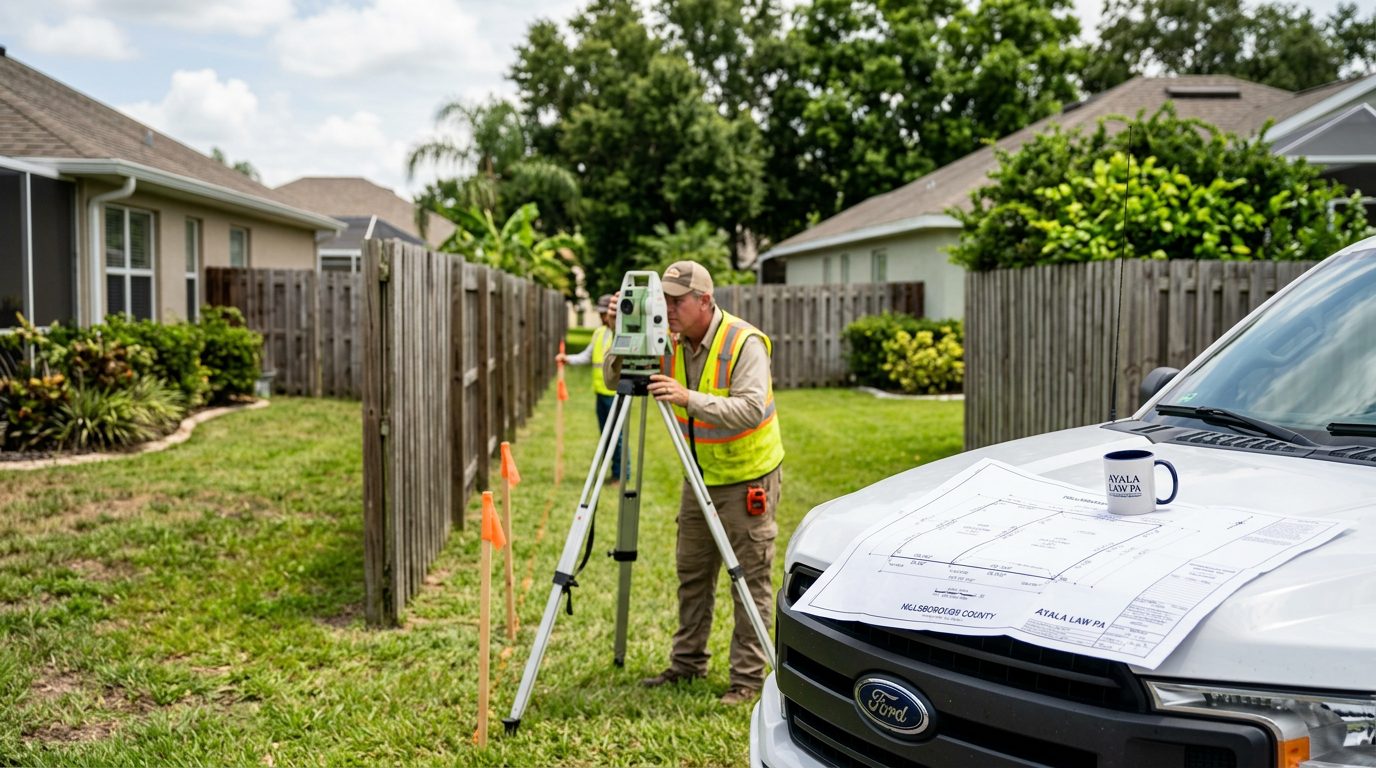
Real estate litigation is a lawsuit or arbitration over property rights, property transactions, or the contracts that govern them. Disputes involving businesses in Hillsborough County can arise from leases, purchase contracts, unpaid construction work, or property held by a company. The questions below cover common issues in these disputes and the records that are useful to gather before you contact our office. Ayala Law PA represents businesses in these matters from its Tampa office, as explained below.
What Real Estate Litigation Means for Businesses in Hillsborough County
Business disputes can affect a company’s operations, finances, and ownership. Commercial leases, purchase contracts, and development deals often involve large sums, many parties, and tight schedules. A stalled closing or a tenant who will not leave can halt operations quickly.
Ayala Law PA focuses on business litigation and commercial litigation, including contract disputes, shareholder disputes, construction litigation, and real estate litigation. Outcomes depend on the facts, the documents, and the law that applies to each matter. No lawyer can say in advance how a particular dispute will end.
If a failed closing, lease default, or unpaid lien has your business tied up, our team can talk through your options and book a case evaluation. Talk it through with our team — we can walk you through how a situation like yours is usually handled and what your options are.
Common Real Estate Disputes Businesses Bring to Court
Business real estate disputes can involve leases, purchase contracts, title problems, and disagreements between owners.
Lease disputes often begin when the lease ends. For nonresidential (commercial) leases, Fla. Stat. § 83.06 provides that a tenant who refuses to give up possession at the end of the lease may owe double the monthly rent once the landlord demands it. Unpaid rent and disputed repair duties also drive many lease cases.
Real estate deals depend on written paperwork. Under Fla. Stat. § 689.01, a transfer of a real property interest generally requires a signed written instrument witnessed by two subscribing witnesses. Leases are exempt from that witness requirement. Failed closings, earnest money disagreements, and claims that a seller misstated a property’s condition can lead to lawsuits.
Easement conflicts and disputes over recorded interests can block how a business uses its land. When a company owns property, co-owners and partners may disagree over control, sale, or income. These cases can overlap with shareholder or partnership claims.
Construction Liens and Lien Foreclosure Across Hillsborough County
A construction lien is a claim against a property tied to unpaid work or materials. Lien disputes often start with a payment disagreement. A contractor may stop receiving draws, a subcontractor may dispute a change order, and a lien may be recorded against the property. Florida’s lien rules include notice and timing steps, and a missed step can affect whether a lien holds. This page does not cover those steps in detail, so each job needs its own review.
A court judgment can also become a lien on real property. Under Fla. Stat. § 55.10, a judgment becomes a lien on real property in a county when a certified copy is recorded there, as long as the lienholder’s address is included or recorded by affidavit. For a copy first recorded on or after July 1, 1994, the lien lasts an initial period of 10 years.
Construction projects in Brandon, Riverview, and Plant City can face the same payment problems. Lien foreclosure is a lawsuit to enforce a lien against the property.
Deadlines, Pre-Suit Steps, and Other Ways to Resolve a Dispute
Florida sets time limits for filing suit, and missing one can end a claim. Filing deadlines for construction-related claims depend on the type of claim and when it arose, so reviewing the timing early in a dispute is important. For claims founded on the design, planning or construction of an improvement to real property, the time limit may begin at the earliest of a temporary certificate of occupancy, a certificate of occupancy, a certificate of completion, or the date construction was abandoned. For a latent defect, the clock starts when the defect is discovered or should have been discovered with due diligence. For those design and construction claims, Florida Statutes § 95.11 generally sets a four-year limitation period. It also sets a seven-year outer limit, measured from that earliest date, which generally applies regardless of when a defect is discovered.
Fla. Stat. § 95.031 generally starts the time to sue when the cause of action accrues, which is when its last element occurs, subject to the exceptions in subsection (2) of that statute and the tolling rules in § 95.051. Fla. Stat. § 95.03 voids any contract term that sets a shorter period to sue than the statute allows. Check the dates early. Waiting for negotiations to end can cost time you may need.
Mediation is another path. Under Fla. Stat. § 44.102, a court must refer a filed civil action for money damages to mediation when one party asks, if that party can pay or the costs can be split fairly. Florida’s court mediation statute lists exceptions, including actions filed to collect a debt, and § 44.102(2)(a) excludes landlord-tenant disputes that do not include personal injury from mandatory referral to mediation. Mediation in a filed case follows the Florida Rules of Civil Procedure.
Arbitration is a private alternative to court. Under Fla. Stat. § 682.02, a written agreement to arbitrate existing or future disputes is generally valid and enforceable, unless a legal ground exists to revoke the contract. A court decides whether an arbitration agreement exists.
Real Estate Litigation in Hillsborough County: How Matters Are Handled From Tampa
Ayala Law PA’s only office is at 1646 W Snow Ave in Tampa. Clients in Hillsborough County, including Tampa, Brandon, Riverview, Plant City, and Temple Terrace, are served from that Tampa office. The firm has its office in Tampa or elsewhere in Hillsborough County.
Where a case is filed matters. Under Fla. Stat. § 47.011, actions are brought only in the county where the defendant resides, where the cause of action accrued, or where the property in litigation is located. That section does not apply to actions against nonresidents.
Eduardo A. Maura is the lawyer responsible for this page. Our team, which includes support staff, helps coordinate calls, documents, and meetings. Tampa Bay clients can ask how those arrangements work when they first reach out.
What to Gather Before a Case Evaluation
Bring your documents and a written timeline before you reach out. Start with the signed contract or lease and every amendment. Add any deed or title papers, lien filings, invoices, and payment records. Include written correspondence such as letters and emails.
Write a short timeline of key events. List each default, notice, and payment with its date. For construction work, note when the work finished and whether a certificate of occupancy or completion was issued, because those dates can start the filing clock.
Also write down your questions. Ask which claims or defenses may apply, what the likely next steps are, and which deadlines may already be running. A lawyer can address those points only after reviewing your documents.
Frequently Asked Questions
Are subscribing witnesses required for a lease in Florida?
Florida law provides that no subscribing witnesses shall be required for a lease of real property.
Where can a business be sued in Hillsborough County?
For corporations, Florida venue is governed by Fla. Stat. § 47.051. A domestic corporation may be sued where it has or usually keeps an office for its customary business, where the cause of action accrued, or where the property in litigation is located. A foreign corporation doing business in Florida may be sued where it has an agent or other representative, where the cause of action accrued, or where the property in litigation is located. A contract may also include a venue clause that can affect where suit is filed.
How long do I have to sue over construction defects in Florida?
Florida’s statute on limitations periods places an action founded on the design, planning, or construction of an improvement to real property within a four-year period, with the time running from a date the statute specifies.
If a lease default, unpaid lien, or failed closing has your business tied up, contact Ayala Law PA at (305) 570-2208 to book a case evaluation.



