
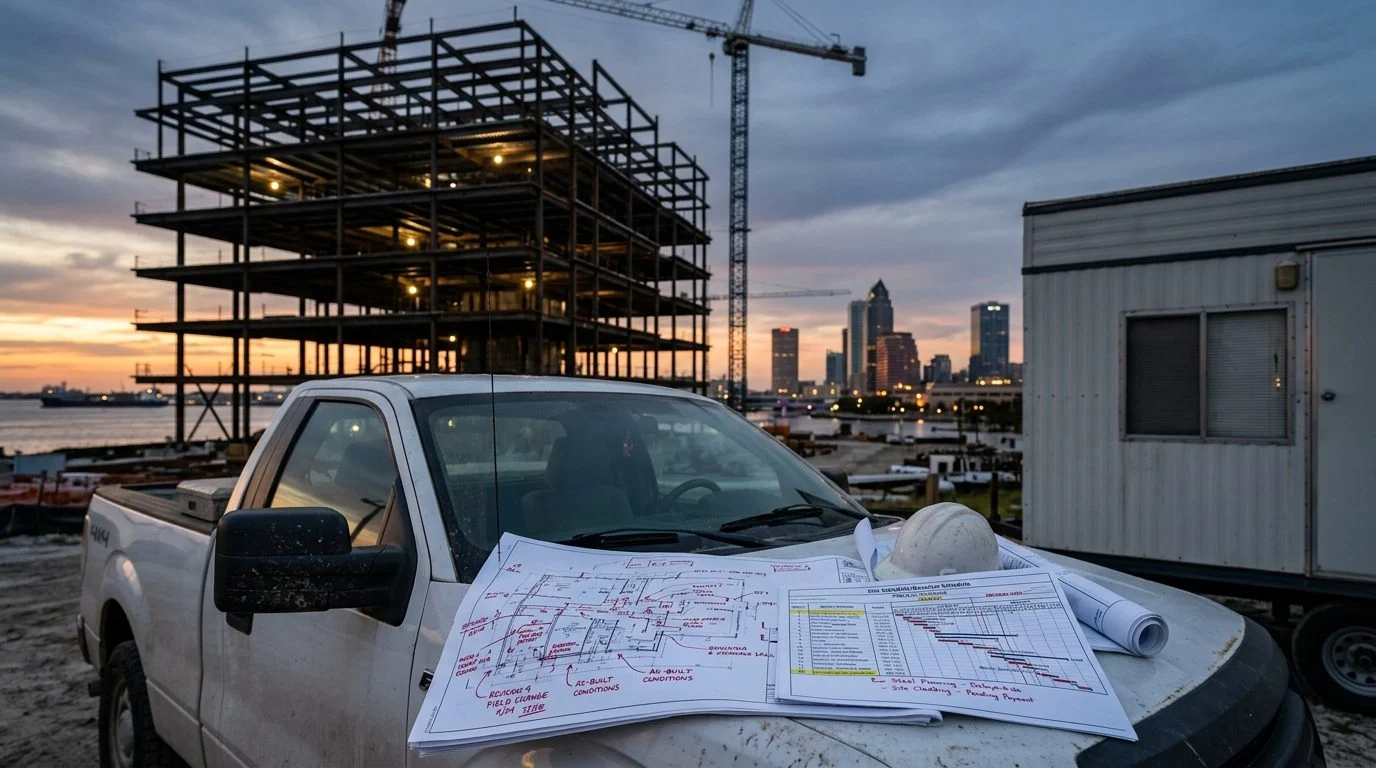
Most construction payment disputes start with ordinary project problems, not one bad act. Unclear changes, thin paperwork, disputed quality, and poor communication cause most of them. This page explains the common reasons for payment disputes in construction and what Florida law generally says about each one. It’s written for owners, contractors, subcontractors and suppliers in Tampa Bay, including Hillsborough County, Brandon, Riverview, Plant City and Temple Terrace.
This page is the responsibility of Eduardo A. Maura at Ayala Law PA, whose office is in Tampa, Florida. The firm focuses on construction litigation and related business and contract disputes.
Why Payment Disputes Start on Construction Projects
Payment disputes usually grow out of friction nobody planned for. A schedule slips, a change happens in the field, or a pay application sits unread. Each person on the job sees the same problem from a different seat. An owner sees spending beyond the budget. A general contractor sees costs it can’t recover. A subcontractor or supplier sees a bill going unpaid while work continues.
The recurring causes are scope changes, pricing and contract gaps, payment paperwork, defects and delays, payment clauses, and communication. Naming the cause helps you decide what to do next. Owners, contractors, subcontractors and suppliers often disagree about the cause, so the paper trail matters. Written records made at the time of each event are easier to rely on than memories pieced together months later.
If a payment on your project has stalled and you're not sure where you stand, we're glad to talk through your situation with you. Talk it through with our team — we can walk you through how a situation like yours is usually handled and what your options are.
Scope Changes and Disagreements Over Extra Work
Scope changes often start a payment fight. A scope change is any work added to, or removed from, the original job. It usually begins with a phone call or a walk-through. The owner asks for an upgrade, the contractor agrees, and the crew starts. Weeks later the invoice shows the extra cost, and the owner says that work was already in the price.
The reverse happens too. A contractor treats a requested addition as included, while the owner believes it is extra.
A written change order closes that gap. It is a written document that changes the price or schedule, and both sides sign it. Unsigned requests and verbal approvals make it hard to prove what was agreed. Save every request, approval, daily log and photo tied to the change. When the owner asks for work outside the contract, confirm it by email, even if the reply is a quick one.
Estimates, Pricing Errors, and Unclear Contract Types
Pricing errors and vague contract terms widen the gap between what was expected and what gets billed. An underpriced bid is a common starting point. A contractor who bids too low may try to recover the loss through change requests. The owner may refuse, and both sides end up arguing over the final number.
Contract type also shapes billing. A lump-sum contract sets one fixed price for the whole job. A cost-plus contract pays actual costs plus an agreed fee or markup. A time-and-materials contract bills for hours worked and materials used. A unit-price contract pays a set rate for each measured unit, such as each foot of pipe installed. Each type breeds different fights. Lump-sum disputes focus on what was included. Cost-plus disputes focus on which costs count.
Gaps in the contract add more risk. Undefined allowances, missing unit prices and unclear markup terms leave room to argue. Florida courts hold that, where an express contract covers the same subject matter, claims arising from that relationship won’t support unjust enrichment (Williams v. Johnson).
Payment Schedules, Invoicing, and Missing Paperwork
Late payment often starts with paperwork that was incomplete or never received. A pay application is the bill a contractor sends for completed work. If it arrives late, lacks detail, or goes to the wrong person, the owner may say payment was never due. Without proof of delivery, that argument is hard to settle.
Lien waivers add another layer. A lien waiver is a document in which a contractor or supplier gives up lien rights for work or materials. A conditional waiver takes effect only when payment clears. An unconditional waiver confirms payment was received. Read each waiver carefully before signing, because it can release rights you still need.
Public projects often follow their own invoice rules. The City of Tampa’s standard purchase order terms cover invoice contents, payment after receipt of a proper invoice, and the procedure for disputed payments (City of Tampa purchase order terms). Those terms govern City purchase orders, not every private job.
Start an organized payment trail with the first invoice. Number each pay application, keep the transmittal, and log the date and method of delivery.
Defects, Delays, and Withheld Payment
Owners often withhold payment when they say the work is defective, incomplete or late. The owner points to a leak, a crack or open punch-list items, and holds back part of the bill. The contractor replies that the work meets the plans, or that the owner caused the delay. The dispute then turns on the facts: what the contract requires, what was inspected, and what was agreed.
Delays create similar fights. Contractors blame owners who changed decisions late, weather, or other trades. Owners blame the contractor’s crew. Daily logs, weather records and written notice of delay help sort out responsibility.
Coordination problems between trades cause rework. When one trade’s work blocks another, someone has to pay to fix it. Disagreement over who pays for rework is a frequent source of disputes on busy sites.
Acceleration adds pressure. If an owner asks to speed up the schedule, the contractor may add crews or overtime. Without a written order, the contractor may later claim the added cost, and the owner may say it never agreed to pay. Get acceleration requests in writing before the extra work starts.
Pay-If-Paid, Pay-When-Paid, and Owner Nonpayment
A subcontractor can finish the work and still go unpaid when the owner doesn’t pay the general contractor. Many subcontracts include a pay-if-paid or pay-when-paid clause. In general terms, pay-when-paid delays the sub’s payment until the contractor gets paid. Pay-if-paid ties it to the owner’s payment. How a court reads either clause depends on its exact wording and the facts of the job.
Lien deadlines can be short, so check them early.
Time limits to sue also matter. Under § 95.11, an action founded on the construction of an improvement to real property has a four-year period. The period generally runs from the earliest certificate of occupancy, certificate of completion, or abandonment of unfinished work. For a latent defect, the time runs from when the defect is discovered or should have been discovered with the exercise of due diligence, but the action must still be commenced within 7 years after the date the authority having jurisdiction issues a temporary certificate of occupancy, a certificate of occupancy, or a certificate of completion, or the date of abandonment of construction if not completed, whichever date is earliest. A contract clause that sets a shorter period to sue is void under § 95.03.
Promises to pay another person’s bill also have a writing rule. Under § 725.01, an action on a promise to answer for another’s debt requires that promise, or some note or memorandum of it, to be in writing and signed by the party to be charged or by some other person lawfully authorized by that party. A verbal assurance from an owner to pay a sub directly may not be enough.
Not sure what your next step is?
Talk it through with our team — we can walk you through how a situation like yours is usually handled and what your options are.
Communication Breakdowns and Unclear Responsibility
Many payment disputes start with a conversation nobody wrote down. Poor communication among owners, contractors, architects and subcontractors leads to disagreement over what was approved and who approved it. A foreman says yes on site. Later, the owner says the foreman had no authority. A text says “go ahead.” Who sent it, and could that person approve the work? Those questions often decide payment.
Written notice protects a payment claim. Send a short notice when a problem starts, a delay begins, or an amount is disputed. Name the work, the date and the amount. Ask for a written reply. A clear notice creates a record that is harder to dispute later.
Keep a written record of every payment-related conversation. Follow each call with an email that summarizes what was agreed. Save texts and emails in one place. Note who gave each approval and that person’s role on the project. A simple log, kept current, makes a dispute easier to explain to a mediator, an arbitrator, or a judge.

Next Steps If Your Payment Is Being Withheld
Start by gathering your contract, change orders, pay applications and notices before you take any other step. Build a timeline showing who asked for what, and when. Many decisions turn on the dates.
Many payment disputes are settled through negotiation. If talks fail, the contract often sets the path. Under § 44.102, a court must, on one party’s request, refer a filed action for monetary damages to mediation if the requesting party is willing and able to pay the costs or the costs can be equitably divided between the parties, unless an exception applies, such as a debt collection action. Actions filed to collect a debt are excluded. Under § 682.02, an arbitration agreement in a record is generally enforceable. Fla. Stat. § 682.02 reads: “(1) An agreement contained in a record to submit to arbitration any existing or subsequent controversy arising between the parties to the agreement is valid, enforceable, and irrevocable except upon a ground that exists at law or in equity for the revocation of a contract.” On state transportation projects, FDOT’s dispute procedures set out how disputes and claims are handled.
Florida follows the American rule. Each party generally pays its own attorney’s fees unless a contract or statute provides otherwise (Price v. Tyler). Check your contract for a fee clause.
Ayala Law PA focuses on business litigation, construction litigation and contract disputes in Florida courts and arbitration. Its office is in Tampa, Florida. The firm serves clients across the Tampa Bay area, including Hillsborough County, Brandon, Riverview, Plant City and Temple Terrace. Case evaluations are fee-based. If a payment on your project has stalled, call (305) 570-2208 or use the contact page to talk through your situation.
What are common reasons for payment disputes in construction?
The most common causes are scope changes, unclear pricing, missing paperwork, withheld payment over defects or delays, pay-if-paid clauses, and poor communication.
How long do I have to sue over unpaid construction work?
Track your key dates now.
Who pays the attorney’s fees in a payment dispute?
Each side generally pays its own fees unless a contract or statute says otherwise.



