
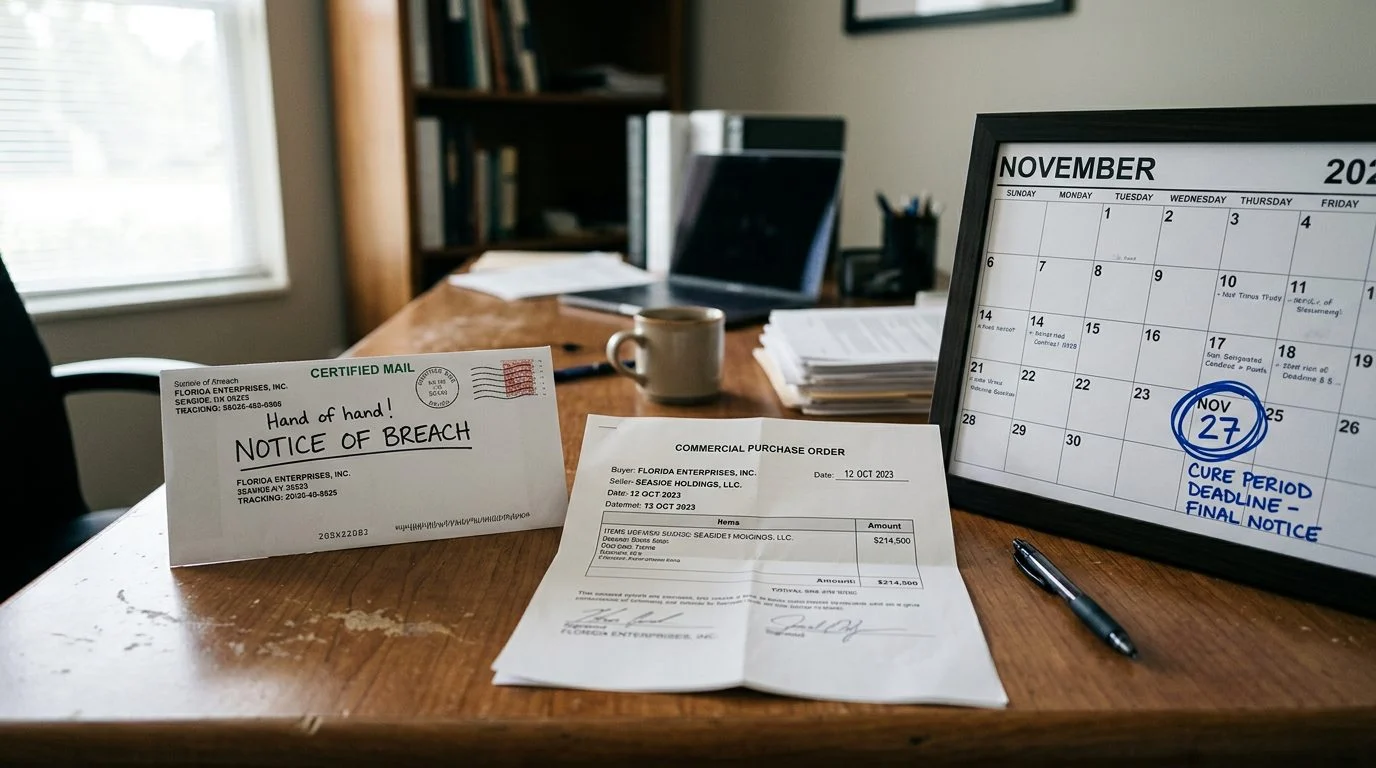
A commercial purchase contract’s due diligence period is the window when the buyer checks the property and its records before the deal becomes firm. When buyer and seller disagree during that window, the contract’s wording on deadlines, notices and deposits usually decides the next step. This page explains how these disputes arise in Florida and what each side should watch. Ayala Law PA focuses on business and real estate litigation, including commercial contract disputes in Florida courts and arbitration.
What a Due Diligence Period Is in a Florida Commercial Purchase Contract
The due diligence period is the time the buyer has to inspect the property and review the paperwork. Buyers often look at the building’s condition, title, the survey, leases, permits, and environmental reports during this time.
Many contracts use an inspection contingency. This is a condition that lets the buyer end the deal if a problem appears, usually by a stated date. If the buyer does not act in time, the buyer may lose that exit.
The contract also says what the seller must deliver and how notices must be sent. It names who receives a notice, by what method, and by when. Those details matter as much as the substance of the complaint.
Your rights depend on the written wording of your agreement. That wording is the starting point for any dispute, so read it before you act.
Not sure what your next step is?
Talk it through with our team — we can walk you through how a situation like yours is usually handled and what your options are.
Common Disagreements That Turn Into Due Diligence Disputes
Most of these fights start with a handful of issues. Knowing them helps you spot your own situation early.
- Inspection findings. The inspector reports roof, HVAC, plumbing, structural, or code problems. The buyer wants repairs or a price credit. The seller says the issues are minor or not the seller’s job.
- Environmental reports. The parties disagree on whether a report shows a condition that allows the buyer to walk away.
- Title and survey objections. The buyer says an easement, lien, or boundary problem must be fixed before closing.
- Zoning, permits, and occupancy. The property may not allow the buyer’s intended use or the certificate of occupancy may be an issue.
- Notice timing. One side argues the termination notice was late, sent to the wrong person, or sent by a method the contract did not allow.
- Earnest money. The parties dispute who gets the deposit after a termination or a missed deadline.
- Waiver and default claims. The seller says the buyer gave up its contingencies or is in default by stopping the deal.
What Our Business and Real Estate Litigation Work Covers
Our team’s work in this area starts with the paperwork. We review the purchase agreement, amendments, notices, and correspondence to find the deadlines and conditions that control the dispute.
Next, we help put your position in writing. That can include a demand letter or notice that states your position under the contract.
Many disputes end in negotiation. Common outcomes in talks include a repair credit, an extension, an amendment, or an agreed termination. Any result depends on the facts and on the other side’s response.
If talks fail, a claim may move forward in court or in arbitration. Florida law generally enforces written arbitration agreements, as Fla. Stat. § 682.02 explains. Venue for a court case depends on where the defendant resides, where the cause of action arose, or where the property is located: under Fla. Stat. § 47.011, actions shall be brought only in one of those counties, and the section does not apply to actions against nonresidents.
If we believe a matter should be referred to another lawyer or firm, we will tell you at the outset.
How a Due Diligence Dispute Typically Unfolds
A dispute usually moves from document review to written notice, then to negotiation, and only then to a formal case. Each step builds on the last.
- Gather the file. Collect the purchase agreement, all amendments, inspection and environmental reports, the survey, and every email or letter exchanged.
- Confirm who has the right to act. Check which party may end the deal or object, what notice form the contract requires, and when the period ends.
- Send a written position before the deadline. The notice should track the contract’s language. Timing and delivery method often matter.
- Negotiate. Parties may agree on a cure, a credit, an extension, an amendment, or a mutual release.
- Escalate if needed. If talks fail, a lawsuit or arbitration demand may follow. The earnest money and the property’s status are addressed as the case requires.
Timelines vary with the facts, the forum, and how the other side responds. We explain the expected steps for your specific matter. We do not promise a timeline.
Why the Diligence Deadline Matters Most
The diligence deadline often decides whether a buyer can still walk away. A late or defective notice can change the result, even when the buyer’s concerns are valid.
Sellers and buyers often argue about what silence or continued performance after a deadline means. For that reason, the timing of written communication is critical.
Sellers often argue the deposit is now non-refundable. Buyers often rely on the same clause to argue they preserved their rights. The contract’s own notice and time terms control those points.
Florida law sets limits on contract clauses. A contract provision that sets a time to sue shorter than the applicable statute of limitations is void, under Fla. Stat. § 95.03.
Florida courts also apply rules on mistake and ratification. Rescission for mutual mistake is available only if the mistake is mutual and goes to the essence of the contract, as Waterside at Boynton Homeowners’ Ass’n explains. A party entitled to undo a voidable contract can lose that right by failing to act after learning the facts, as Flaherty v. Flaherty describes.
Why Work With Ayala Law PA on a Commercial Purchase Dispute
Ayala Law PA focuses on business litigation, commercial litigation, contract disputes, shareholder disputes, construction litigation, real estate litigation, and international trade litigation. The firm handles these matters in Florida courts and arbitration.
Eduardo A. Maura is the responsible lawyer for this page. Our team, including support staff, works through each contract, notice, and report in the file.
The firm’s office is at 1646 W Snow Ave, Tampa, FL. The firm represents clients in Hillsborough County, Brandon, Riverview, Plant City, Temple Terrace, and the wider Tampa Bay area in Florida courts and arbitration.
We do not claim certification on this page. We also do not predict outcomes or describe past results. Each matter turns on its own contract and facts.
Not sure what your next step is?
Talk it through with our team — we can walk you through how a situation like yours is usually handled and what your options are.
Frequently Asked Questions About Due Diligence and Inspection Disputes
Can a buyer walk away during the due diligence period?
It depends on the termination clause and notice rules in your contract. Those written terms control whether the buyer may end the deal.
Does a disagreement over inspection findings always lead to a lawsuit?
No. Many of these disputes end through written positions, repair credits, or amendments. A lawsuit or arbitration is one option, not the only one.
Who holds the earnest money during a dispute?
The contract’s escrow and release provisions control. Disputes often arise over when and to whom the deposit is released.
What if the seller says the buyer missed the deadline?
Notice timing, delivery method, and any waiver argument are reviewed against the contract. The seller’s position is tested the same way as the buyer’s.
Do I need to act before the diligence period ends?
Often, yes. Contract deadlines can be short, and written communication timing is central to protecting your position.
Do attorney’s fees usually shift to the losing side?
Under Florida law, each party generally bears its own attorneys’ fees unless a contract or statute provides otherwise, as Price v. Tyler states.
Talk to Our Team About Your Purchase Contract
If you received an inspection report, a repair demand, or a termination notice, and you’re unsure whether the deadline has run, you’re not alone in that position. Buyers and sellers in this spot often need to act quickly and carefully.
Our team can review your purchase agreement and the notices already exchanged to identify your next step. Call Ayala Law PA at (305) 570-2208 to request a case evaluation before your next contract deadline, or visit the contact page.
Ayala Law PA, 1646 W Snow Ave, Tampa, FL. Responsible lawyer: Eduardo A. Maura.



