
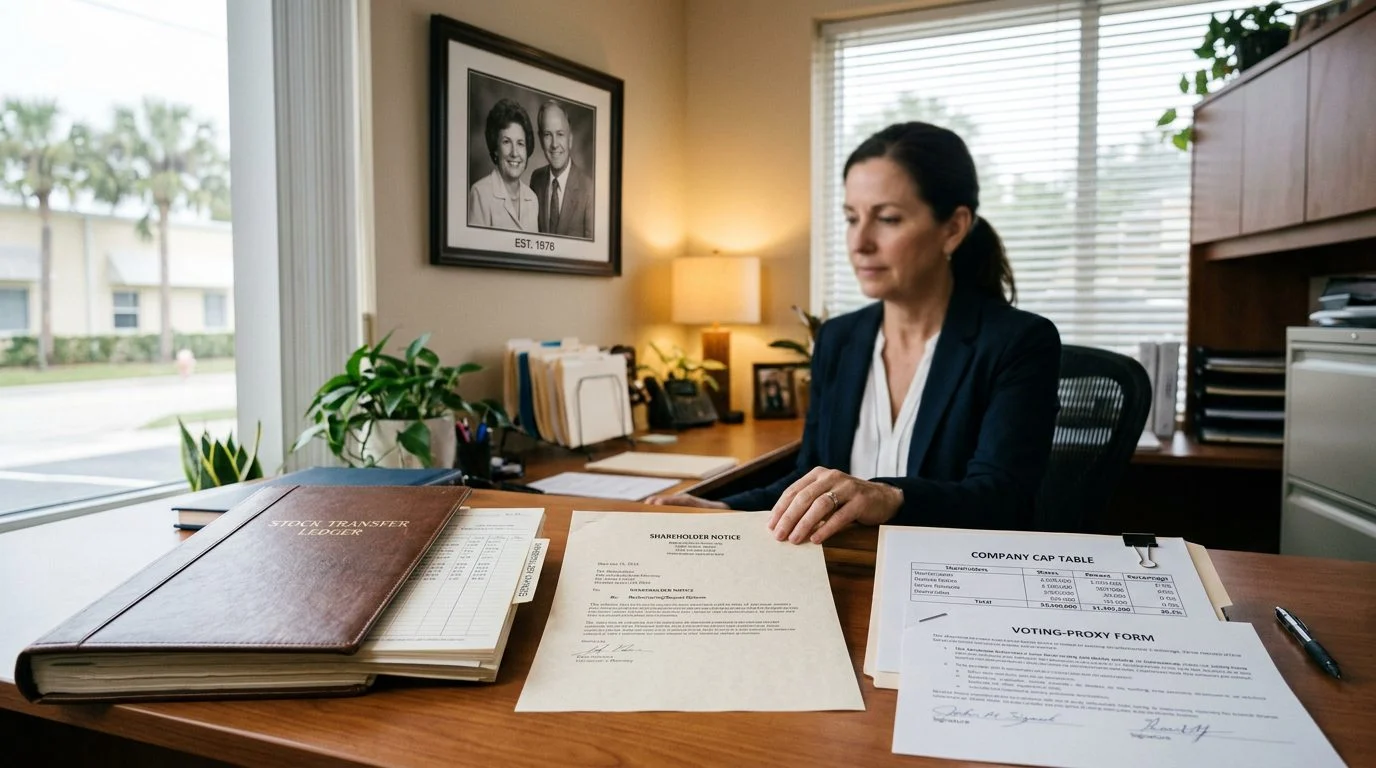
Can a Company Get Rid of Its Shareholders? Florida Options Explained
If a co-owner or a deadlock is disrupting a business you built or rely on, our team can review your documents and facts with you. Talk it through with our team — we can walk you through how a situation like yours is usually handled and what your options are.

Short answer: a company cannot simply remove a shareholder
If owners disagree about a shareholder’s continued role in the company, gathering the bylaws, shareholder agreements and related records before speaking with a lawyer can make that first conversation more productive. Removal takes a legal path: a negotiated buyout, a buy-back under the company’s documents, a transfer, a statutory merger, or a court order. Which path is open depends on the facts.
Florida corporations are governed by Chapter 607. Florida LLCs are governed by Chapter 605. So the first question is what kind of entity you have.
Many owners make two mistakes early. They act first and check the documents later. Or they assume a majority vote settles everything. Both moves can create new disputes. For a wider look at owner conflicts, see our shareholder disputes in Florida overview.
Start with the governing documents
The company’s own documents usually set the first rules. These include the articles of incorporation, the bylaws, any shareholder agreement, and any buy-sell agreement. These papers often decide the exit terms, even when they were signed years ago.
Florida lets these documents limit share transfers. The articles, the bylaws, an agreement among shareholders, or an agreement between shareholders and the corporation can restrict transfers under Fla. Stat. § 607.0627. A restriction can require a shareholder to offer shares to the company or others first. It can also require the company or others to buy them.
Enforcement has conditions. The restriction must be authorized by statute. Its existence must be noted conspicuously on the share certificate or the information statement. Without that note, the restriction may not bind a buyer who didn’t know about it.
A shareholder agreement has its own rules. It can also set a mechanism for breaking a deadlock.
For an LLC, the operating agreement is the starting point. Under Fla. Stat. § 605.0105, except as otherwise provided in subsections (3) and (4), the operating agreement governs relations among the members and between the members and the company. The LLC chapter fills in what the agreement leaves out.
Check for right of first refusal terms, mandatory buy-sell triggers, valuation formulas, and dispute clauses. Those clauses often hold the real answer.
Negotiated buyouts and share redemption
The simplest route is a negotiated buyout. The owner agrees to sell shares to the company or to the remaining owners. Both sides agree on the price and the terms.
A company buying back its own shares faces legal limits. A payment for shares counts as a distribution. Under Fla. Stat. § 607.06401, a distribution can’t be made if, afterward, the company couldn’t pay its debts as they come due in the usual course of business, or if its total assets would fall below its total liabilities plus, unless the articles permit otherwise, certain preferential amounts. The company must pass that test before it pays.
Directors can face personal exposure. Under Fla. Stat. § 607.0834, a director who votes for or assents to an unlawful distribution can be personally liable to the company for the amount that exceeds what could lawfully have been distributed. That applies when the director didn’t meet the statutory standard of conduct. Claims under that section face strict time limits.
Put the deal in writing. A signed release should cover the price, the payment schedule, confidentiality, and any non-disparagement terms. It should also state what each side gives up.
Informal promises carry risk. Under Frutafino, S.A.S. v. Dole Chile, S.A., a promise of future action can be fraud if the person making it had no intention of keeping it. A written deal makes both sides’ commitments clear.
Diluting a shareholder through new share issuance
Issuing new shares can lower an owner’s percentage. The company must also follow its own agreements.
Check whether the articles or an agreement give current owners a right to buy new shares first. Skipping that step invites a dispute.
Directors also owe duties. Under Fla. Stat. § 607.0830, each director must act in good faith. The director must also act in a way the director reasonably believes is in the corporation’s best interests. Directors must use the care that an ordinary prudent person in a like position would reasonably believe appropriate under similar circumstances when becoming informed for a decision or devoting attention to oversight.
A share issue that appears aimed mainly at pushing out one owner can raise questions under those duties. Review dilution options before any notice or vote is taken. Acting on a plan without that review is a common and costly mistake.
Squeeze-outs, deadlock, and court remedies
A court can dissolve a corporation in some cases, or order a lesser remedy. Under Fla. Stat. § 607.1430, in a proceeding by the Department of Legal Affairs, a circuit court may dissolve a corporation if it obtained its articles of incorporation through fraud or has continued to exceed or abuse the authority conferred upon it by law. The same section also covers deadlock.
Deadlock can have its own path. If the shareholder agreement has a compliant deadlock sale provision, that provision can resolve the deadlock. It must be carried out within the time periods and terms the agreement sets, as the same section provides.
Under Fla. Stat. § 607.1436, in a proceeding under s. 607.1430(1)(b), the corporation may elect to buy the petitioner’s shares at fair value or, if it fails to elect, one or more shareholders may elect to do so. The election is generally due within 90 days after the petition, unless the court allows more time. If, within 60 days after the filing of the first election, the parties agree on value and terms, the court enters an order on those terms.
If the election to purchase is filed by one or more shareholders, the corporation must, within 10 days thereafter, notify all shareholders other than the petitioner in writing. Under Fla. Stat. § 607.1431, within 30 days after a shareholder’s dissolution proceeding under s. 607.1430(1)(b) begins, the corporation must notify all other shareholders that they can avoid dissolution by electing to buy the petitioner’s shares under s. 607.1436, and include a copy of that section. A court may also, in its discretion, award attorney fees and other reasonable expenses to the other parties to the proceeding who have been adversely affected by a party that acted arbitrarily, frivolously, vexatiously, or not in good faith.
Courts have other tools. Under Fla. Stat. § 607.1434, as an alternative to dissolution and upon a showing of sufficient merit, a court may appoint a receiver or custodian during the proceeding. It may appoint a provisional director or order a purchase of the petitioner’s shares. It may also grant other equitable relief.
In certain mergers and asset sales that need shareholder approval, a dissenting owner may have appraisal rights. Under Fla. Stat. § 607.1302, a shareholder of a domestic corporation is entitled to payment of the fair value of their shares in the event of listed corporate actions, such as certain mergers and dispositions of assets, subject to the statute’s exceptions.
Not sure what your next step is?
Talk it through with our team — we can walk you through how a situation like yours is usually handled and what your options are.
How a removal process typically unfolds
A removal usually moves through five steps. Skipping a step can undo the work you’ve already done.
- Review the documents. Find the provisions on transfers, buy-sell terms, and disputes.
- Choose the exit path. Decide between a transfer, a buy-back, a merger, or court action.
- Give required notices. Honor any pre-emptive or transfer rights before you act.
- Value the shares. Use the agreed formula or a fair-value process. Then agree on price and payment terms.
- Complete the transfer. Sign the documents, update the stock ledger, and record the corporate approvals.
Frequently asked questions
Can a company remove one of its shareholders?
It usually takes a buyout, a buy-back under the company’s documents, or a court order.
What happens to shareholders when a company is bought out?
They receive the agreed or court-set payment. In return, they give up their shares, under the deal’s terms.
Can I be removed if I own 51% of a company?
The company’s governing documents determine how voting power is allocated. Your job and any removal terms still turn on the company’s documents and agreements.
Who has more power, the board or shareholders?
In general, owners vote on major matters and choose the directors. The board handles day-to-day decisions. The company’s documents set the details.

Talk with Ayala Law about your situation
A co-owner who stops cooperating, or a deadlock that freezes decisions, can stall a business you built or rely on. You may be dealing with this while still trying to understand your options.
Eduardo A. Maura is the responsible lawyer for this page. The firm represents businesses in Tampa, Hillsborough County, Brandon, Riverview, Plant City, Temple Terrace, and across the Tampa Bay area.
Case evaluations are paid services, and the firm discusses fee terms directly with you. No outcome can be promised, because every matter turns on its own facts and documents. Some matters may be referred to another lawyer or firm.
Our team can review your documents and the facts with you. Call (305) 570-2208 or request a case evaluation through our contact page.
This page is attorney advertising.



