
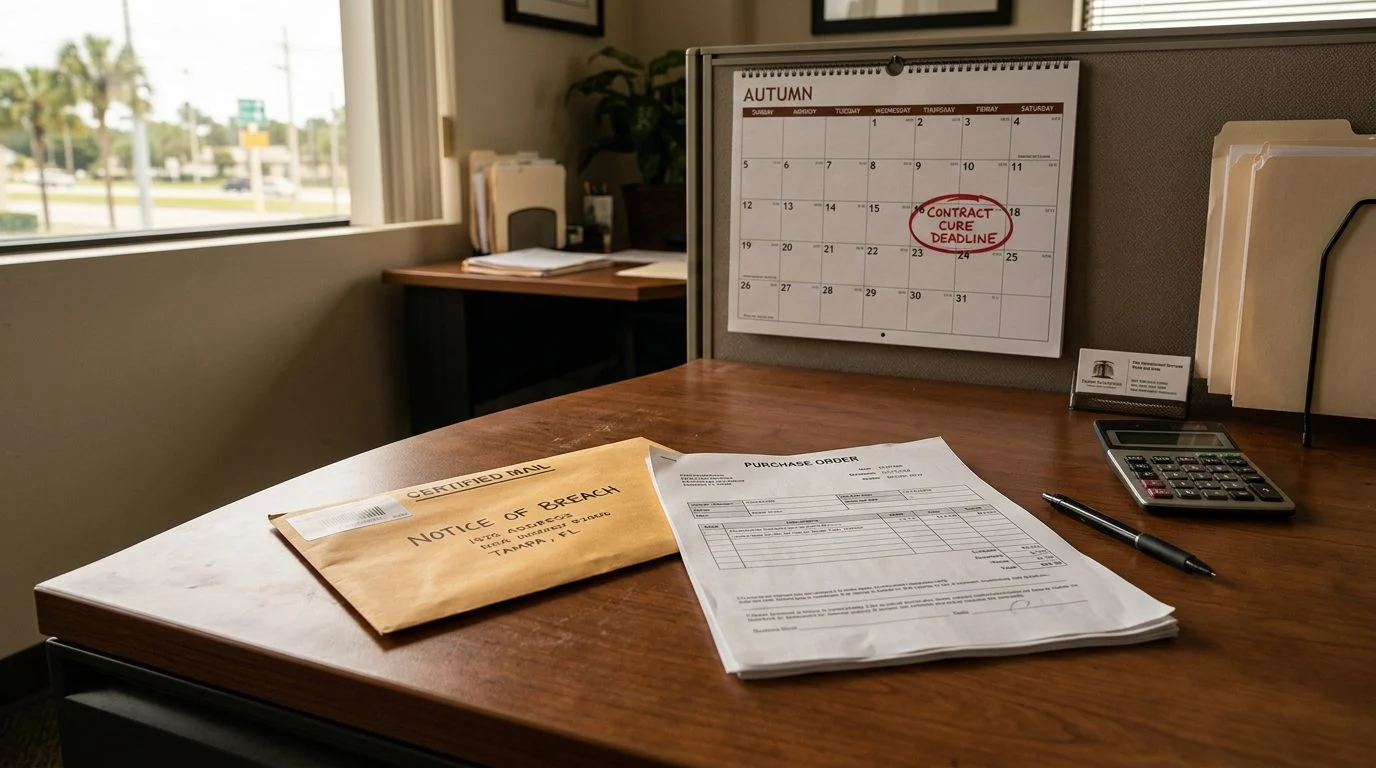
When a customer or supplier walks away from a deal, the income your business expected can disappear fast. If that happened to your Tampa company, you need proof that the lost profits were real and that the breach caused them.
This page walks through each piece, one step at a time. It is written for owners, managers, and family members who are still gathering facts. For the wider picture, see our guide to breach of contract claims for Tampa area businesses.
What Lost Profits Mean in a Florida Breach of Contract Case
Lost profits are the net income your business would have earned if the other side had performed. They are not the total sales you expected. Net income is what remains after you subtract the costs of earning that revenue.
Think of a job that brings in a large invoice but needs heavy labor, materials, and overhead. The margin left after those costs is the figure that matters, not the invoice total.
The claim starts with the contract’s own terms. Pricing, volume, and delivery dates show what the deal promised. Your staffing, equipment, and supplier costs show what it would have cost to deliver.
Write down the expected revenue, costs, and margin for the work the contract covered. That single page becomes the outline for everything that follows.
If a broken contract has cost your company income it was counting on, our team can talk through your agreement and records with you at our Tampa office. Talk it through with our team — we can walk you through how a situation like yours is usually handled and what your options are.
How Judges and Juries Test Lost Profit Numbers
Judges and juries look for numbers tied to real records, not a bottom-line figure with no support. A number in a demand letter is only a starting point. The other side will ask how you got it, what it assumes, and which documents back it up.
Expect questions about each input: the price, the volume, the margin, and the time period. A reliable method is one a reader can follow step by step, from source documents to the final figure. If an input is an estimate, label it and explain where it came from.
Owners often make one mistake here. They present a projection based on their strongest month ever and treat it as expected performance. A steadier pattern from your own history is easier to defend.
Every assumption should be traceable to a document. If the story holds together with the paperwork, it is much harder to attack.
Building the Baseline: Historical Financial Records
Your past financial records show what the business earned before the breach. They are the foundation for any lost profits figure.
Useful records include profit and loss statements, balance sheets, general ledgers, bank statements, sales invoices, and business tax returns. Monthly or quarterly results for comparable periods show a pattern. A single strong month proves much less than a year of consistent results.
Isolate the revenue and costs tied to the contract. If the agreement covered one product line or one job site, separate that revenue and those costs from the rest of the company. Owners often hand over total company figures, which hide the affected operations.
If the business changed in the months before the breach, note that too. A new hire or a lost supplier can shift the numbers, and the baseline should explain it.
Keep original ledgers and bank entries. Exported reports help, but the underlying entries are what the other side will check.
Showing the Contract Would Have Produced the Profits
The strongest proof is evidence that the contract was set to produce profit on a known schedule. Purchase orders, signed bids, backlog, pipeline records, customer forecasts, and the contract’s pricing and volume terms all help.
Capacity records matter too. Payroll, equipment logs, and supplier orders can show your business was ready to perform. Readiness is part of the proof. In Ryan v. Landsource Holding Co., Florida’s Second District Court of Appeal stated that to be entitled to damages based on an anticipatory breach, the nonbreaching party must establish its ability to perform at the time of the breach. The party must show it was able to perform when the breach occurred, as Ryan v. Landsource Holding Co. explains.
Industry data and comparable deals can support your assumptions. Tie them to your own business, though. A generic industry average carries less weight than your own margins on similar jobs.
Separating the Breach From Other Causes and Mitigation
Lost profits must come from the breach itself, not from other forces that also hurt sales. A market downturn, a competitor’s price cut, rising material costs, or a management decision can all cut into margins.
The other side will look for these alternative explanations. Expect them to ask whether sales fell for reasons unrelated to the contract. A clear timeline helps. Show when the breach happened, what changed in the numbers afterward, and what else was happening in the same period.
Expect questions about what your business did after the breach. The other side will ask whether you pursued replacement customers or other work. Document every effort: proposals sent, calls made, and bids submitted. Those efforts are part of the story the numbers tell.
Do not hide weak periods. A chart that skips a bad quarter invites doubt about the rest. Show the full picture and explain it.
Lost Profits for New or Limited-History Businesses
A newer business has less history to measure against, so its numbers get closer review. Without several years of results, every projection draws a question.
Evidence that may still help includes signed commitments from the other party, purchase orders, written terms, and documented market data. Your own experience in similar work can matter too. Records from earlier jobs, even from a prior business, show what comparable work produced. Keep proof of where those records came from.
Owners in this position sometimes assume a short history rules out a claim. Whether it does depends on the facts of your business and your contract. The question is whether the numbers rest on something solid, not only on how long the business has operated.
Not sure what your next step is?
Talk it through with our team — we can walk you through how a situation like yours is usually handled and what your options are.
When the Contract Includes a Liquidated Damages Clause
A liquidated damages clause sets a fixed amount in advance for a breach, so it changes how the loss is proven. Read the clause early, before you build a lost profits model.
Some clauses name the amount at signing. The dispute then becomes whether that clause applies and how it works in practice. Other contracts say nothing about damages and leave you to prove the loss from records. Either way, the wording controls much of the analysis. Compare the clause’s language with your financial records to see how they fit together. Our guide to liquidated damages clause disputes under Florida business contracts explains these clauses in more detail.
Notice and cure clauses need attention too. Some contracts require written notice or a chance to fix a problem before a party can terminate or sue.
Organizing the Evidence and Working With a Forensic Accountant
A forensic accountant can organize your records into a lost net profit model that a judge or jury can follow. The model turns raw ledgers into a clear calculation, with each assumption labeled.
Start preserving evidence now. Keep emails, texts, contract drafts, notices, cancelled orders, and accounting files. Destroyed or deleted records can weaken a claim, even when the lost data seemed unhelpful. Do not edit or clean up old files. Make copies and store them safely.
Every model must rest on verifiable inputs. Its assumptions will be challenged in discovery, the formal exchange of records and information between the sides, and again at trial. A forensic accountant can explain those assumptions in plain numbers. The numbers are only as strong as the records behind them.
Keep a simple log of who received what and when. Communication timelines often matter as much as the dollar figures.
Timing, Forum, and Talking Through Your Own Records
Florida sets deadlines for filing contract claims, so check timing early. The state’s limitations statute, Fla. Stat. § 95.11, sets the filing periods. The clock starts when the cause of action accrues, which happens when the last element of the claim occurs, under § 95.031. That event may differ from the date you remember as the breach.
Venue matters too. Under Fla. Stat. § 47.011, actions are brought in the county where the defendant resides, where the cause of action accrued, or where the property in litigation is located. This section shall not apply to actions against nonresidents. For a Tampa business, that may point to Hillsborough County.
Check the contract for an arbitration clause. Under Fla. Stat. § 682.02, an agreement to arbitrate is valid, enforceable, and irrevocable, except on grounds that exist for revoking a contract. Mediation can come early as well. Under Fla. Stat. § 44.102, a court must refer a filed money damages case to mediation when one party asks, provided the requesting party is willing and able to pay the costs of the mediation or the costs can be equitably divided between the parties, unless an exception applies.
If you just learned a major customer cancelled, or margins are shrinking while a dispute drags on, deciding what to gather first can feel urgent. A short list of records and a clear timeline are a good place to start.
How do you prove lost profits in Florida?
Show what the business earned before the breach using financial records. Then show the contract would have produced profit and tie the loss to the breach.
How long do you have to sue for breach of contract in Florida?
Florida sets filing deadlines in Fla. Stat. § 95.11. The clock generally starts when the claim accrues, so the start date needs review.
Can a business recover lost profits if the other side refuses to perform?
A business seeking damages based upon an anticipatory breach must establish its ability to perform at the time of the breach. (Ryan v. Landsource Holding Co.) The business must also show it was able to perform when the breach occurred, under Ryan v. Landsource Holding Co..
If a broken contract has cost your company income it was counting on, our team can talk through your agreement and records with you at our Tampa office. This page was prepared under the responsibility of Eduardo A. Maura of Ayala Law PA, whose Tampa office is at 1646 W Snow Ave, Tampa, FL 33606. Call (813) 414-5715 or request a case evaluation at https://www.lawayala.com/contact/.



