
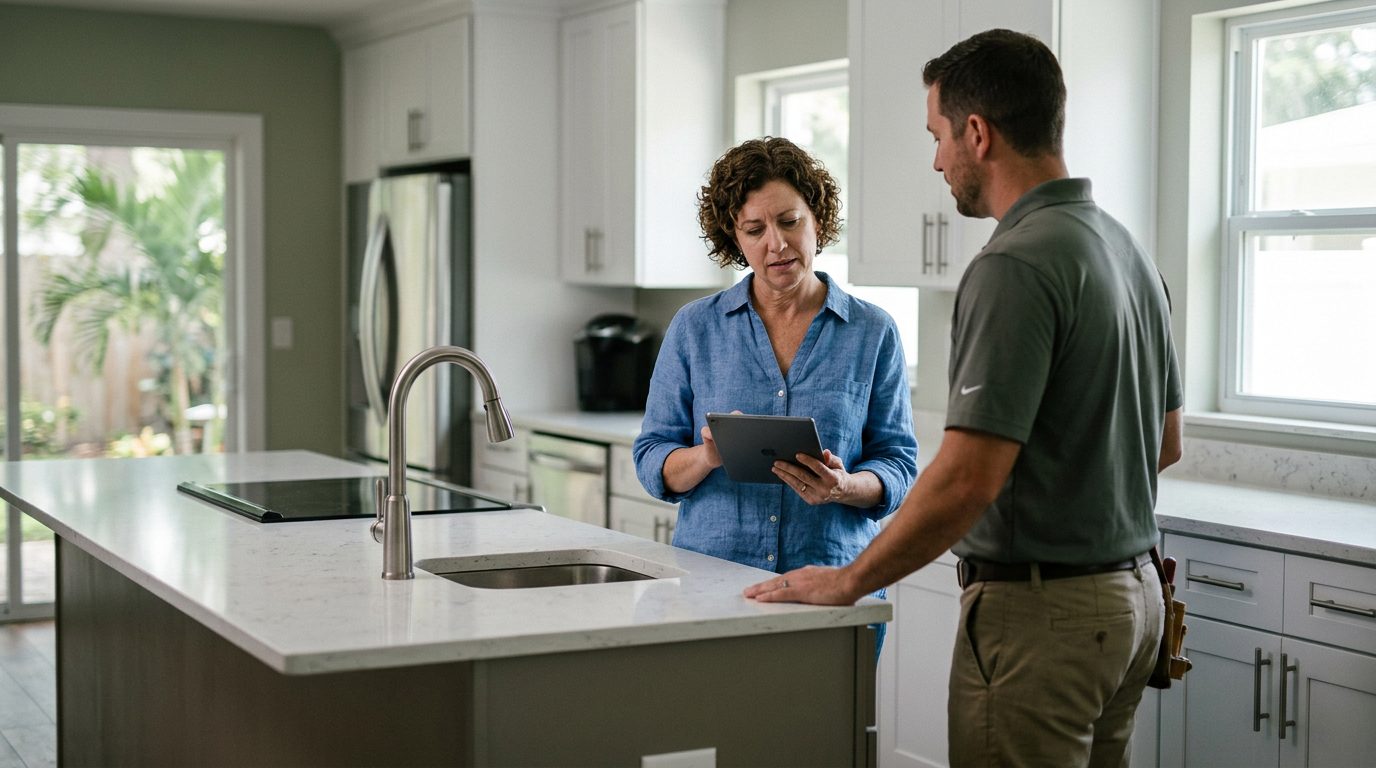
Can a Customer Refuse to Pay for Work You Already Finished?
Whether a particular refusal holds up depends on the facts. The signed contract, the scope that was agreed, any change orders, and the written messages between the parties matter most. Two jobs that look alike can end very differently because their paper trails differ.
A quality complaint doesn’t always stop a payment case.
If a customer stopped paying after you finished the job, you may have a claim, and you don't have to sort out the deadlines alone. Our team can talk through your contract with you. Talk it through with our team — we can walk you through how a situation like yours is usually handled and what your options are.

Why Customers Refuse Payment After the Work Is Done
Customers who refuse to pay after completion usually raise one of a few issues. The most common is a claim of defects or unfinished items that were never written down at the end of the job. Another is a dispute over price or extra work that was agreed by phone or in person and never documented.
Money pressure is another driver. Some customers hold the final payment until their own lender, insurer, or property owner pays them. Others use the last invoice as leverage to win a discount or a release of other claims.
Confusion over who owes payment also causes trouble. When a general contractor, property manager, or other third party sits between you and the owner, it can be unclear who must pay you. That gap often turns a simple invoice into a standoff.
A common mistake is waiting for the customer to raise the problem. Issues raised late are harder to answer. Write down each concern as it comes up, along with the date.
Immediate Steps to Protect Your Position
Start by collecting your records. Gather the signed contract, estimates, change orders, invoices, completion records, and photos or video of the finished work. Keep emails, text messages, and voicemails in their original form, not only as screenshots.
Next, stop making informal promises. Offering to fix something or give a refund without a written record can create new claims and weaken your position. Put any new commitment in writing before you make it.
Then send a clear written demand. A demand letter should identify the invoice, the amount due, the work performed, and a reasonable deadline to pay or to state specific objections. Date it, keep a copy, and ask the customer to put any objections in writing.
Avoid threats, public accusations, and social media posts about the customer. These can expose you to claims of your own and make a fair resolution harder to reach.
Legal Options for Recovering Payment in Florida
The agreement can be written or oral.
When a customer accepted and benefited from your work without a clear agreed price, a court may look at unjust enrichment. The Florida Supreme Court explained that this claim requires a benefit you gave, the customer’s appreciation of it, and the customer keeping it in circumstances that make it unfair to keep it without paying. See Pincus v. American Traffic Solutions.
Smaller disputes may fit Florida’s small claims process, which has its own rules. Where a suit is filed matters too. Under Fla. Stat. § 47.011, an action must be brought only in the county where the defendant resides, where the cause of action accrued, or where the property in litigation is located, but this section does not apply to actions against nonresidents. For a Hillsborough County job, that could be the county where the customer lives or where the work was done.
Your contract may also require arbitration. Under Fla. Stat. § 682.02, an arbitration agreement in a record is generally valid and enforceable. Fla. Stat. § 682.02 reads: “(1) An agreement contained in a record to submit to arbitration any existing or subsequent controversy arising between the parties to the agreement is valid, enforceable, and irrevocable except upon a ground that exists at law or in equity for the revocation of a contract.” Florida’s ADR Resource Handbook describes how court-related arbitration and mediation work.
Mandatory mediation has exceptions. Under Fla. Stat. § 44.102, the court must, upon one party’s request and provided the requesting party is willing and able to pay the costs of the mediation or the costs can be equitably divided between the parties, refer to mediation any filed civil action for monetary damages, unless an exception applies, including a landlord and tenant dispute without a personal injury claim, a debt collection action, a medical malpractice claim, or an action governed by the Florida Small Claims Rules.
Limitation periods for filing suit come from a separate statute, § 95.11, so a claim filed after the period expires can be barred even when the debt is still owed.
Deadlines That Can Decide Your Options
Florida sets time limits by statute, and the limit depends on the type of claim. Under Fla. Stat. § 95.11, an action founded on the design, planning, or construction of an improvement to real property must be commenced within four years, with the time running from the date the authority having jurisdiction issues a temporary certificate of occupancy, a certificate of occupancy, or a certificate of completion, or the date of abandonment of construction if not completed, whichever date is earliest. When the action involves a latent defect, the time runs from when the defect is discovered or should have been discovered with the exercise of due diligence. In any event, the action must be commenced within 7 years after that date, although related counterclaims, cross-claims and third-party claims may be brought up to 1 year after the pleading they relate to is served, even if they would otherwise be time-barred. That period runs from the earliest of a temporary certificate of occupancy, a certificate of occupancy, a certificate of completion, or the date construction was abandoned.
The same statute sets an outer limit. When the claim involves a latent defect, which is a hidden flaw, the time runs from when the defect was or should have been discovered with due diligence.
The periods in Fla. Stat. § 95.11 are set by statute for each type of action other than recovery of real property; whether a contract term can shorten them is addressed separately, in § 95.03 (see below). Under Fla. Stat. § 95.03, a contract term that sets a shorter time to sue than the statute allows is void. Don’t assume a clause in your agreement sets your deadline.
The clock starts when the cause of action accrues. Under Fla. Stat. § 95.031, a cause of action accrues when the last element of it occurs. For an unpaid invoice, that may be the date payment was due, not the day you finished. Other claims have their own limits under § 95.11, so the right deadline depends on your claim and facts.
Keep a written timeline of completion dates, invoice dates, and follow-up contacts. That record makes deadlines easier to check quickly.
When to Talk to a Business Litigation Lawyer
Talk to a lawyer when the stakes or the complications grow. These are common signals:
- The unpaid balance affects payroll, supplier bills, or the company’s stability.
- The customer has threatened a lien, a bond claim, a counterclaim for damages, or a complaint to a licensing board.
- The contract is unclear, was signed by a different company than the one that did the work, or involves a general contractor, owner, or lender.
- A demand letter has gone unanswered and a deadline is approaching.
- Evidence may disappear, such as messages that auto-delete or a job site that is being changed.
Waiting can make each of these harder to answer. Early review often gives you more options.
Not sure what your next step is?
Talk it through with our team — we can walk you through how a situation like yours is usually handled and what your options are.
How Our Business Litigation Practice Handles Payment Disputes
Ayala Law PA focuses its practice on business litigation. That includes commercial litigation, contract disputes, shareholder disputes, construction litigation, real estate litigation, and international trade litigation in Florida courts and arbitration. Payment and construction disputes for businesses in Tampa, Hillsborough County, Brandon, Riverview, Plant City, Temple Terrace, and the wider Tampa Bay area fall within that practice.
The firm’s office is located at 1646 W Snow Ave, Tampa, Florida. The firm’s only office is in Tampa, Florida, and it does not have a Tampa location. Tampa Bay businesses may be represented from the firm’s Tampa office.
Eduardo A. Maura is the responsible lawyer for this page. Support staff help with document organization and scheduling.
Your matter may be referred to another lawyer or firm where appropriate. Fee terms for a case evaluation are explained before you commit to anything.
Frequently Asked Questions
Can I file a construction lien for unpaid work on a home?
Possibly. Lien claims involve several steps, and the details of each project and contract matter, so it is worth discussing your specific situation with our team early.
How do agreements affect getting paid?
How an agreement is documented can affect how easily its terms are proven in a dispute, so it helps to discuss your specific situation with our team. Written records of the scope, price, and changes matter.
Can I use small claims court for an unpaid invoice?
Smaller disputes may fit Florida’s small claims process. Whether it fits depends on the claim and the amount owed.
Should I keep working for a customer who has not paid?
That is a business decision. Extending more work on credit adds risk, so get written terms first.
How long does a payment dispute take?
Timing depends on the claim, the court or arbitration forum, and the customer’s response. No timeline can be promised.
Talk With Our Team About Your Unpaid Balance
A finished job with an unpaid balance is stressful. Notices, deadlines, and the choice of next steps can feel urgent, especially if you are handling this for a partner or your company. Our team can review your contract, invoices, and messages and explain which deadlines and options may apply to your situation. Call (305) 570-2208 or request a case evaluation to get started.



