
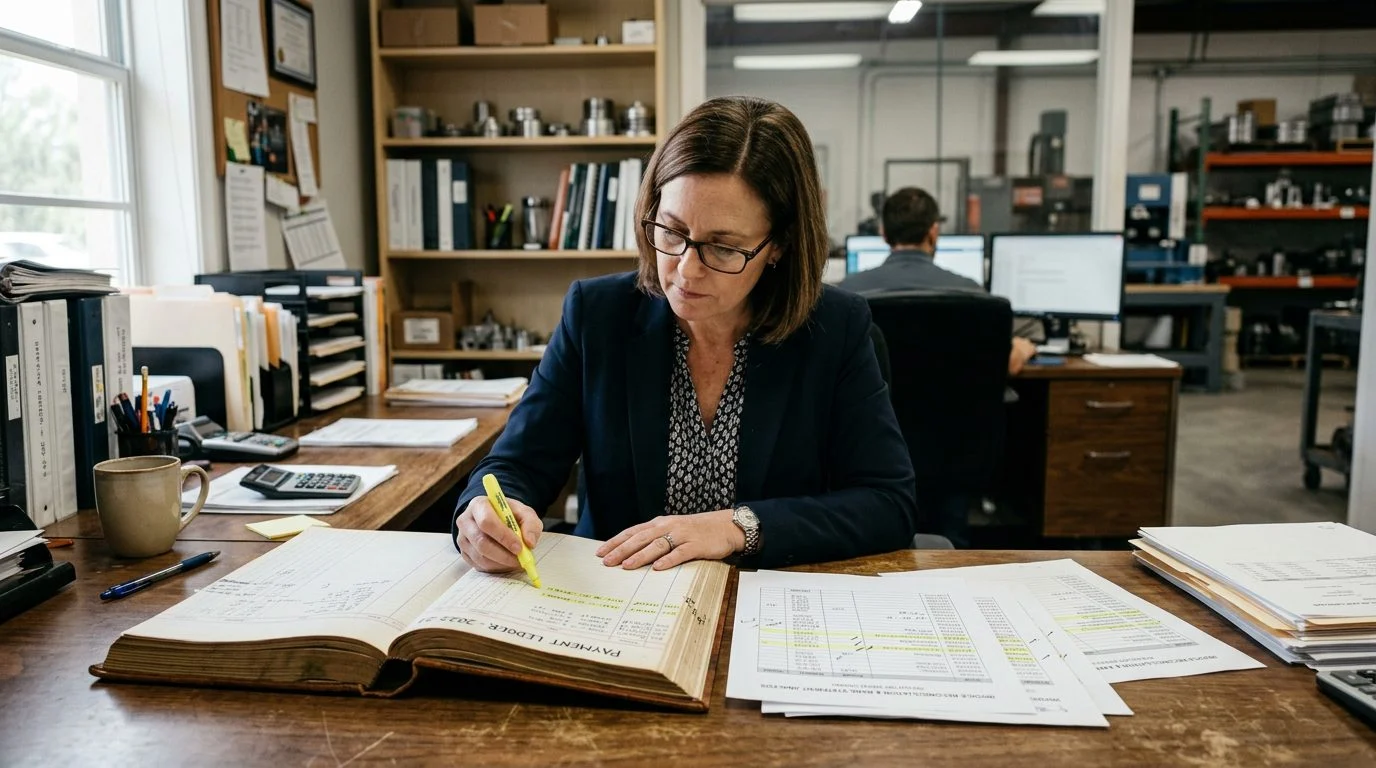
Money or property has gone missing from your company, and you want to know if you can sue for it. In Florida, a civil theft lawsuit can recover threefold your actual damages, but you must prove the taking by clear and convincing evidence under Fla. Stat. § 772.11.
This page explains what the claim requires, what it can recover, how a case usually moves and where the risks sit. Use it to understand your options before you decide on a next step.
What a Civil Theft Lawsuit Is and Who It Helps
A civil theft lawsuit is a private claim for money damages when a theft caused you a loss. It is a civil case, not a criminal one, brought by the injured party.
The civil remedy sits in § 772.11. It covers a person who proves by clear and convincing evidence that they were injured by a violation of Florida’s theft statutes, sections 812.012 through 812.037, or of section 825.103(1). A broken promise or a bad business deal is not enough by itself. The conduct has to fit the theft statutes.
Business owners, partners, shareholders, LLC members and companies harmed by insiders or outsiders may bring the claim when those facts exist. Civil theft is one tool among several. Many owners file it alongside contract, shareholder or construction claims. For the wider picture, see our business litigation services page.
If money or property left your business without approval, you may have a claim worth reviewing, and our team is ready to talk through the facts with you. Talk it through with our team — we can walk you through how a situation like yours is usually handled and what your options are.

Common Business Scenarios Behind Civil Theft Claims
Most business cases start with money or property taken by someone the company trusted. Common examples include:
- An employee or manager diverting company funds, manipulating payroll or making unauthorized transfers
- A partner or shareholder taking company money, property or business opportunities for personal use
- A contractor or subcontractor using construction payments for something other than the project they were paid for
- A former employee or agent taking client lists, equipment or inventory
Each scenario needs its own review. Early on, the key questions are what the person knew and what they intended when the money or property moved. Write down dates, amounts and who approved each transfer while the details are fresh. Keep copies of bank statements, invoices and emails.
What You Must Prove in a Florida Civil Theft Case
You must prove that the other side violated Florida’s theft statutes. You must also prove it by clear and convincing evidence, as § 772.11 requires. The burden of proof sits with you as the injured party.
Courts also separate theft from ordinary contract disputes. The Frutafino decision reflects the common law principle that a plaintiff may not recover in tort for a contract dispute unless the tort is independent of any breach of contract. A tort claim must be independent of the contract breach. An unpaid bill, by itself, is often a contract issue.
Evidence that tends to matter includes:
- Bank records and payment trails
- General ledgers and accounting entries
- Emails, texts and approval records
- Corporate records and meeting minutes
- Witness statements
Shareholders may have an early tool. Under Fla. Stat. § 607.1602, a shareholder may inspect and copy certain corporate records. The shareholder must give written notice at least 5 business days ahead. For some records, such as excerpts of board minutes, the demand must also be made in good faith and for a proper purpose, and must describe with reasonable particularity the shareholder’s purpose and the records the shareholder wants to inspect.
Treble Damages, Attorney Fees and What Can Be Recovered
Under § 772.11, the remedies include:
- Threefold the actual damages sustained
- Reasonable attorney’s fees and court costs in the trial and appellate courts
- No punitive damages under this section
As an illustration only, $10,000 in actual damages would become $30,000 under the threefold formula, if proven. The court decides the amount. Actual damages usually means the money or property value you lost, so document it with statements, invoices and valuations.
The fee provision works both ways. The defendant can recover its fees and costs if the court finds the claimant raised a claim without substantial fact or legal support. The court may not consider the other side’s ability to pay those fees.
How a Civil Theft Case Typically Proceeds
A civil theft case usually moves from evaluation to a written demand, then a lawsuit, discovery, settlement talks and possibly trial.
- Evaluation and records review. We review the facts of the taking, the financial records and any deadlines.
- Written pre-suit demand. Before filing, you must make a written demand for $200 or the treble damage amount; a person who complies within 30 days after receipt gets a written release from further civil liability for that specific act.
- Filing in the right county. Under § 47.011, an action must be brought where the defendant resides, where the cause of action accrued or where the property in litigation is located, but this rule does not apply to actions against nonresidents.
- Discovery. This can include bank subpoenas, document requests and depositions.
- Mediation and offers. On request, a court must refer most civil actions for monetary damages to mediation, provided the requesting party is willing and able to pay the costs of the mediation or the costs can be equitably divided between the parties, with exceptions, under § 44.102. A written offer of settlement remains open for 45 days unless it is withdrawn sooner by a writing served on the offeree or accepted, and an offer neither withdrawn nor accepted within 45 days is deemed rejected. Subsection (6) of Fla. Stat. § 45.061 provides that this section does not apply to causes of action that accrue after the effective date of this act.
- Trial, if needed.
Timelines depend on the facts and the court’s calendar. Expect several stages, not a quick result.
Why Work With Ayala Law PA on a Civil Theft Matter
Ayala Law PA focuses on business litigation. That includes commercial and contract disputes, shareholder and partnership disputes, construction litigation, real estate litigation and international trade litigation in Florida courts and arbitration.
Civil theft claims often arise alongside these disputes. The firm reviews the contract, the ownership structure and the payment records together.
Eduardo A. Maura is the responsible lawyer for this page. The firm’s support staff handle document organization and scheduling.
The firm’s office is at 1646 W Snow Ave, Tampa, and the firm serves businesses in Tampa and Hillsborough County. The firm represents businesses in Tampa, Hillsborough County, Brandon, Riverview, Plant City, Temple Terrace and the wider Tampa Bay area. Fees are discussed directly with the firm before any engagement.
Not sure what your next step is?
Talk it through with our team — we can walk you through how a situation like yours is usually handled and what your options are.
Common Questions About Civil Theft Claims in Florida
Does a civil theft claim require a criminal case first?
The claim turns on proof of a violation of the theft statutes by clear and convincing evidence. A criminal case is not the test under the statute’s text.
Can I sue a business partner for civil theft?
Yes, if the partner’s conduct meets the statute’s requirements. The evidence decides whether it does.
Does a contract dispute become civil theft?
Not automatically. Courts can treat an unpaid invoice as a contract dispute, as the Frutafino decision shows.
Can a business recover attorney’s fees if it wins?
The statute allows reasonable attorney’s fees and court costs to a claimant who proves the claim. The court decides what is reasonable, and filing a claim does not assure a fee award.
What happens if a claim lacks support?
Under § 772.11, a defendant may recover fees and costs when a civil theft claim was filed without substantial fact or legal support.
Can I hold a company’s owner personally liable?
Sometimes, but the bar is high. Florida requires proof that a corporation was actually organized or used to mislead creditors or defraud them. Under the Wurtzebach decision, this “showing of improper conduct” requires proof that “the corporation was actually organized or used to mislead creditors or to perpetrate a fraud upon them.”

Talk With Our Team About Your Business’s Situation
If money or property left your business without approval, you don’t have to sort out the next step alone. You may be reading this after finding unexplained transfers, a partner who took funds, or a contractor who did not apply project money to the work.
A case evaluation reviews those facts, your documents and any deadlines with the responsible lawyer. Call (305) 570-2208 or request a case evaluation to begin.



