
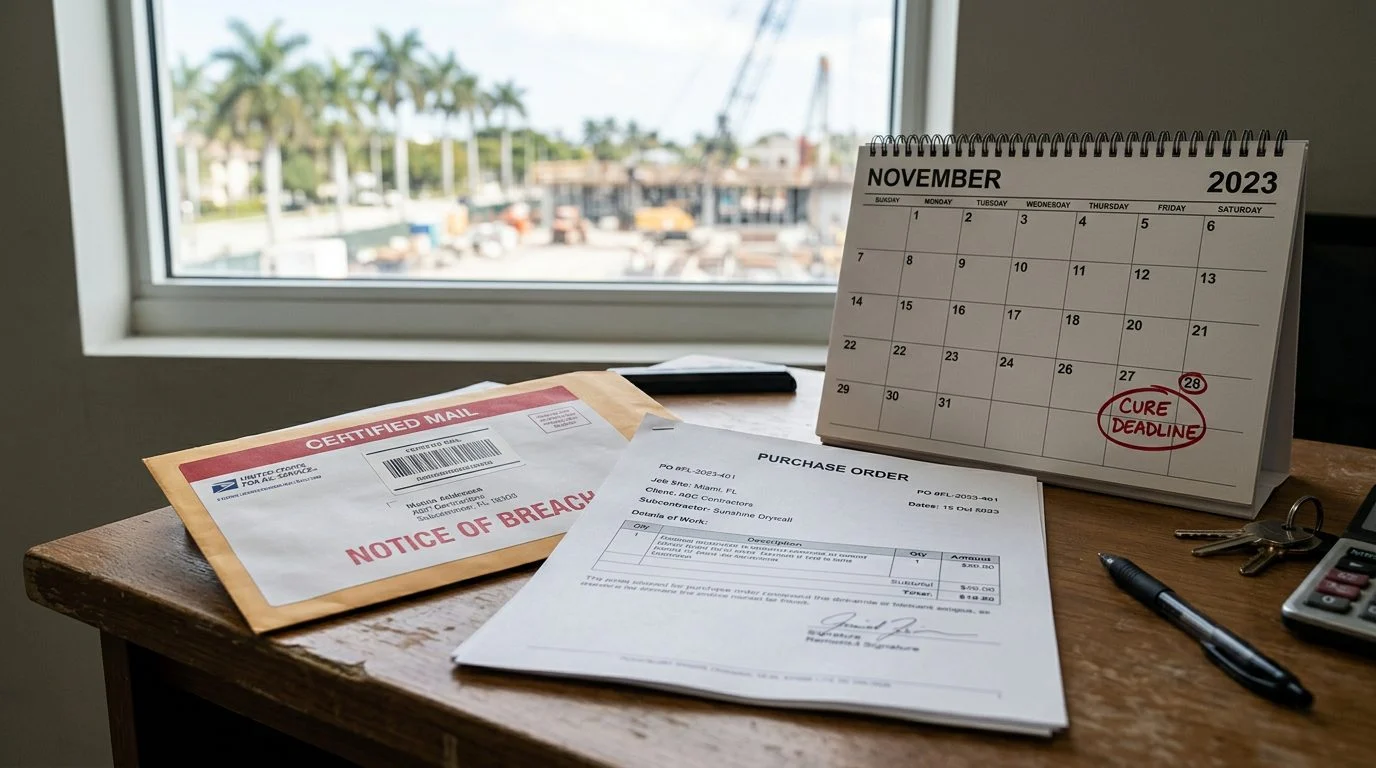
If you’ve received a notice to owner on a Florida construction project, or you’re deciding whether to send one, you need to know what it does. In short, it warns the property owner that someone further down the chain may be owed money, and it can lead to a lien or a lawsuit if the bill stays unpaid.
This page explains who serves a notice, what owners should do when one arrives, and the signs that a payment problem is turning into litigation. It’s written for subcontractors, suppliers, and property owners in Tampa, Hillsborough County, and the wider Tampa Bay area.
What a Notice to Owner Is and Who It Protects
A notice to owner is a written notice to the property owner that a subcontractor or supplier is working on the project and may not be paid.
The notice helps both sides. For the sender, it helps protect the right to be paid for work and materials. For the owner, it shows early where unpaid-work exposure may come from, instead of surprising them with a recorded lien months later.
Three groups usually deal with this issue: subcontractors and suppliers who want to protect payment, owners who received a notice, and anyone deciding whether to serve one. Ayala Law PA focuses on construction litigation for contractor, subcontractor, and owner disputes in Florida courts.
If a notice to owner has reached your project, or you're unsure whether to send one, we can talk through the timing and what it may mean for you. Talk it through with our team — we can walk you through how a situation like yours is usually handled and what your options are.
Who Must Serve a Notice and When
For payment bond claims, Florida’s limitations statute uses the section 713.01 definitions of contractor, subcontractor, and sub-subcontractor (Fla. Stat. § 95.11). Those labels help decide who counts as a lower-tier party on a project.
Timing is set by statute and tied to dates on the job. Keep a clear record of when your labor or materials first went onto the project and when they last did. Those dates drive the timing questions.
What Owners Should Do After Receiving a Notice
On receipt, an owner should record the date, read the claim, and compare it against the paper trail. Treat the notice as a fact-finding document, not a demand to pay on the spot.
Pull these records next:
- Your contract with the general contractor
- Payment applications and the payments you’ve already made
- The notice of commencement and other recorded documents on the property
- Change orders, back-charges, and written scope descriptions
Ask the contractor for a written statement of what has been paid and what is still claimed as owed. A clear written record shows which amounts are actually in dispute.
Think carefully before withholding money. Keep every response in writing, factual, and dated.
Warning Signs a Notice Dispute Is Becoming Litigation
A notice dispute often becomes litigation when a balance stays unpaid after written demands and the sides disagree about the facts. Watch for these signals:
- Unpaid balances that continue after written demands and a notice has been served
- A claim of lien recorded against the property, or a notice of contest filed in response
- Disputed scope, change orders, or back-charges that turn a payment question into a contract question
- Allegations that construction funds were diverted or misused, which can bring trust fund and fraud theories into the dispute
- Contractor insolvency, or a surety’s involvement under a payment bond, which changes the remedies available
Contract facts often decide which claim fits. Florida courts have held that where an express contract covers the same subject matter, claims arising from that relationship won’t support unjust enrichment (Williams v. Johnson). That’s why the written contract matters from the start.
What Construction Litigation Covers
Construction litigation covers lien foreclosure, payment bond claims, contract claims, and fraud-related claims in Florida courts and arbitration. Each has its own clock, so the dates matter.
- Equitable liens for improvements: Under Fla. Stat. § 95.11, an action to enforce an equitable lien arising from the furnishing of labor, services, or material for the improvement of real property shall be commenced within one year.
- For a latent defect, the four-year period runs from when the defect is discovered or should have been discovered with the exercise of due diligence, but the action must still be brought within seven years of the earliest date a temporary certificate of occupancy, certificate of occupancy, or certificate of completion was issued, or the date of abandonment, whichever applies. Counterclaims, cross-claims, and third-party claims arising out of the conduct, transaction, or occurrence set out in a pleading may be commenced up to 1 year after that pleading is served, even if they would otherwise be time barred. When the action involves a latent defect, the time runs from when the defect is discovered or should have been discovered with the exercise of due diligence. In any event, under § 95.11(3)(b), Florida Statutes, the outside limit for filing is 7 years from the earliest of these dates: the date the authority having jurisdiction issues a temporary certificate of occupancy, a certificate of occupancy, or a certificate of completion, or the date construction was abandoned if it was not completed. For latent defects, the four-year period runs from the date the defect is discovered or should have been discovered with the exercise of due diligence, but the 7-year outside limit still applies in any event.
- Corporate owners: Florida courts pierce a corporate veil only on proof of improper conduct, such as using the company to mislead or defraud creditors. Under Florida law, veil piercing requires a showing of improper conduct, meaning proof that ‘the corporation was actually organized or used to mislead creditors or to perpetrate a fraud upon them’ (Wurtzebach v. Flooring Depot FTL).
- Suits generally go to the county where the defendant resides, where the cause of action accrued, or where the property in litigation is located, but this rule does not apply to actions against nonresidents (Fla. Stat. § 47.011). For Hillsborough County property, that often means a Hillsborough County court.
How a Matter Moves From Notice to Court
A matter usually moves from a notice, to written demands, and then to court or arbitration if the balance stays unpaid. Timelines vary by project and by case.
- Document the project. Gather the contract, notices served, payments made, and recorded documents.
- Check each deadline. A cause of action accrues when its last element occurs (Fla. Stat. § 95.031). That accrual point can move the deadline.
- Try written resolution. A demand letter, a payment plan, or a bond claim notice may come first, depending on the facts.
- Choose the forum. Check the contract for an arbitration clause. Florida courts decide whether an arbitration agreement exists, and an agreement to arbitrate is generally enforceable (Fla. Stat. § 682.02).
Courts also weigh fairness before setting aside a contract term. Florida requires both procedural and substantive unconscionability, weighed together, before refusing to enforce a term (Basulto v. Hialeah Automotive). If a damages case is filed in court, a party may ask the court to refer it to mediation, and the court must do so if the requesting party is willing and able to pay the costs or the costs can be equitably divided between the parties, subject to listed exceptions (Fla. Stat. § 44.102). Fla. Stat. § 44.102 reads: “(2) A court, under rules adopted by the Supreme Court: (a) Must, upon request of one party, refer to mediation any filed civil action for monetary damages, provided the requesting party is willing and able to pay the costs of the mediation or the costs can be equitably divided between the parties, unless: 1.”
If a contract entered into on or after October 1, 1988, lets one party recover attorney’s fees for enforcing it, the court may also allow reasonable fees to the other party if that party prevails in any action with respect to the contract (Fla. Stat. § 57.105).
Not sure what your next step is?
Talk it through with our team — we can walk you through how a situation like yours is usually handled and what your options are.
Why Ayala Law PA for Construction Payment Disputes
Ayala Law PA handles construction payment disputes as part of its business litigation practice. The practice also covers commercial litigation, contract disputes, shareholder disputes, real estate litigation, and international trade litigation.
Eduardo A. Maura is the responsible lawyer for this page. Our team, including assistants and office staff, handles intake and document organization for these matters.
The firm’s only office is at 1646 W Snow Ave in Tampa, Florida. The firm represents businesses and property owners in Tampa, Hillsborough County, and the Tampa Bay area.
The firm doesn’t promise any outcome. Each dispute turns on its own documents, contract terms, and timing. Fees depend on the facts of your matter, and the firm will explain them when you make contact.
Frequently Asked Questions
Does a subcontractor always have to serve a notice to owner in Florida?
Timing is set by statute.
Can an owner withhold payment after receiving a notice?
An owner can review the claim and address disputed amounts in writing.
What happens if a notice was served late?
Timing questions like this one depend on the specific facts of each project, so they are worth discussing with our team early. A late notice can limit the lien rights that would otherwise apply. Review the timing early, because the statute’s text controls.
Is lien foreclosure the only remedy?
No. Payment bond claims, contract claims, and some fraud-related claims may also apply.
Does Ayala Law PA promise a result?
No. The firm doesn’t promise any outcome, and each matter depends on its own documents and timing.
If a notice to owner has arrived on a project you’re working on, or you’re worried an unpaid balance is about to become a lien, reach out through the contact page or call (305) 570-2208 to talk through the timing.



