
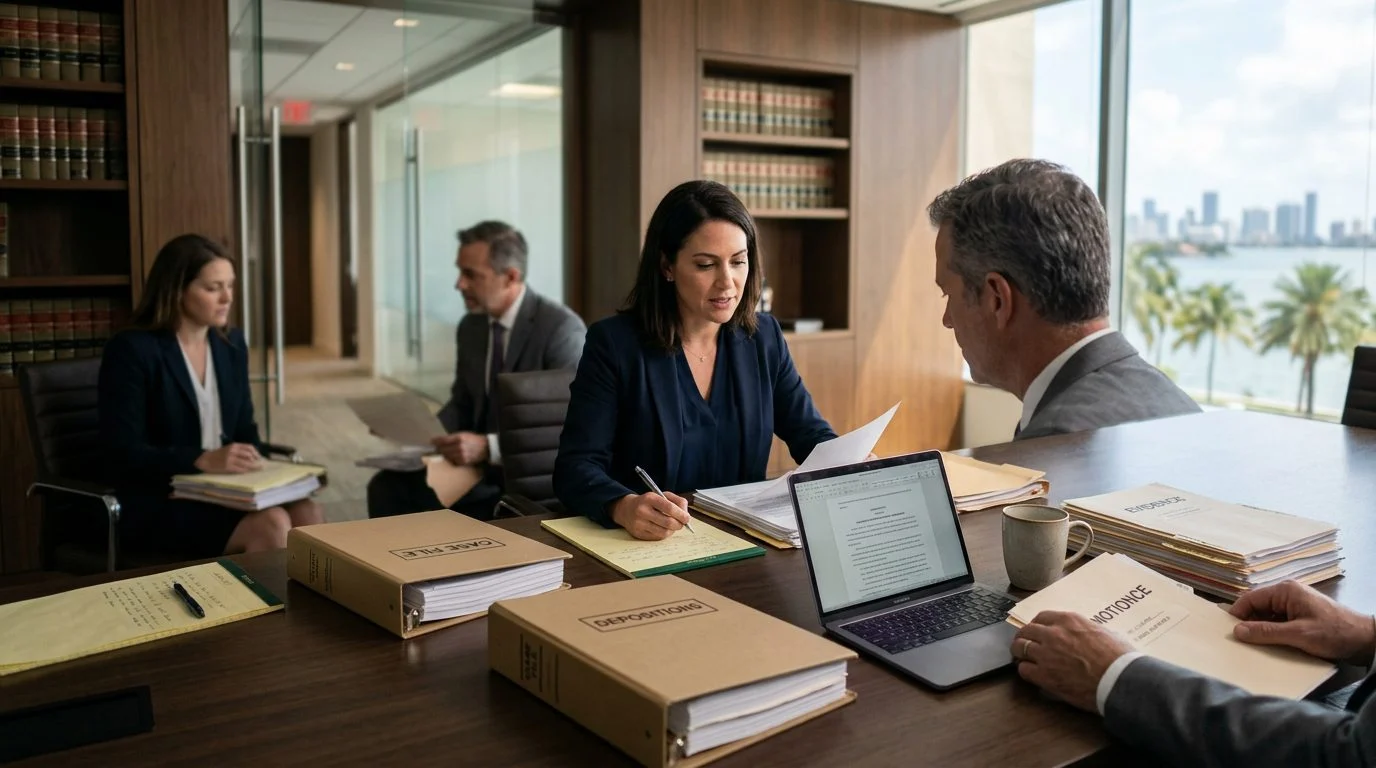
When a business dispute cannot be settled between the parties, it is resolved through a court case or an arbitration proceeding. In a law firm, the lawyers direct that process, from the first document review to a settlement, a ruling or a hearing. Assistants and office staff keep filings, deadlines and records moving along the way. This guide walks through each stage in plain language, using Florida business disputes as the example.
What litigation means in a law firm
Litigation is the formal legal process for resolving a dispute that has already happened. It usually means a court case or arbitration. It is different from negotiating a deal or drafting a contract, which aim to prevent disputes.
Civil litigation generally involves disputes over money, property or rights, and focuses on determining liability and damages.
Many business disputes in Florida go to state circuit and county courts. Others go to federal court, or to arbitration when the parties’ contract requires it. The lawyer’s job is to explain which path fits the facts and to represent the client on that path.
Inside a firm, lawyers make the legal calls and appear for the client. Assistants and office staff handle the paperwork that keeps a case on track. That includes filings, calendars, deadlines and document files.
If a partner, customer or contractor has put your business in a dispute, we can talk through what it may mean for you and which options are open. Talk it through with our team — we can walk you through how a situation like yours is usually handled and what your options are.

Why a business might need a litigation lawyer
A business usually needs a litigation lawyer when a dispute will not resolve through letters, phone calls or a meeting between owners. Common examples include:
- An unpaid invoice that stays unpaid after repeated demands.
- A breached commercial contract.
- A disagreement between partners or shareholders.
- A conflict between a contractor and a subcontractor, or a lien on a property.
- A dispute over a real estate deal or an international trade transaction.
Timing matters. Florida sets deadlines for filing, and they differ by claim. For example, under Fla. Stat. § 95.11, an action on a judgment or decree of a court of record in this state must be commenced within twenty years.
Whether litigation is the right step depends on the facts, the contract terms and what the business wants to achieve. A litigation lawyer can review the documents, check the deadlines and lay out the options before the dispute grows.
Investigation and early case evaluation
The first job is to find out what happened and what the paper trail shows. The lawyer gathers contracts, emails, invoices, change orders, meeting notes and corporate records tied to the dispute.
Next, the lawyer identifies the parties, the agreement that governs them and any deadlines. An arbitration clause matters at this stage. Under Fla. Stat. § 682.02, a written agreement to arbitrate existing or later disputes is valid, enforceable and irrevocable, except on a ground that exists to revoke any contract. The court decides whether an agreement to arbitrate exists and whether a dispute falls under it.
Then the lawyer tests the claims and defenses in plain terms. The goal is to show the client the strong points, the weak points and the likely next steps. That gives the client a clear basis for deciding what to do.
A common mistake is waiting to collect records until the other side files. Emails and texts can be deleted, and people forget details over time.
Fees and costs are discussed directly with you before work begins, so you know what to expect.
Filing the case and responding in Florida courts
A lawsuit starts when one party files a complaint with the court and has it served on the other side. The complaint lays out the facts, the legal claims and what the plaintiff asks the court to award or order.
The defendant then responds, usually with an answer. The answer admits or denies each allegation. It also lists affirmative defenses, which are reasons the claim should fail even if the stated facts are true. A defendant may also file a counterclaim against the party who sued.
Where the case is filed matters. Under Fla. Stat. § 47.011, actions must be brought in the county where the defendant resides, where the cause of action accrued, or where the property in litigation is located, though this section does not apply to actions against nonresidents. For a business dispute tied to Hillsborough County, one of those places may point to a court there.
Service of process must also be done correctly. For a Florida LLC, service usually goes to its registered agent under Fla. Stat. § 48.062. If the LLC no longer has a registered agent, or the registered agent cannot otherwise be served after one good faith attempt because of a failure to comply with this chapter or chapter 605, process may be served on any manager of a manager-managed company, any member of a member-managed company, or any person listed publicly on the latest annual report, as most recently amended, under Fla. Stat. § 48.062.
Construction disputes can add lien foreclosure to the contract claims. A construction lien secures payment against a property. Foreclosure is the court process used to enforce it.
Discovery: interrogatories, requests for production and requests for admission
Discovery is the exchange of information between the parties before trial. In many commercial disputes, the key facts are developed through the exchange of information between the parties, and each side’s account of events is examined closely. The main tools are:
- Interrogatories: written questions the other party answers under oath.
- Requests for production: demands for documents, emails and other electronically stored information.
- Requests for admission: statements the other party must admit or deny, which narrows what the court must decide.
- Depositions: sworn testimony taken outside the courtroom, with a court reporter present.
Lawyers prepare clients and witnesses for depositions. They review key documents and the facts each person will be asked about.
The records gathered during the investigation drive this phase. A party with organized records can usually answer discovery more accurately and more quickly.
Motions, pre-trial work and settlement talks
A motion asks the judge to rule on a specific issue before trial. A motion to dismiss argues that the complaint does not state a valid claim. Some disputes can be narrowed before trial when the parties agree on the key facts or when a court is asked to decide a purely legal question.
Pre-trial preparation includes witness lists, exhibits and pre-trial statements, followed by conferences with the court.
Many civil cases seeking money damages go to mediation before trial. Under Fla. Stat. § 44.102, a court must refer a filed civil action for monetary damages to mediation when one party asks, if that party can pay the cost or the cost can be equitably divided. Fla. Stat. § 44.102 reads: “(2) A court, under rules adopted by the Supreme Court: (a) Must, upon request of one party, refer to mediation any filed civil action for monetary damages, provided the requesting party is willing and able to pay the costs of the mediation or the costs can be equitably divided between the parties, unless: 1.” The statute lists exceptions, including debt-collection actions and cases where the parties agreed to binding arbitration. Mediation is a process in which a neutral mediator helps the parties work toward a settlement, and parties often choose it as an alternative to trial.
Florida’s Fla. Stat. § 45.061 addresses settlement offers, but its reach is limited. Subsection (6) states: “This section does not apply to causes of action that accrue after the effective date of this act.” The text cited here does not state that effective date, so whether the section applies to a particular dispute depends on when its cause of action accrued, and subsection (4) also excludes class actions, shareholder derivative suits, and matters relating to dissolution of marriage, alimony, nonsupport, eminent domain, or child custody. Other Florida rules on offers of settlement and offers of judgment can apply to a present-day case as well, so the timing of any offer should be reviewed for the specific dispute. A party facing a dispute should contact our office to review its timing.
The lawyer reviews any proposed settlement terms with the client before the client decides.
Not sure what your next step is?
Talk it through with our team — we can walk you through how a situation like yours is usually handled and what your options are.
Trial, arbitration and the business disputes the firm handles
Trial is when a judge or jury hears evidence and argument and decides the case. Arbitration is a private hearing where an arbitrator decides the dispute under the parties’ agreement.
Federal law also supports arbitration clauses in business contracts. Under 9 U.S.C. § 2, a written arbitration provision in a contract involving commerce is valid, irrevocable and enforceable, except on grounds that exist for revoking any contract.
Ayala Law PA focuses on business litigation, commercial litigation, contract disputes, shareholder and partnership disputes, construction litigation, real estate litigation and international trade litigation. The firm handles these matters in Florida courts and in arbitration. Construction work includes contractor and subcontractor disputes and lien foreclosure.
A matter may be referred to another lawyer or law firm where appropriate. If that happens, the firm will tell you.

Talking with Ayala Law PA about a business dispute
If a partner, customer, contractor or lender has put your business in a dispute, you did not choose that position. The timing can feel urgent, and the paperwork can feel overwhelming.
Eduardo A. Maura is the lawyer responsible for this page. Our only office is at 1646 W Snow Ave in Tampa, Florida. The firm serves businesses in Tampa, Hillsborough County and the wider Tampa Bay area.
Common questions
Does every business dispute end up in court?
No. Some disputes resolve through talks or mediation, and some contracts send disputes to arbitration instead of court.
Is there a deadline to file?
Yes. Deadlines vary by claim, and Florida’s limitations statute sets a four-year limit for fraud claims.
If you are dealing with a dispute with a business partner, contractor or customer, call Ayala Law PA at (305) 570-2208 or send a message through the contact page to talk through your situation.



