
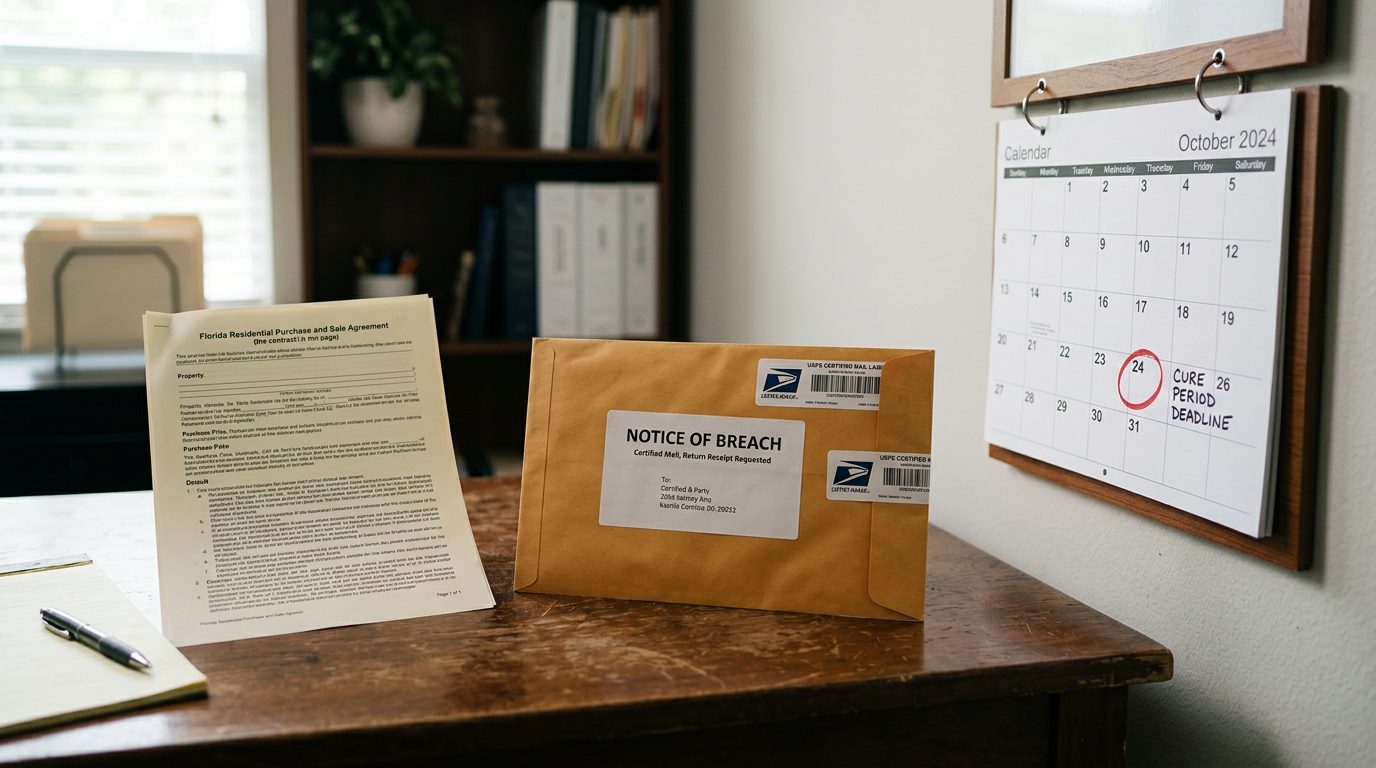
The short answer: a seller backing out is not always a breach
What happens when a seller backs out of a contract? In short, it depends on the contract’s terms and the facts. Sometimes the seller had a right to walk away. Other times, the withdrawal is a breach that gives the buyer legal options.
Oral deals count too. An oral contract still needs an offer, an acceptance, consideration, and essential terms stated clearly enough (St. Joe Corp. v. McIver).
This guide covers when a seller may have grounds to leave, when backing out is likely a breach, what buyers can do, how earnest money works, and the deadlines and steps to take now.
If a seller has gone quiet or walked away from a deal you signed, our team can talk through what your contract says and where you stand. Talk it through with our team — we can walk you through how a situation like yours is usually handled and what your options are.
When a seller may have a legal basis to walk away
Several situations come up often.
Contingencies. Many purchase contracts include conditions, such as financing or inspection conditions. If a stated condition is not met, the contract may let a party end the deal. The seller must still follow the contract’s notice steps and deadlines.
A casual text like “fine, let’s cancel” may not say enough. Read the exact words before relying on it.
Buyer default. A buyer who misses a deadline, fails to deliver required funds or documents, or skips a condition may give the seller a right to terminate, if the contract language allows it.
Title problems. If the contract requires clean title and the seller cannot deliver it, the seller may have grounds to end the deal.
Mistake and unfairness arguments. A seller may argue the deal should be undone. Florida allows rescission for mutual mistake only when the mistake is really mutual and goes to the essence of the contract (Waterside at Boynton Homeowners’ Ass’n). A seller may also call a term unconscionable. Florida requires both unfair dealing and unfair terms, weighed together (Basulto v. Hialeah Automotive).
When backing out is likely a breach
Asking for a higher price after signing is another common problem. So is accepting a better offer from someone else.
If the contract does not give the seller that right, “I got a better offer” usually will not fix the problem.
Ratification is another point. A voidable contract can be ratified. Ratification occurs when a party entitled to cancel fails to do so after learning the facts that justify cancellation (Flaherty v. Flaherty). A seller who learns of a problem but keeps acting as if the deal is on may lose the right to cancel over it. This is a general rule, not an automatic result.
What a buyer can do after a seller walks away
Start by reading the contract’s default and notice clauses. They may require a set notice and a chance to fix the problem first.
Keep a record of every notice, deadline, and reply. The amount depends on the facts and the proof.
Where the case is filed also matters. Actions must be brought in the county where the defendant resides, where the claim arose, or where the property is located, unless the defendant is a nonresident (§ 47.011). For a Tampa-area property, Hillsborough County may be a proper place to file.
Read the fee clause too. If a contract lets a party recover fees for enforcing it, the court may allow reasonable fees to the other side when that party prevails, for contracts entered into on or after October 1, 1988 (§ 57.105).
Some contracts send disputes to arbitration. The American Arbitration Association describes arbitration as a private, legally binding option for commercial disputes. A pending arbitration also pauses the limitations clock for the dispute (§ 95.051).
Earnest money, deposits, and who holds them
The contract decides who holds the earnest money and who can keep it. Earnest money is a good-faith deposit the buyer puts down to show commitment. Usually an escrow agent or title company holds it, and the contract names that holder.
Deposit clauses vary. Some say the deposit is the seller’s remedy if the buyer backs out. Others say it is the buyer’s remedy if the seller backs out. Small wording differences can change who gets the money, so read the exact words.
Disputes often start when a seller refuses to release a deposit or claims it without a clear basis under the contract.
Buyers sometimes try a different legal theory to recover money. When a written contract covers the same subject, a separate unjust enrichment claim generally will not support recovery arising from that relationship (Williams v. Johnson). The deposit terms usually come first.
Business sales, asset deals, and commercial contracts
These deals can include consents, conditions, financing terms, and transfer steps.
If the seller owns shares, shareholder rules may matter. Florida allows shareholders to make agreements that govern how a corporation is run, if they meet the statute’s requirements (§ 607.0732). Those agreements can set rules for directors, voting, and deadlock, which can affect whether an owner can simply leave.
Partnership exits follow their own rules. When a partner leaves a partnership without ending it, the partnership must buy that partner’s interest at a price set by statute (§ 620.8701).
Business owners in Hillsborough County and the Tampa Bay area often face these questions alongside the sale itself. Each one should be checked against the signed documents.
Not sure what your next step is?
Talk it through with our team — we can walk you through how a situation like yours is usually handled and what your options are.
Deadlines and steps to take now
Check your contract for deadlines first. A contract provision that sets a shorter time to sue than the statute allows is void (§ 95.03). Florida’s limitations statute sets the outer time limits (§ 95.11). A claim generally accrues when its last element occurs (§ 95.031).
Real estate needs careful paperwork too. Florida law says most real estate interests of more than one year must be created or transferred by a signed written instrument, witnessed by two people, but no witnesses are required for a lease of real property (§ 689.01). Fla. Stat. § 689.01 reads: “unless by will and testament, or other testamentary appointment, duly made according to law; and no estate or interest, either of freehold, or of term of more than 1 year, or any uncertain interest of, in, to, or out of any messuages, lands, tenements, or hereditaments, shall be assigned or surrendered unless it be by instrument signed in the presence of two subscribing witnesses by the party so assigning or surrendering, or by the party’s lawfully authorized agent, or by the act and operation of law; provided, however, that no subscribing witnesses shall be required for a lease of real property or any such instrument pertaining to a lease of real property.”
Take these steps now:
- Gather the purchase agreement, amendments, addenda, emails, texts, inspection reports, lender letters, and escrow records.
- Avoid casual statements that could read as agreeing to cancel. Send notices in writing, the way the contract requires.
- Keep a dated timeline of every deadline, notice, and response.
Talking through your situation with Ayala Law PA
If a seller has stopped responding after you signed, or said they are backing out, you may be wondering whether the contract still binds them. That uncertainty is hard, especially when a deposit and a closing date are on the line.
What happens when a seller backs out of a contract in Florida?
The answer depends on the contract.
Does the buyer get the earnest money back?
The contract decides. Check who holds the deposit and what the clause says about each side’s remedy.
How long does a buyer have to sue?
Florida’s statutes set time limits, and a contract clause cannot shorten them. Check the dates in your situation right away.
Eduardo A. Maura is the responsible lawyer for this page. Ayala Law PA’s only office is at 1646 W Snow Ave in Tampa, Florida. The firm focuses on business, contract, construction, and real estate disputes, and it serves businesses in Tampa, Hillsborough County, and the Tampa Bay area. Ayala Law PA charges a fee for case evaluations, and fee terms are explained when you reach out. Call (305) 570-2208 or use the contact page to talk through your contract.



