
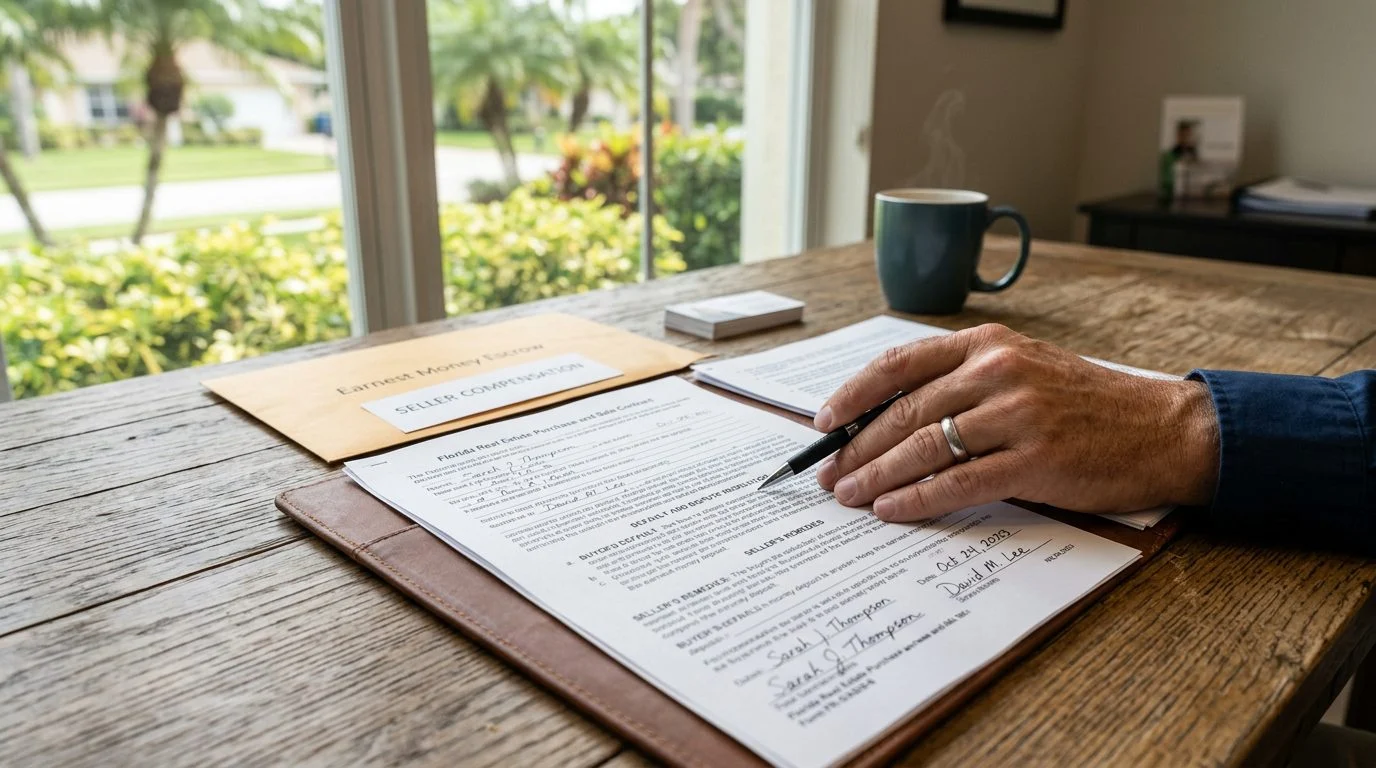
A seller’s recovery after a buyer backs out depends first on the signed purchase contract. Its default and remedies terms are the starting point. Florida law then limits what the seller can enforce, how long the seller has to file suit, and what a court can order. This page explains the common paths in plain terms.
What a Seller Can Usually Recover When a Buyer Backs Out
A buyer who walks away after signing a binding purchase contract may be in default. Sellers usually look at three paths: keeping the deposit the buyer paid, suing for money damages, or asking a court to order the sale to close.
Some deals are binding even when they are not in one polished document. Florida courts apply basic contract rules to oral agreements too. Those rules include an offer, an acceptance, consideration and enough detail on the essential terms. The St. Joe Corp. v. McIver opinion applies those requirements to an oral contract.
Save every written notice, text and email from the deal. Those records show when the buyer left and what each side said. Next, find out who holds the money. The buyer’s deposit usually sits with a neutral escrow agent, and the contract controls when it can be released.
For a broader look at Florida real estate disputes, see our real estate litigation overview.
If a buyer has backed out and your deposit is tied up, reach out to Ayala Law PA to talk through your purchase contract and your options. Talk it through with our team — we can walk you through how a situation like yours is usually handled and what your options are.

Keeping the Earnest Money Deposit as Liquidated Damages
Many purchase contracts let the seller keep the earnest money deposit if the buyer defaults. This clause is often called liquidated damages (an amount the parties agree on in advance). When it applies, it may limit the seller’s recovery to the deposit, so the seller cannot also collect other losses.
Read the clause closely. Some contracts make the deposit the seller’s only remedy. Others let the seller choose between the deposit and a claim for actual loss. The exact wording decides which path is open.
Escrow terms matter here too. An escrow agent, often a title company or closing attorney, usually releases the deposit only under the contract’s release terms. Those terms may call for written instructions from both sides or a court order. A seller who takes the money without that process can create a second dispute.
Suing for Actual Damages
Typical claims include the gap between the contract price and a later sale price, carrying costs such as taxes and insurance, and costs tied to the failed sale. Sellers sometimes assume the loss is the full price gap. The contract and the proof decide the number.
Two Florida rules shape these claims. First, a contract cannot shorten the time to sue. Under § 95.03, a contract provision that sets a shorter period than the statute allows is void. Florida’s limitations statute sets time limits by type of claim, so check the deadline early.
Second, a seller generally cannot turn a contract loss into a fraud or tort claim. In Frutafino v. Dole Chile, the Third District barred fraud-based claims that were really about unpaid invoices. Similarly, when an express contract covers the same subject, a claim for unjust enrichment (unfair gain without a contract) will not support recovery, as Williams v. Johnson explains.
Asking the Court for Specific Performance
Specific performance asks a court to order the buyer to complete the purchase instead of paying money.
Timing can change the picture. Some events pause the clock for filing suit. Under § 95.051, a payment of part of the principal or interest on a written obligation pauses the time to sue. A pending arbitration over the same dispute does too.
Relying on a pause is risky. Waiting while the buyer stays silent can leave a seller with fewer choices later.
Broker Commissions, Escrow Disputes, and Court Timing
A listing broker’s commission usually depends on the listing agreement. A failed closing can raise a separate commission question. The seller, the buyer and the broker may each claim the deposit. When that happens, the escrow agent may hold the money until the parties agree or a court rules. That delay can keep a seller from the funds even when the seller has a valid claim.
If a seller files a money damages suit, the court process adds its own rules. On one party’s request, a court must refer a civil action for money damages to mediation (a settlement meeting led by a neutral mediator). This applies when the requesting party is willing and able to pay the costs of the mediation or the costs can be equitably divided between the parties. Listed exceptions apply, including cases where the parties agreed to binding arbitration. See § 44.102.
When a court refers the action to mediation, Florida law tolls the time to respond to certain settlement offers or demands for judgment until the mediator declares an impasse or reports that no agreement was reached; note that the older offer-of-settlement statute, § 45.061, does not apply to causes of action that accrue after its effective date. Under § 45.061, a written settlement offer stays open for 45 days unless the offeror withdraws it sooner by a writing served on the offeree before the offeree accepts, and the statute itself states that it does not apply to causes of action that accrue after the effective date of the act. Its offer procedure therefore does not govern a buyer-default claim that accrued after that date. Fla. Stat. § 45.061 reads: “The offer shall remain open for 45 days unless withdrawn sooner by a writing served on the offeree prior to acceptance by the offeree.” Under § 45.061(1), an offer that is neither withdrawn nor accepted within 45 days is deemed rejected, but only for causes of action covered by the section.
When the Buyer Has a Valid Reason to Walk Away
Not every exit is a default. Purchase contracts often include contingencies (conditions) for financing, inspection or title. A buyer who leaves under a valid contingency stands in a different position from one who simply changes their mind. The seller’s recovery turns on whether the contract allowed that exit, including its deadlines and notice terms.
Buyers also raise mistakes. Florida allows rescission (undoing a contract) for a mutual mistake only when both sides shared the mistake and it concerns a fact essential to the contract. Waterside at Boynton Homeowners’ Ass’n states that rule. Under Waterside at Boynton Homeowners’ Ass’n v. Southern Homes of Palm Beach, LLC, “The term ‘mutual mistake of fact’ is one of law, and the equitable remedy of rescission is available only if the mistake is mutual and the fact is of the essence of the contract.”
A seller faces a related risk. If the seller learns facts that could justify undoing the contract, then keeps treating it as binding, the seller may lose that option. This is called ratification. It is a general rule, not an automatic result, as Flaherty v. Flaherty explains. Acting promptly after learning the facts protects a seller’s options.
Not sure what your next step is?
Talk it through with our team — we can walk you through how a situation like yours is usually handled and what your options are.

Talk With Ayala Law PA About Your Buyer Dispute
Quick answers
Can a seller keep the deposit if the buyer backs out?
Often, the contract decides. Many contracts make the deposit the seller’s remedy after a buyer default, but the exact wording controls.
How long does a seller have to sue?
Florida sets time limits by type of claim, and a contract cannot shorten them. Check the deadline early.
Specific performance in real estate contracts
If a buyer has stopped performing and your money is tied up in escrow, the uncertainty is stressful. That is especially true when you planned the sale around those funds. Ayala Law PA focuses on business litigation, contract disputes and real estate litigation. The firm, whose office is located in Tampa, Florida, represents businesses and property owners in Hillsborough County and the Tampa Bay area. Eduardo A. Maura is the responsible lawyer for this page. Call (305) 570-2208 or use the contact page to talk through your purchase contract, the default and the deposit. Fee terms are discussed directly with the firm.



