
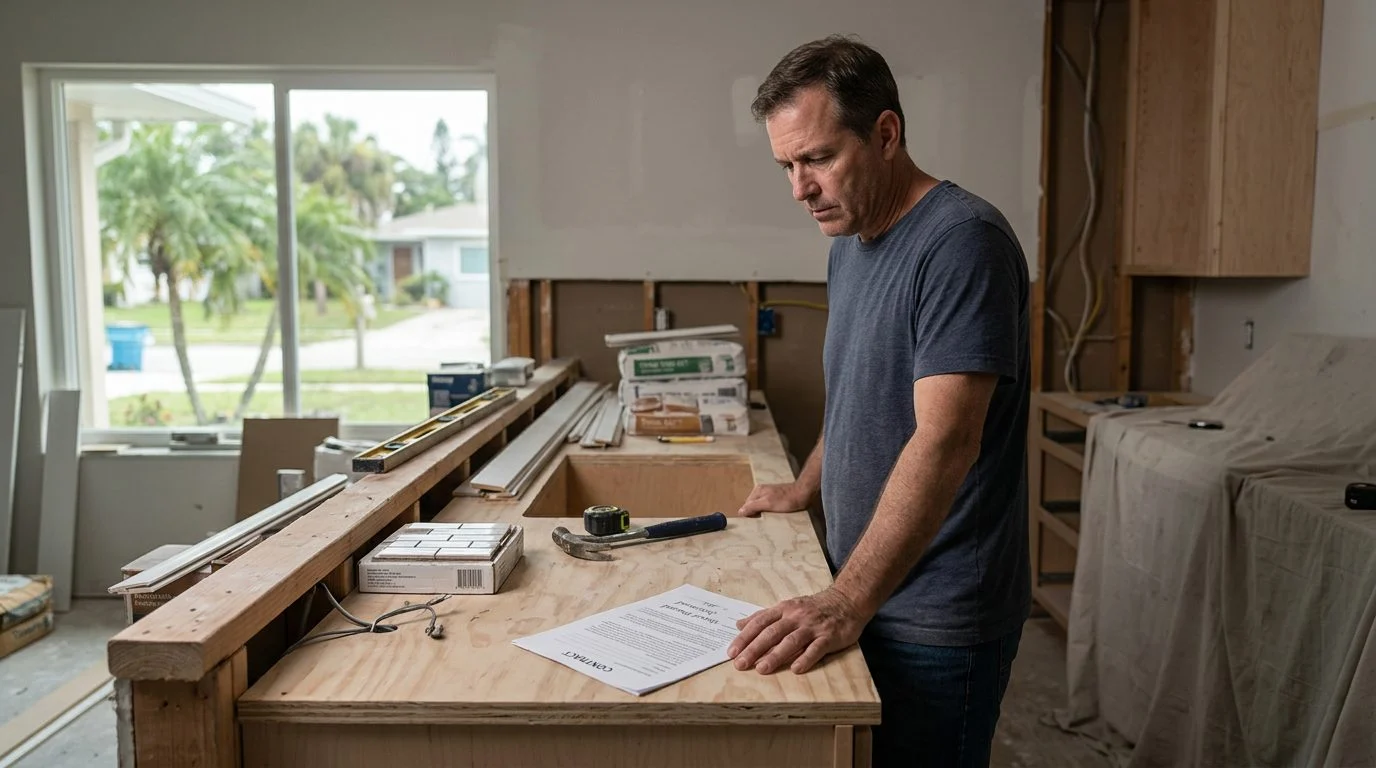
If you paid a contractor a deposit for work that was never performed, gathering the written contract, payment records and project communications is a practical first step before you talk with a lawyer. Whether any part of the deposit can stay with the contractor depends on the written contract and on why the job never started. This guide covers the contract terms, the Florida laws that matter, and the steps to take if a contractor won’t refund a deposit. It is written for property owners and business owners in Tampa and across Hillsborough County.
What a Construction Deposit Is and Why Contractors Ask for One
A construction deposit is money you pay a contractor before work starts. Contractors ask for it to buy materials, reserve their crew, and show you’re committed to the job.
A deposit is not the same as a progress payment. A progress payment pays for work already done. A deposit pays for work that hasn’t begun. Some contracts say the deposit is credited to the final price. Others call it a commitment payment the contractor keeps if you back out. That difference matters later.
The amount and the terms belong in the written contract. Look for the dollar amount, what the money covers, whether it’s credited to the total, and whether it’s refundable.
Some people agree to work by phone or text. An oral deal can still be a contract. The Florida Supreme Court explains that a contract, including an oral one, needs an offer, an acceptance, consideration, and enough detail on essential terms (St. Joe Corp. v. McIver). Save every message, because proof gets harder without a written record.
If your deposit is still with a contractor whose start date has passed, our team can review your contract and timeline with you. Talk it through with our team — we can walk you through how a situation like yours is usually handled and what your options are.

Can a Contractor Keep the Deposit When the Job Never Starts?
Whether the contractor may keep any part of it usually turns on three things. First, what the contract says about deposits and cancellation. Second, what the contractor actually spent or committed to the job. Third, why the work didn’t begin.
If you caused the delay, the analysis changes. Late approvals, blocked site access, or changes you requested can shift responsibility. If the contractor never showed up or stopped answering calls, its position is usually weaker.
Choosing the right claim also matters. A Florida appeals court applied the rule that a plaintiff may not recover in tort for a contract dispute unless the tort is independent of the breach (Frutafino, S.A.S. v. Dole Chile). Another appeals court held that an express contract covering the same subject matter bars an unjust enrichment claim arising from that relationship (Williams v. Johnson). If a written contract covers the deposit, a claim built only on unjust enrichment may not work.
What the Written Contract Says About Deposits, Cancellation, and Deadlines
The written contract sets the rules for your deposit, so read it first. Check the deposit amount, what it covers, refund terms, cancellation rights, notice requirements, and the start date or completion deadline.
A missed start date matters. If the contractor misses a set date without a valid reason, that miss can shift responsibility for the delay and the money. Check whether any change to the date was signed.
Gather every document. That includes the signed contract, change orders, invoices, payment receipts, and texts or emails about the schedule. Keep them in one folder, in date order. A clear timeline is often the first thing a lawyer needs.
Watch for a clause that shortens the time to sue. Florida law makes void any contract provision that sets a period to sue shorter than the statute of limitations (Fla. Stat. § 95.03). A short deadline printed in the contract does not control.
Florida Laws That Affect a Deposit Dispute
Florida sets time limits for filing suit, and it decides which county can hear a case. Each rule has its own details, so check them early.
Under the limitations statute, a cause of action accrues when its last element occurs (Fla. Stat. § 95.031). For fraud, the clock runs from when the facts were discovered or should have been discovered, but no later than 12 years after the fraud was committed (same statute). Under Fla. Stat. § 95.11(3)(b), an action founded on the design, planning, or construction of an improvement to real property is generally subject to a four-year limitations period, with the time running from the date the authority having jurisdiction issues a temporary certificate of occupancy, a certificate of occupancy, or a certificate of completion, or the date of abandonment of construction if not completed, whichever date is earliest. When the action involves a latent defect, however, the time runs from the time the defect is discovered or should have been discovered with the exercise of due diligence. In any event, the action must be commenced within 7 years after that date (Fla. Stat. § 95.11). Fla. Stat. § 95.11 reads: “(b) An action founded on the design, planning, or construction of an improvement to real property, with the time running from the date the authority having jurisdiction issues a temporary certificate of occupancy, a certificate of occupancy, or a certificate of completion, or the date of abandonment of construction if not completed, whichever date is earliest; except that, when the action involves a latent defect, the time runs from the time the defect is discovered or should have been discovered with the exercise of due diligence.” The clock generally starts on the earliest of a temporary certificate of occupancy, a certificate of occupancy, a certificate of completion, or abandonment of construction if it is not completed. Fla. Stat. § 95.11 reads: “(b) An action founded on the design, planning, or construction of an improvement to real property, with the time running from the date the authority having jurisdiction issues a temporary certificate of occupancy, a certificate of occupancy, or a certificate of completion, or the date of abandonment of construction if not completed, whichever date is earliest; except that, when the action involves a latent defect, the time runs from the time the defect is discovered or should have been discovered with the exercise of due diligence.” Latent defects follow a discovery rule, and in any event the action must be commenced within seven years of that date. Which period applies to a deposit claim depends on how the claim is framed, so confirm it before you wait.
Venue is set by Fla. Stat. § 47.011. A case must be brought in the county where the defendant resides, where the cause of action accrued, or where the property in litigation is located. This rule does not apply to actions against nonresidents. Hillsborough County may fit many Tampa Bay disputes, but the facts decide.
If the contract allows attorney’s fees to a party that must enforce it, a court may also allow reasonable fees to the other party when that party prevails, whether as plaintiff or defendant; this applies only to contracts entered into on or after October 1, 1988 (Fla. Stat. § 57.105).
Common Reasons a Contractor Gives for Keeping the Deposit
The most common excuses are that materials were ordered, the owner delayed, the schedule was reset, or the owner canceled. Each one needs proof.
For materials, ask for the purchase order, supplier invoice, and proof the items were bought for your job. A real, non-refundable commitment supports the contractor. A vague claim with no paperwork does not.
For owner delay, ask what approval or access was needed and when it was requested. Messages showing you were slow to respond help the contractor. Messages showing the contractor never asked for anything hurt it.
For a schedule reset, ask for the new date in writing and whether you agreed to it. A date the contractor moved is different from one you moved.
For owner cancellation, check the contract’s cancellation terms. A clause may allow the contractor to keep a set amount, so read it closely.
Missed visits, unanswered calls, and no visible progress are facts that often weaken a contractor’s story. Keep call logs and dated texts.
How to Demand the Deposit Back in Writing
A written demand is the usual first step, and it creates a record. Name the contract, the deposit amount, the date you paid, the missed start date, and a specific refund deadline.
Send it by certified mail with a return receipt, and email a copy. Keep proof of both. Use plain, factual language. Avoid threats and accusations you can’t back up, because they can weaken your position.
If the contractor responds with a reason, reply in writing and keep it short. A clear demand often shows whether the contractor will refund the money, explain the delay, or dispute the claim.
Reporting is a separate route.
Not sure what your next step is?
Talk it through with our team — we can walk you through how a situation like yours is usually handled and what your options are.
Legal Options If the Contractor Refuses to Return the Deposit
If the demand fails, a breach of contract claim is the most direct route to recover the deposit. You may also seek other losses you can prove, such as the added cost of hiring a replacement contractor.
A fraud claim may be an option when the facts show the contractor took money without intending to perform. The discovery timing rule in § 95.031 applies, but in any event a fraud action must be begun within 12 years after the date of the commission of the alleged fraud, regardless of when it was or should have been discovered, so act once you know the facts.
Some contracts require arbitration. Under Florida law, an agreement to arbitrate contained in a written record is valid, enforceable, and irrevocable, except on a ground that exists at law or in equity for revoking a contract. The court decides whether an agreement to arbitrate exists. Check for an arbitration clause before you file, because it changes where the dispute is heard.
Some parties try mediation first. The U.S. Court of Appeals for the Fourth Circuit explains what mediation is and how it works (Fourth Circuit mediation guidance).
A contractor may answer with claims of its own, and property issues can come up. Get advice before you take any action involving the property.
Frequently asked questions
Can a contractor keep my deposit if the job never started?
The answer depends on the contract terms and the facts of the job, so contact our team to discuss your situation. The contract and the reason for the delay decide the result.
Can a contract shorten the time to sue in Florida?
No. Florida makes void a contract provision that sets a shorter period than the statute of limitations.
Can I sue for fraud as well as breach of contract?
You may, if the facts support fraud. The discovery timing rule in § 95.031 applies to fraud claims, but in any event an action for fraud under s. 95.11(3) must be begun within 12 years after the date of the commission of the alleged fraud, regardless of the date the fraud was or should have been discovered.

Talk With Eduardo A. Maura About Your Deposit Dispute
If you paid a deposit, the start date passed with no work, and the refund hasn’t come back, you have real options to weigh. Eduardo A. Maura can review your contract, timeline, and payment records with you. Request a case evaluation through the contact page or call (305) 570-2208. Fee terms for a case evaluation are explained directly when you call or book.
Eduardo A. Maura is the responsible lawyer for this page. The firm’s only office is at 1646 W Snow Ave, Tampa, Florida. The firm represents businesses and property owners in Tampa, Hillsborough County, Brandon, Riverview, Plant City, Temple Terrace, and across the Tampa Bay area. A matter may be referred to another lawyer or firm where appropriate. No result can be promised.



