
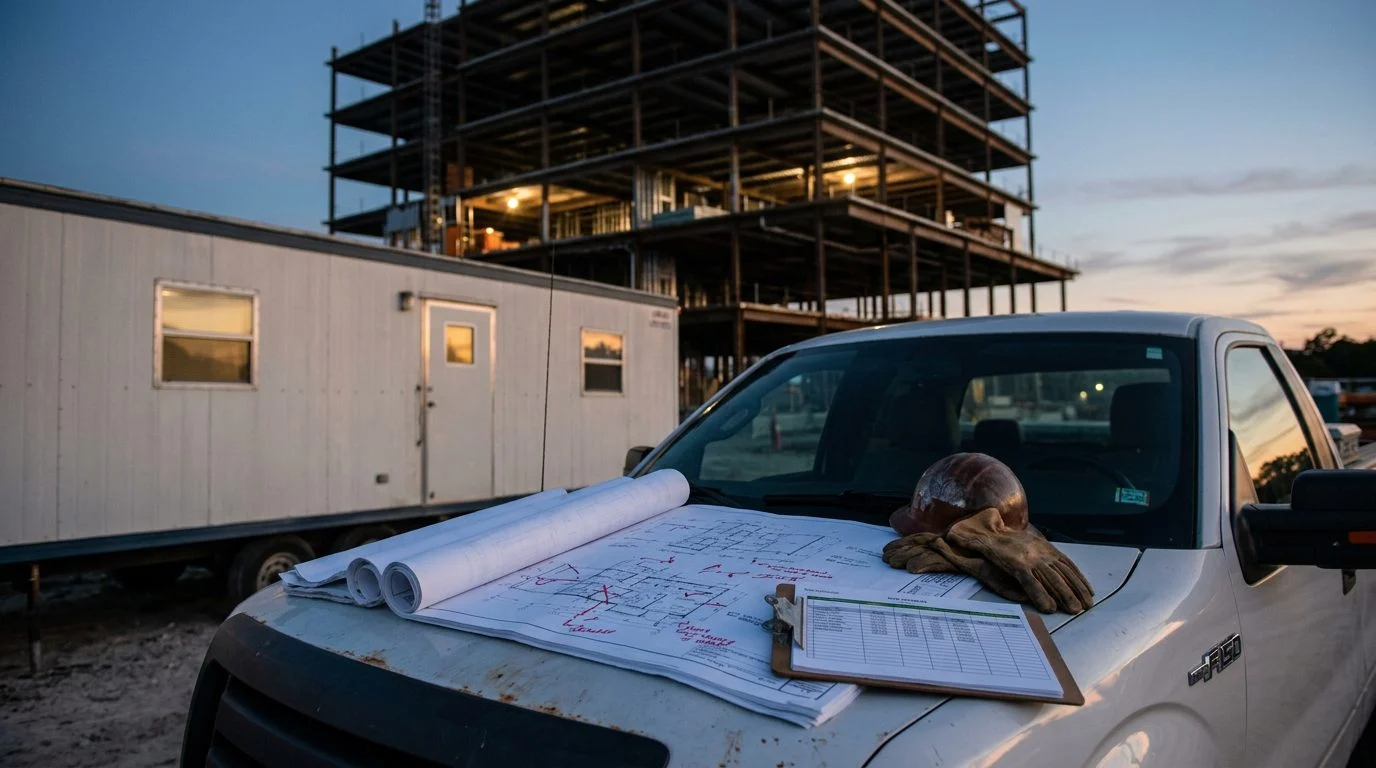
Construction litigators resolve disputes that come from building, improving or supplying a construction project. They review the paperwork, check notice and filing deadlines, push for settlement, and file suit or start arbitration when needed. This guide walks through that work in order, so you can see where your own dispute fits.
What construction litigation covers
Construction litigation resolves disputes over construction projects, in court or in arbitration. Ayala Law PA focuses its business litigation practice on construction matters, including contractor and subcontractor disputes, construction lien foreclosure and construction contract fraud.
These disputes often involve several parties. An owner may disagree with a general contractor. A subcontractor may be unpaid by the general contractor. A supplier may be owed for materials. Lenders and sureties can also become involved.
A construction litigator focuses on the legal and paper side of the dispute. The litigator is not the one framing walls or pouring concrete. The job is to decide what each party owed, what was delivered, and what the law allows.
If you received a lien notice or are owed payment on a project, you don't have to sort out the deadlines by yourself. Contact Ayala Law PA to describe your dispute. Talk it through with our team — we can walk you through how a situation like yours is usually handled and what your options are.

The early work: contracts and the paper trail
Most construction matters start with documents. The litigator reads the prime contract, any subcontract, purchase orders, change orders and payment applications. Lien waivers, daily logs, emails, inspection reports and photos come next.
These records go into a timeline. The timeline shows what each party promised, what was actually delivered, and where the two no longer match. Gaps in that timeline often matter as much as the documents themselves.
Many owners and subcontractors assume they can recover the value of their work without a signed contract. Florida courts have said that when an express contract covers the same subject matter, claims arising from that relationship generally will not support unjust enrichment. See Williams v. Johnson.
Notices, liens and deadlines
Those steps can affect a party’s right to be paid.
A litigator checks whether required notices were sent to the owner. The litigator also checks whether a lien was recorded in time. These deadlines can be short, so this review should happen early.
Suits over the design, planning or construction of an improvement to real property have their own time limit. Florida law requires that an action founded on the design, planning, or construction of an improvement to real property be commenced within four years, with the time running from the earliest of the date the authority having jurisdiction issues a temporary certificate of occupancy, a certificate of occupancy, or a certificate of completion, or the date of abandonment of construction if not completed. Where the action involves a latent defect, the time runs from when the defect is discovered or should have been discovered with the exercise of due diligence. For latent defects, the clock can start when the defect is discovered or should have been discovered, but the suit must still be filed within seven years of that certificate or abandonment date.
Repairs made under warranty do not extend that period for permitted work. Other exceptions also exist, so an early review matters.
Demand letters, negotiation and mediation
A demand letter states the amount owed, the contract basis for the claim, and a date by which the other side must respond. It often comes before any lawsuit. Many disputes settle in negotiation with the other side, its lawyer or its insurer.
When a case is filed, Florida courts can send it to mediation. Under Fla. Stat. § 44.102, a court must refer any filed civil action for money damages to mediation when one party asks, provided the requesting party is willing and able to pay the costs of the mediation or the costs can be equitably divided between the parties, unless a listed exception applies. Mediation is a structured session with a neutral mediator. The litigator prepares the client’s numbers and goals before that session.
Mediation discussions are generally confidential under Fla. Stat. § 44.405. A signed written settlement agreement is different. It is not confidential unless the parties agree otherwise.
A party can also serve a formal offer of settlement. Under Fla. Stat. § 45.061, a written offer to settle may be served more than 60 days after service of a summons and complaint and not less than 60 days before trial (or 45 days if it is a counteroffer). It stays open for 45 days unless it is withdrawn sooner.
Filing suit, discovery and motions
A complaint lays out the claims. Common claims include breach of contract, fraud and lien foreclosure. Venue matters too. Under Fla. Stat. § 47.011, an action must be brought only in the county where the defendant resides, where the cause of action accrued, or where the property in litigation is located; this section does not apply to actions against nonresidents. For Tampa Bay projects, Hillsborough County is often a key county to check.
Fraud claims need care. Under Third District law, a party generally cannot recover in tort for what is really a contract dispute. The tort must be independent of the breach. See Frutafino v. Dole Chile.
Discovery is the fact-gathering stage. The litigator sends requests for documents and written questions. The litigator also takes depositions of owners, project managers and subcontractors. Subpoenas can reach third parties with records.
Motion practice follows. A motion to dismiss asks the court to end a claim on its legal sufficiency. A motion for summary judgment asks the court to decide issues without a trial. Disputes over evidence also go to the judge.
Some cases need technical witnesses. These witnesses explain workmanship, delay or costs. The litigator coordinates their input with the rest of the case.
Lien foreclosure, bond claims and arbitration
A lien foreclosure lawsuit asks a court to enforce a recorded construction lien against the property. The court process depends on the lien, the notices and the property records. The litigator checks each of these before filing.
A bond claim is different. Payment and performance bonds involve a surety, not the property itself. The bond’s terms and deadlines control that claim.
Many construction contracts require arbitration. Under Fla. Stat. § 682.02, a written agreement to arbitrate is generally valid and enforceable. The court decides whether an agreement exists. An arbitrator decides certain conditions before arbitration.
If one side refuses to arbitrate, Fla. Stat. § 682.03 lets a party ask the court to order arbitration. The court cannot refuse only because the claim lacks merit. Court proceedings on the arbitrable claim are generally stayed.
The path changes the timeline. Court cases follow court rules and calendars. Arbitration follows the agreement and the arbitrator’s schedule. Challenges to an award have short windows. Under Fla. Stat. § 682.13, a motion to vacate must generally be filed within 90 days after the movant receives notice of the award, unless the movant alleges the award was procured by corruption, fraud, or other undue means, in which case the 90 days run from when the ground is known or would have been known with reasonable care.
Not sure what your next step is?
Talk it through with our team — we can walk you through how a situation like yours is usually handled and what your options are.

Next steps if you are facing a construction dispute
You may be an owner who just received a lien notice. You may be a contractor still waiting on payment. You may be a family member trying to understand a dispute someone else is living through. In each case, the first step is organizing what you have.
Gather the contract, change orders, payment records, lien waivers, notices received and any emails about the work. Write down key dates in order. Don’t throw away texts or photos, even if they seem minor.
Attorneys’ fees follow their own rules. Under Florida law, each party generally pays its own attorneys’ fees unless a contract or statute provides otherwise. See Price v. Tyler.
Common questions
What does a construction litigator do?
A construction litigator reviews contracts and records, sends demand letters, and works toward settlement. When needed, the litigator files suit or handles arbitration.
Start with an early review of your dates.
Can a construction contract dispute go to arbitration?
If the parties signed a written arbitration agreement, Florida law generally enforces it.
If you are dealing with a lien, a payment dispute or a construction contract issue, contact Ayala Law PA at (305) 570-2208 or through the contact page. Describe the project and the dispute, and the firm will discuss next steps with you.
Responsible attorney: Eduardo A. Maura, Ayala Law PA, 1646 W Snow Ave, Tampa, Florida.



