
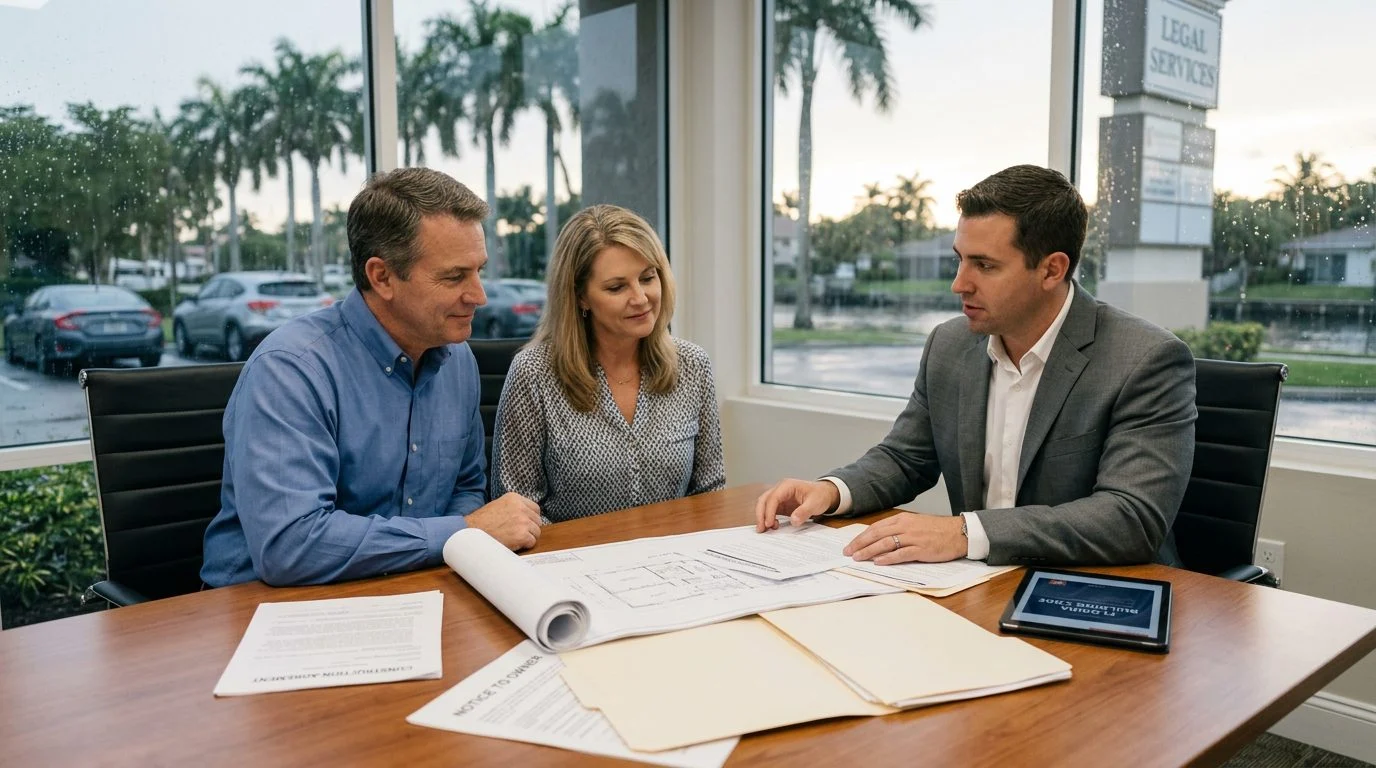
What do I need to sue a contractor? In Florida, you generally need a clear agreement, proof of what went wrong, proof of your losses, the right defendant, and a filing made before the deadline. This page covers those basics for businesses in Tampa and Hillsborough County.
The short answer: what a contractor lawsuit in Florida requires
What do I need to sue a contractor? Breach of contract covers most disputes over unfinished or poor work. Fraud, lien disputes, and licensing problems can need different proof.
Think of it as four questions. What did you agree to? What went wrong? What did it cost you? Who should be sued? Then check the clock, because a late filing can end a strong claim.
Florida also limits how a contract can change that clock. Under Fla. Stat. § 95.03, a contract term that sets a shorter time to sue than the statute allows is void.
Fraud has its own rules. Butler v. Yusem holds that justifiable reliance is not a necessary element of fraudulent misrepresentation. Justifiable reliance is not a necessary element of fraudulent misrepresentation. See Butler v. Yusem, 44 So. 3d 102 (Fla. 2010). When an express contract covers the same subject, Williams v. Johnson says claims from that contract will not support unjust enrichment.
If an unfinished job or a deposit that never came back has you wondering whether you can sue, you don't have to work out the deadlines alone; call (305) 570-2208. Talk it through with our team — we can walk you through how a situation like yours is usually handled and what your options are.

Proof of the agreement and its terms
The written contract is the core document. Signed change orders, emails, and text messages can also prove what was agreed.
Look closely at the scope of work, the payment schedule, the deposit, and the completion date. Each term is something you will need to prove. If the contractor missed a finish date, you need that date in writing.
Keep permits, plans, specifications, and inspection records tied to the project. They show what was supposed to be built and whether required inspections happened.
Payment records prove what you paid and when. Pull cancelled checks, bank transfers, card statements, and receipts. Match each payment to a milestone on a simple timeline. A deposit that never led to work is often easiest to prove with a clear payment trail.
If a change order was never signed, note that in the timeline. An oral deal can still matter, but it is harder to prove.
Evidence of the breach and your losses
A claim needs proof that the work was missing or defective, and proof of what it cost to fix. Start documenting before repairs begin.
Take dated photos and videos, and keep a simple log of what was done, what was missing, and when. Photos taken before anyone covers or repairs the work are often the most useful.
Save every message with the contractor. Texts, emails, letters, and requests to fix the problem all count. A written notice of the defect, with a clear request to fix it, shows the contractor had a chance to act.
Track your losses in dollars. Keep invoices from a replacement contractor, repair estimates, rental or lodging costs, and business losses where the law allows them.
A third-party inspector’s or engineer’s written report can support the claim. Ask for it in writing, with dates and findings. Gather evidence before any work is covered up, since some proof disappears once walls are closed.
Who you can sue: licensing, defendants, and subcontractors
The right defendant is the party that made the promise or caused the harm, which is often the contracting company.
Check whether the contractor holds a valid state license, and under what name. Note who signed the contract and who did the work. Unlicensed work can change how a claim is handled, so bring those license details to your first conversation.
Naming the wrong defendant can waste time. Depending on who contracted with whom, the defendant may be a company, an owner in some cases, a surety on a bond, or a subcontractor.
Where you file matters too. Under Fla. Stat. § 47.011, a suit goes in the county where the defendant resides, where the cause of action accrued, or where the property in litigation is located, but this section does not apply to actions against nonresidents. For a job done in Hillsborough County, the cause of action often accrued there. If two defendants live in different counties, Fla. Stat. § 47.021 allows suit in any county where one of them resides.
Notice requirements, deadlines, and arbitration
Under Fla. Stat. § 95.11(3)(b), actions founded on the design, planning, or construction of an improvement to real property must be commenced within four years, with the time running from the earliest of a temporary certificate of occupancy, a certificate of occupancy, a certificate of completion, or the date of abandonment of construction if not completed; for latent defects, the time runs from when the defect is discovered or should have been discovered with due diligence, and in any event the action must be commenced within 7 years after that earliest date. However, counterclaims, cross-claims, and third-party claims arising out of the conduct, transaction, or occurrence set out in a pleading may be brought up to 1 year after that pleading is served, even if they would otherwise be time barred.
Hidden defects follow a different start.
Some contracts send disputes to arbitration instead of court. Under Fla. Stat. § 682.02, an agreement contained in a record to submit a controversy to arbitration is valid, enforceable, and irrevocable except upon a ground that exists at law or in equity for the revocation of a contract, and the court decides whether an agreement to arbitrate exists. If a party asks the court to order arbitration, Fla. Stat. § 682.03 requires the court, on just terms, to stay any related lawsuit involving a claim alleged to be subject to the arbitration until the court renders a final decision on the motion.
A recorded construction lien adds separate steps, so raise it early. Some defect claims also need written notice before filing, so ask about that first.
Talking with a lawyer about your contractor dispute
Bring your records to a first conversation, so a lawyer can review the claims and the deadlines. You don’t need every document to start.
Many people reach this point after an unfinished job, a deposit that never came back, defective work covered over, or a lien notice that arrived without warning. Each one raises a different question.
Bring the contract, payment records, photos, correspondence, and any notice you received.
Ayala Law PA focuses on business litigation, contract disputes, shareholder and partnership disputes, construction litigation, real estate litigation, and international trade litigation in Florida courts and arbitration. Its only office is at 1646 W Snow Ave, Tampa, and the firm represents businesses in Tampa and Hillsborough County. The firm serves businesses in Tampa, Hillsborough County, Brandon, Riverview, Plant City, Temple Terrace, and the Tampa Bay area.
Eduardo A. Maura is the responsible lawyer for this page. Some matters may be referred to another lawyer or firm, and the firm will tell you if that applies. Ask about fees directly when you call, since the office can explain its fee terms.
Frequently asked questions
Start dates and exceptions matter.
Can a contract shorten the time to sue?
No. Under Fla. Stat. § 95.03, a contract term that sets a shorter period than the statute allows is void.
If an unfinished job or a deposit that never came back has you asking what do I need to sue a contractor, you don’t have to work through the deadlines alone. Contact Ayala Law PA or call (305) 570-2208 to describe your situation.



