
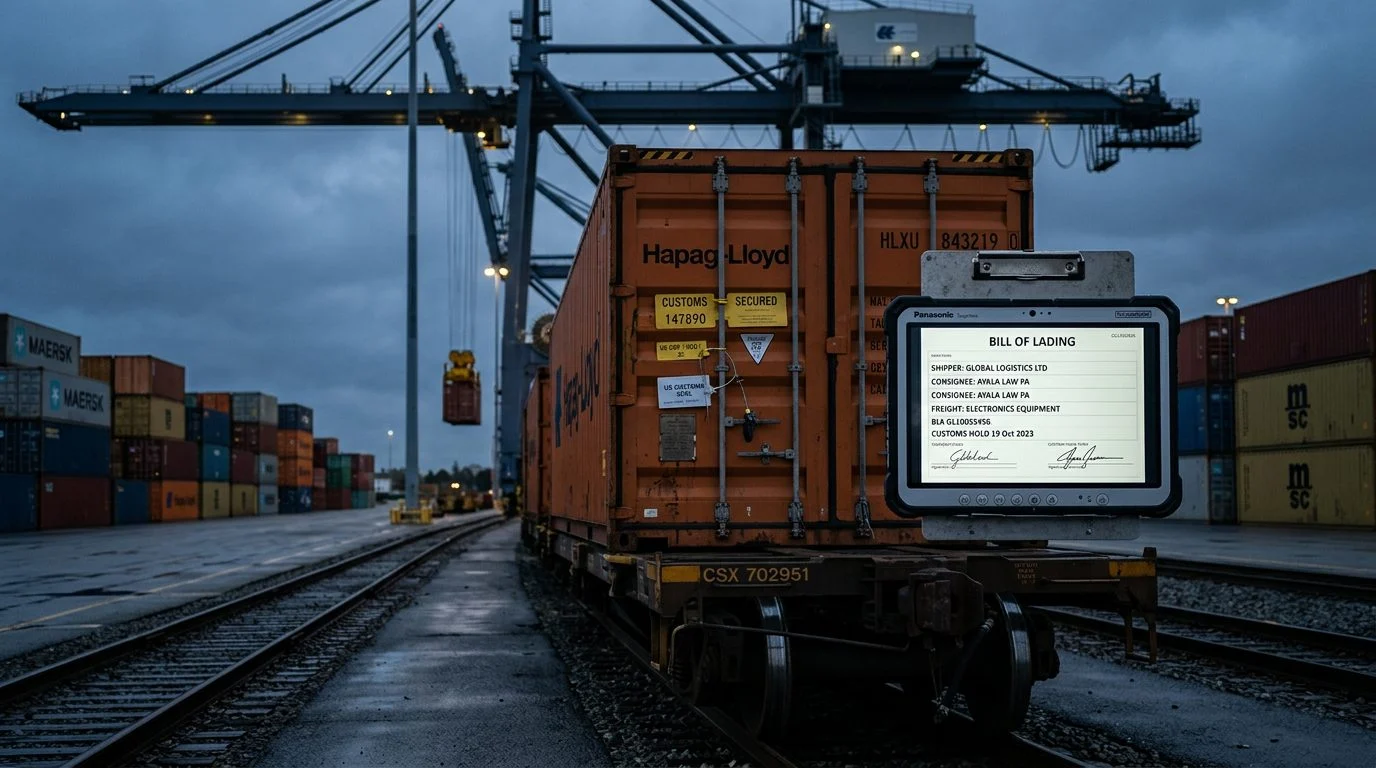
What to Do When Customs Holds My Shipment
Knowing what to do when customs holds my shipment starts with reading the U.S. Customs and Border Protection (CBP) notice, finding the stated reason, and writing down every date. When customs holds a shipment, business owners and importers in Tampa, Hillsborough County and the wider Tampa Bay area need to know where to start. It also explains when a customs problem can turn into a contract dispute.
Not sure what your next step is?
Talk it through with our team — we can walk you through how a situation like yours is usually handled and what your options are.
What a U.S. Customs Hold Means
A customs hold means CBP has not released your goods into U.S. commerce yet. The goods wait while CBP reviews admissibility, classification, value or documentation.
Holds are common. Many are routine document or classification reviews. Others point to a real problem with the entry, so read every notice carefully. Don’t assume a hold is minor because the goods look fine.
CBP generally communicates with the importer of record, the party responsible for the entry paperwork. Confirm which company holds that role on your shipment. If a customs broker filed the entry for you, check the entry paperwork and your broker agreement to see whose name appears.
Storage charges can start building at the port, airport or warehouse while the review runs. Ask the carrier or warehouse for its daily rates in writing.
Detention, Seizure and Liquidated Entry: The Differences
The label on your notice tells you which stage the goods are in. Each stage calls for a different response, so the three terms below matter.
Detention means CBP is holding the goods for examination or further review. The goods have not been forfeited. Often the next step is answering CBP’s questions with documents.
Seizure is a formal government action. A seizure notice is not a simple request for paperwork, so read it closely.
Liquidated entry means CBP has finalized the entry and the duties on it. A dispute at this stage usually runs through the protest process, not a simple document reply.
Treat the label as your first decision point. Each label points to a different set of deadlines and steps.
Why Holds Feel So Sudden and Common Causes
Most holds start with a gap in the paperwork or a question about the goods. The notice usually names the reason, and that reason sets the next step.
Common triggers include:
- Incomplete or incorrect entry documents
- Classification questions about how the goods are described
- Unclear product descriptions on the invoice or packing list
- Questions about the declared value
- Unpaid duties or fees
Some goods are restricted or need extra review before entry. Import disputes can arise from many different circumstances, and each situation turns on its own circumstances. An inspection hold is a different problem from a paperwork question, and the response differs.
The carrier’s tracking message often says only that the shipment is held. Read it alongside the CBP notice, and ask the carrier for the stated reason in writing.
How Long Can Items Be Held at Customs?
There is no single number of days. The length of a hold turns on the reason for it, any inspection CBP needs, and how fast the importer answers requests.
A complete response can move a file along. Missing invoices, a vague product description or an unsupported value question tend to add time. Each back-and-forth adds days.
Storage and demurrage charges keep accumulating while goods wait. Get those rates in writing early so you know what each extra day costs.
Once CBP finalizes an entry through liquidation, the dispute usually moves to the protest process. That stage has its own deadline, covered in the next section.
The Protest Deadline: Why Timing Matters Most
A protest has a filing deadline, and that deadline can be short.
Calendar the date as soon as a decision posts. Don’t wait for a reply from the broker or carrier before you start tracking it. Write down the decision being challenged, the date it was issued and the date you learned of it.
Missing the window can close the administrative route for that decision. Once that window closes, the protest option for that decision may no longer be open.
Not sure what your next step is?
Talk it through with our team — we can walk you through how a situation like yours is usually handled and what your options are.
What to Do When Customs Holds My Shipment
Start by gathering the entry packet and the CBP notice. Then answer every request in writing and track every date. These steps organize your record. They do not control when CBP acts.
- Pull the entry packet. Gather the commercial invoice, bill of lading, classification and valuation support, and the CBP notice.
- Answer CBP’s requests on time and in writing. Keep a copy of everything you send and note the date you sent it.
- Note the liquidation date and protest deadline. Identify which decision you are challenging so your response matches it.
- Coordinate with your broker, forwarder or carrier. Ask who is billing storage and demurrage. Check the sales and shipping contracts, since those contracts usually set who bears these charges.
Keep every communication factual and specific. A clear record makes each later step easier to evaluate.
How an Importer Dispute Can Move Into Litigation
Customs disputes can take several different paths, and the right approach turns on the facts of each matter. A contract dispute with a supplier, buyer or carrier may move into court or arbitration.
Start with the sales contract. An oral contract is subject to the basic requirements of contract law such as offer, acceptance, consideration and sufficient specification of essential terms (St. Joe Corp. v. McIver). Check whether the contract includes a dispute-resolution clause, since that clause can affect whether a dispute goes to court or arbitration.
Florida’s sales-of-goods rules appear in Chapter 672 of the Florida Statutes. Under Fla. Stat. § 672.606, acceptance of goods occurs when the buyer, after a reasonable opportunity to inspect them, signifies that they conform or keeps them despite a nonconformity; it also occurs when the buyer fails to make an effective rejection, but acceptance does not occur until the buyer has had a reasonable opportunity to inspect them, or when the buyer does any act inconsistent with the seller’s ownership, but if such act is wrongful as against the seller it is an acceptance only if ratified by her or him. Under Fla. Stat. § 672.607, where a tender has been accepted, the buyer must notify the seller of a breach within a reasonable time after discovering or should have discovered it, or be barred from any remedy.
Under Fla. Stat. § 672.709, when the buyer fails to pay the price as it becomes due, the seller may recover the price of goods accepted, together with incidental damages under the next section.
Each stage of a customs dispute raises its own questions, so the facts of each matter matter. The right next step turns on the specific record. A Florida state court is not automatically the place for that review.
The outcome of any protest or court challenge turns on the facts and the record. No one can promise a result.
Working With Ayala Law PA on Customs and Trade Disputes
Ayala Law PA handles international trade litigation and related commercial disputes in Florida courts and arbitration. The firm focuses its practice on business litigation, commercial litigation, contract disputes, shareholder disputes, construction litigation and real estate litigation.
Responsibility for this page rests with Eduardo A. Maura of Ayala Law PA, whose office is at 1646 W Snow Ave, Tampa, Florida. The firm’s only office is in Tampa, Florida, at 1646 W Snow Ave. This page serves businesses in Tampa and Hillsborough County.
If a matter fits better with another lawyer or firm, the firm may refer it, and the firm will say so.
Talk With Our Team About Your Held Shipment
If your goods are sitting at a port or warehouse, a CBP notice is in your hand, and a protest date may be coming up, you need a clear plan now. Our team can review the notice, the entry packet and the timeline with you. Call (305) 570-2208 or request a case evaluation with the notice and entry documents ready.
Frequently Asked Questions
What should I do when customs holds my shipment?
Read the CBP notice, gather the entry documents, and answer every request in writing. Track every date, especially any protest deadline.
How long can items be held up at customs?
There is no fixed number of days. The reason for the hold, any inspection, and how fast the importer responds all affect the timing.
What is the difference between customs detention and seizure?
Detention means CBP is holding goods for examination or further review. Seizure is a formal government action with its own notice and response rules.
What does liquidated entry mean?
It means CBP has finalized the entry and its duties. Disputes at that stage usually move to the protest process.
Does a Florida court decide a customs protest?
A customs dispute can involve questions about the agency’s decision and the facts behind it. Questions about where a customs dispute belongs depend on the facts of each matter.



